![4-[(3-Chloro-2-fluorophenyl)amino]-7-methoxy-6-quinazolinyl acetate structure](https://cnstatic.chemtradehub.com/structs/740/740081-22-5-f58f.webp "4-[(3-Chloro-2-fluorophenyl)amino]-7-methoxy-6-quinazolinyl acetate structure")
4-[(3-Chloro-2-fluorophenyl)amino]-7-methoxy-6-quinazolinyl acetate
CAS号:
740081-22-5
分子式:
C17H13ClFN3O3
Jye-Shane Yang, Guan-Jhih Huang, Yi-Hung Liu, Shie-Ming Peng
The Z → Ephotoisomerization and fluorescence quantum yields for the wild-type green fluorescence protein (GFP) chromophore (p-HBDI) and its meta- and para-amino analogues (m-ABDI and p-ABDI) in aprotic solvents (hexane, THF, and acetonitrile) and protic solvents (methanol and 10–20% H2O in THF) are reported. The dramatic decrease in the quantum yields on going from aprotic to protic solvents indicates the important role of solvent–solute hydrogen bonding in the nonradiative decay pathways. The enhanced fluorescence of m-ABDI is also discussed.

Organic Preparations and Procedures International

Pharmacological Reviews

Journal of Catalysis

Fibre Chemistry
Nature

Proceedings of the National Academy of Sciences of the United States of America
Journal of Organometallic Chemistry

Science

Pure and Applied Chemistry

Journal of Physics and Chemistry of Solids
Shigeru Matsuoka, Masayuki Inoue
DOI: 10.1039/B910230B
Jun Terao, Misaki Nakamura, Nobuaki Kambe
DOI: 10.1039/B915620H
Cátia Ornelas, Marcus Weck
DOI: 10.1039/B913139F
Xing Yi Ling, Jurriaan Huskens
DOI: 10.1039/B909918B
Fan-Lin Zeng, Xiao-Lan Chen, Kai Sun, Hu-Lin Zhu, Xiao-Ya Yuan, Ling-Bo Qu, Yu-Fen Zhao, Bing Yu
DOI: 10.1039/D0QO01410A
Victor Duffort, René Thouvenot, Carlos Afonso, Guillaume Izzet, Anna Proust
DOI: 10.1039/B913475A
Detlef Reichert, Michael Kovermann, Nicole Hunter, David Hughes, Ovidiu Pascui, Peter Belton
DOI: 10.1039/B711113D
Rakesh Maiti, Jia-Lei Yan, Bivas Mondal, Xing Yang, Huifang Chai, Lin Hao, Zhichao Jin
DOI: 10.1039/D0QO01380C
Zheng Wang, Wei Zhao, Gefei Hao, Baoan Song
DOI: 10.1039/D0QO00946F
4,5-二甲基-2-硝基苯甲酸主要应用于制药、染料和农药等行业。由于其潜在的毒性,其市场趋势可能受到法规限制和环保考量的影响,推动了替代产品的研发。在研究领域,...
处理直接黑22时应穿戴适当的个人防护装备(PPE),包括实验服、手套、护目镜和口罩。操作应在通风橱内进行,以避免吸入有害气体。如果发生泄漏,应立即清理,并使用大...
处理2,1,3-苯并噻二唑-4-基异氰酸酯时应注意以下安全事项:穿戴个人防护装备,如实验室外套、防护眼镜和手套;在通风橱中操作,确保良好的通风;保持实验室环境干...
含有Δ-8,9-脱氢雌酮的废料需要进行适当的处理以确保环境和人体安全。首先,收集废液并存放于密封容器中,避免泄漏。其次,可以考虑将其转化为无害物质或通过专业处理...
5-溴戊酸应储存在阴凉、干燥、通风良好的环境中,避免阳光直射。建议在室温(约15-25°C)下保存,保持相对湿度低于60%。应使用密封的玻璃或塑料容器,并远离热...
4-(甲基亚磺酰基)苯胺在医药、聚合物和传感器等领域有一定的应用。在医药方面,它可以用作合成药物的中间体;在聚合物领域,可以作为合成特殊性能高分子材料的单体;在...
1-(2-氟苯基)-5-甲基-1H-吡唑-4-亚甲基肼是一种有机化合物,其分子式为C9H9FN3O。该化合物具有特定的物理化学性质,如熔点、沸点等,但具体值需查...
Dauricumine通常通过复杂的合成路线制备,涉及多个步骤,包括环化、氧化、卤化等反应。合成过程中使用了多种催化剂和试剂,例如金属催化剂、氧化剂等。产率通常...
5-氰基苯酞在正常使用条件下相对安全,但其具有一定的毒性,需谨慎操作。在实验或工业应用中,应采取适当的防护措施,如佩戴防护手套、护目镜和实验服,确保通风良好。误...
该化合物在使用时需要谨慎操作。虽然其毒性和健康风险尚未完全明确,但建议在通风良好的环境中操作,并穿戴适当的个人防护装备,如手套和防护眼镜。
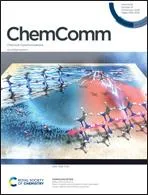
ChemComm publishes urgent research which is of outstanding significance and interest to experts in the field, while also appealing to the journal’s broad chemistry readership. Our communication format is ideally suited to short, urgent studies that are of such importance that they require accelerated publication. Our scope covers all topics in chemistry, and research at the interface of chemistry and other disciplines (such as materials science, nanoscience, physics, engineering and biology) where there is a significant novelty in the chemistry aspects. Major topic areas covered include: Analytical Chemistry Catalysis Chemical Biology and medicinal chemistry Computational Chemistry and Machine Learning Energy and sustainable chemistry Environmental Chemistry Green Chemistry Inorganic Chemistry Materials Chemistry Nanoscience Organic Chemistry Physical Chemistry Polymer Chemistry Supramolecular Chemistry
![[4-(Isobutyrylamino)phenyl]boronic acid structure](https://cnstatic.chemtradehub.com/structs/874/874219-50-8-6ab5.webp "[4-(Isobutyrylamino)phenyl]boronic acid structure")
![2-{[(1R,2S)-2-Aminocyclohexyl]amino}-4-{[3-(2H-1,2,3-triazol-2-yl)phenyl]amino}-5-pyrimidinecarboxamide structure](https://cnstatic.chemtradehub.com/structs/137/1370261-96-3-40df.webp "2-{[(1R,2S)-2-Aminocyclohexyl]amino}-4-{[3-(2H-1,2,3-triazol-2-yl)phenyl]amino}-5-pyrimidinecarboxamide structure")