


Aptamer-based electrochemical sensors that are not based on the target binding-induced conformational change of aptamers
文献信息
发布日期
2008-07-28
DOI
10.1039/B807913G
影响因子
4.616
作者
Ying Lu, Ningning Zhu, Ping Yu, Lanqun Mao
查看原文
摘要
This study describes a new kind of aptamer-based electrochemical sensor that is not based on the target binding-induced conformational change of the aptamers by using a 15-mer thrombin-binding aptamer (5′-GGTTGGTGTGGTTGG-3′) as the model oligonucleotide. The sensors are developed by first self-assembling the aptamer (i.e. a thrombin-binding aptamer) onto an Au electrode and then hybridizing the assembled aptamer with a ferrocene (Fc)-labeled short aptamer-complementary DNA oligonucleotide to form an electroactive double-stranded DNA (ds-DNA) oligonucleotide onto the Au electrode. The binding of the target (i.e. thrombin) towards the aptamer essentially destroys the Watson–Crick helix structure of the ds-DNA oligonucleotide assembled onto the electrode and leads to the dissociation of the Fc-labeled short complementary DNA oligonucleotide from the electrode surface to the solution, resulting in a decrease in the current signal obtained at the electrode, which can be used for the determination of the target. With the thrombin-binding aptamer as the model oligonucleotide, the current decrease obtained with the aptamer-based electrochemical sensors is linear with the concentration of thrombin within the concentration range from 0 to 10 nM (ΔI/nA = 6.7Cthrombin/nM + 2.8, γ = 0.975). Unlike most kinds of existing aptamer-based electrochemical sensor, the electrochemical aptasensors demonstrated here are not based on the conformational change of the aptamers induced by the specific target binding. Moreover, the aptasensors are essentially label-free and are very responsive toward the targets. This study may pave a facile and general way to the development of aptamer-based electrochemical sensors.
期刊推荐

Heteroatom Chemistry

Bioorganic & Medicinal Chemistry

Journal of the Indian Institute of Science

Bioorganic & Medicinal Chemistry Letters

Journal of Asian Natural Products Research

Herald of the Russian Academy of Sciences

NDT & E International

Polycyclic Aromatic Compounds

Topics in Catalysis

Acta Metallurgica Sinica-English Letters
相关文献
Circular arrays of polymer-based miniature rectilinear ion traps
Miriam Fico, Jeffrey D. Maas, Scott A. Smith, Anthony B. Costa, Zheng Ouyang, William J. Chappell, R. Graham Cooks
2009-04-03
Paper
DOI: 10.1039/B822140E
Reflection contributions to the dispersion artefact in FTIR spectra of single biological cells
Paul Bassan, Hugh J. Byrne, Joe Lee, Franck Bonnier, Colin Clarke, Paul Dumas, Ehsan Gazi, Michael D. Brown, Peter Gardner
2009-04-09
Paper
DOI: 10.1039/B821349F
Ultrasensitive therapeutic drug monitoring of methotrexate by a structure-switching aptamer with cascade primer exchange reaction
Junqing He, Junyan Wang, Min Zhang, Guoyue Shi
2022-12-06
Communication
DOI: 10.1039/D2AN01658C
Probing inhibitory effects of destruxins from Metarhizium anisopliae using insect cell based impedance spectroscopy: inhibition vs chemical structure
Keith B. Male, Yew-Min Tzeng, Johnny Montes, Bing-Lan Liu, Wan-Chun Liao, Amine Kamen
2009-04-15
Paper
DOI: 10.1039/B822133B
Raman spectroscopy – a potential platform for the rapid measurement of carbon nanotube-induced cytotoxicity
Peter Knief, Colin Clarke, Eva Herzog, Maria Davoren, Fiona M. Lyng, Aidan D. Meade, Hugh J. Byrne
2009-03-03
Paper
DOI: 10.1039/B821393C
Characterization of glycerophospholipids at multiple isomer levels via Mn(ii)-catalyzed epoxidation
Xi Chen, Shuli Tang, Dallas Freitas, Erin Hirtzel, Heyong Cheng, Xin Yan
2022-09-13
Paper
DOI: 10.1039/D2AN01174C
Correction: In situ synthesis of chiral AuNCs with aggregation-induced emission using glutathione and ceria precursor nanosheets for glutathione biosensing
Guoxing Wu, Alaa Eldin A. Salem, Lei Su, Bing Shi Li
2022-10-10
Correction
DOI: 10.1039/D2AN90082C
Label-free fibre optic Raman spectroscopy with bounded simplex-structured matrix factorization for the serial study of serum in amyotrophic lateral sclerosis
Visakan Kadirkamanathan, Martin R. Turner, Andrea Malaspina, John C. C. Day
2022-09-28
Paper
DOI: 10.1039/D2AN00936F
Chronocoulometric signalling of BNP using a novel quantum dot aptasensor
Samantha F. Douman, Onyinyechi V. Uhuo, Kefilwe V. Mokwebo, Nelia Sanga, Emmanuel I. Iwuoha
2022-09-15
Paper
DOI: 10.1039/D2AN01357F
Molecularly imprinted nanoparticle-based assay (MINA) for microcystin-LR detection in water
Yadiris García, Myleidi Vera, Verónica A. Jiménez, Luis F. Barraza, Joao Aguilar, Susana Sánchez, Eduardo D. Pereira
2022-12-14
Paper
DOI: 10.1039/D2AN01680J
您可能还喜欢
化合物问答
什么是2,6-二溴-4,8-双[(2-乙基己基)氧基]苯并[1,2-b:4,5-b']二噻吩(CAS号:1226782-13-3)?
2,6-二溴-4,8-双[(2-乙基己基)氧基]苯并[1,2-b:4,5-b']二噻吩是一种有机化合物,分子式为C23H32Br2O2S2。该化合物具有芳香性和...
1226782-13-32,6-Dibromo-4,8-bis[...
化合物问答
木聚硫钠(CAS号:37319-17-8)的物理化学性质是什么?
木聚硫钠通常为无色或白色结晶性粉末,具有吸湿性。其分子量约为121.11 g/mol。木聚硫钠易溶于水,不溶于醇类和其他非极性溶剂。在酸性或碱性溶液中,木聚硫钠...
37319-17-8Pentosan
化合物问答
2-甲氧基-4-(三氟甲基)苄溴, JRD(CAS号:886500-59-0)适用哪些法规指南?
该化合物在合成、储存和运输过程中需遵循《全球化学品统一分类和标签制度》(GHS)的健康、环境和物理危险分类。在欧洲还需符合《化学品注册、评估、授权和限制》(RE...
886500-59-02-Methoxy-4-(trifluo...
化合物问答
1,4-Diazoniabicyclo[2.2.2]octane-1,4-disulfinate(CAS号:119752-83-9)的主要用途是什么?
1,4-二氮杂双环[2.2.2]辛烷-1,4-二硫酸二酯主要用于有机合成中的保护基团,特别是在保护胺基和硫醇基方面具有广泛应用。此外,它还用于一些特殊化学反应的...
119752-83-91,4-Diazabicyclo[2.2...
化合物问答
如何处理含有4-(Bromomethyl)-2-fluorobenzenesulphonamide(CAS号:1645275-47-3)的废料?
含有4-(Bromomethyl)-2-fluorobenzenesulphonamide的废液应首先进行中和处理,以降低pH值,避免对环境造成腐蚀性影响。随后...
1645275-47-34-(Bromomethyl)-2-fl...
化合物问答
Loureiriol(CAS号:479195-44-3)的物理化学性质是什么?
Loureiriol是一种天然化合物,其分子式为C15H22O4。Loureiriol为无色结晶性粉末,具有较高的熔点和良好的热稳定性。其相对分子质量为262....
479195-44-3Loureiriol
化合物问答
在合成中是否有3-氨基苯甲酰苯胺(CAS号:14315-16-3)的替代品?
在合成过程中,可以考虑使用类似结构的化合物作为3-氨基苯甲酰苯胺的替代品,例如N-苯基-3-氰基苯胺或N-苯基-3-硝基苯胺等,这些化合物具有相似的化学性质,可...
14315-16-33-Amino-N-phenylbenz...
化合物问答
4-异氰酰苯基硼酸频哪醇酯(CAS号:380430-64-8)的市场或研究趋势如何?
4-异氰酰苯基硼酸频哪醇酯主要应用于有机合成、药物化学和材料科学领域。随着绿色化学的发展,该化合物因其高效的官能团转化能力和环境友好性而受到越来越多的关注。近年...
380430-64-82-(4-Isocyanatopheny...
化合物问答
如何储存3β-乙酰氧基-7,25-甘遂二烯-24(R)-醇(CAS号:1352001-09-2)?
3β-乙酰氧基-7,25-甘遂二烯-24(R)-醇应储存在阴凉、干燥、通风良好的地方,避免直接光照。储存容器应密封,防止空气中的水分和氧气影响化合物的稳定性。建...
1352001-09-23β-acetoxy-eupha- 7,...
化合物问答
如何储存4-氟-2-甲基-1H-吲哚(CAS号:1260383-51-4)?
应将4-氟-2-甲基-1H-吲哚存放在阴凉、干燥、通风良好的地方,避免直接暴露在光照下。容器应密封,避免与空气中的水蒸气接触。建议在避光、温度不超过25℃的环境...
1260383-51-44-Fluoro-2-methyl-1H...
来源期刊
Analyst

CiteScore:
7.8
自引率:
5.6%
年发文量:
653
Analyst publishes analytical and bioanalytical research that reports premier fundamental discoveries and inventions, and the applications of those discoveries, unconfined by traditional discipline barriers.
推荐化合物
![6,6-Dimethylbicyclo[3.1.1]hept-2-ene-2-carbaldehyde structure](https://cnstatic.chemtradehub.com/structs/564/564-94-3-e746.webp "6,6-Dimethylbicyclo[3.1.1]hept-2-ene-2-carbaldehyde structure")
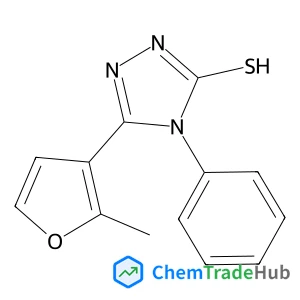
5-(2-Methyl-3-furyl)-4-phenyl-2,4-dihydro-3H-1,2,4-triazole-3-thione
CAS号:
346464-59-3
分子式:
C13H11N3OS
![(1R,5R)-3-{[(2-Methyl-2-propanyl)oxy]carbonyl}-3-azabicyclo[3.1.0]hexane-1-carboxylic acid structure](https://cnstatic.chemtradehub.com/structs/116/1165450-63-4-bfe1.webp "(1R,5R)-3-{[(2-Methyl-2-propanyl)oxy]carbonyl}-3-azabicyclo[3.1.0]hexane-1-carboxylic acid structure")
推荐供应商




免责声明
本页面提供的学术期刊信息仅供参考和研究使用。我们与任何期刊出版商均无关联,也不处理投稿事宜。如有投稿相关咨询,请直接联系相关期刊出版商。
如发现页面信息有误,请发送邮件至 support@chemtradehub.com 联系我们。我们将及时核实并处理您的问题。