



Surface binding vs. sequestration; the uptake of benzohydroxamic acid at iron(iii) oxide surfaces
文献信息
发布日期
2008-08-06
DOI
10.1039/B808805E
影响因子
6.222
作者
Iria M. Rio-Echevarria, Fraser J. White, Euan K. Brechin, Peter A. Tasker, Steven G. Harris
查看原文
摘要
Benzohydroxamic acid is shown to be an unexpectedly good ligand for iron(III) oxides, favouring surface attachment to the formation of trisbenzohydroxamato complexes, which are known to have very high thermodynamic stability in solution.
相关文献
Construction of porphyrin-based photocatalyst comprising pyridinium ionic liquid moiety for the metal-free visible light-assisted N-arylation of amines: facile approach to afford drug intermediates
Bhairav Chandroday Mataghare
2023-11-02
Paper
DOI: 10.1039/D3NJ04295B
A DFT study of NHC-catalyzed reactions of [3+3] annulations of 2-bromoenals and thioamides: mechanisms and regio- and stereoselectivities
Yan Li, Lina Geng, Zhiyi Song, Zhiqiang Zhang
2023-11-09
Paper
DOI: 10.1039/D3NJ04532C
Sorghum-derived porous carbon for outstanding green supercapacitors
Fuming Zhang, Hongchao Lang, Jinggao Wu, Jing Huang
2023-11-22
Paper
DOI: 10.1039/D3NJ04881K
2-(Indol-3-yl)- and 6-(pyrrol-2-yl)-substituted (bi)pyridine-based AIE-probes/fluorophores: synthesis and photophysical studies
Olga S. Taniya, Albert F. Khasanov, Sougata Santra
2023-11-03
Paper
DOI: 10.1039/D3NJ04051H
Effect of SO2 introduction into CeO2 on its surface acidity and redox property for the selective catalytic reduction of NO with NH3
Xuejun Zhang, Dujuan Mo, Zhongxian Song, Wei Liu, Haiyang Li, Nana Guan, Mengru Zhang, Ruihua Guo, Zhenzhen Huang
2023-11-27
Paper
DOI: 10.1039/D3NJ03924B
Theoretical study of the electronic structure of the complexes of gold, silver, and copper mono- and bimetallic nanoclusters decorated on graphitic carbon nitride (g-C3N4): DFT and TD-DFT studies of photocatalytic activity
Hanieh Moradi, Hossein Farrokhpour, Sayyed Mahdi Hosseini, Mehran Ghiaci
2023-11-29
Paper
DOI: 10.1039/D3NJ04497A
A MXene@AgAu@PDA nanoplatform loaded with AgAu nanocages for enhancing catalytic activity and antibacterial performance
Guanghui Liu, Hongfa Wang, Chunyan Xu, Qunling Fang, Hailong Wang, Yunqi Xu, Min Sang, Shouhu Xuan, Lingyun Hao
2023-11-01
Paper
DOI: 10.1039/D3TB01755A
Constructing Z-scheme heterojunctions of Zr-MOF/g-C3N4 for highly efficient photocatalytic H2 production under visible light
Jun Shi, Weiting Yang, Yulong Li, Ruoyu Wu, Jiani Wu
2023-11-15
Paper
DOI: 10.1039/D3NJ03923D
Ionic liquid-catalysed regioselective oxygenation of quinoxalin-2(1H)-ones under visible-light conditions
2023-11-13
Communication
DOI: 10.1039/D3NJ04496C
Nonlinear optical-active ferrocene conjugated Y-shaped imidazole donor–π–acceptor [(D–π)2–IM–π–A] compounds for dye-sensitized solar cells using non-corrosive copper complexes as a redox mediator
Selvam Prabu, Fagnani Francesco, Alessia Colombo, Claudia Dragonetti, Paolo Biagini, Fabio Melchiorre, Nallasamy Palanisami
2023-11-20
Paper
DOI: 10.1039/D3NJ03668E
您可能还喜欢
化合物问答
6-氯-2H-1,4-苯并噁嗪-3(4H)-酮(CAS号:7652-29-1)应用于哪些行业?
6-氯-2H-1,4-苯并噁嗪-3(4H)-酮主要应用于医药、农药和聚合物等领域。在医药领域,该化合物可用于合成抗菌药物;在农药领域,可用作杀虫剂的中间体;在聚...
7652-29-16-Chloro-2H-1,4-benz...
化合物问答
活性氧化铝(CAS号:1302-74-5)应用于哪些行业?
活性氧化铝广泛应用于医药、聚合物、传感器、半导体和催化等领域。在医药行业,活性氧化铝用作吸附剂和干燥剂,有助于去除杂质和水分。在聚合物行业,它用作增白剂和抗结块...
1302-74-5aluminum;trihydrate
化合物问答
什么是硅胶(CAS号:112926-00-8)?
硅胶(Silica gel, pptd.,cryst.-free)是一种无定形、多孔的硅酸盐材料,主要成分为二氧化硅(SiO₂)。其结构由硅氧四面体构成,通过酸...
112926-00-8Silica gel, pptd.,cr...
化合物问答
二乙基甲基一氢硅烷(CAS号:760-32-7)的主要用途是什么?
二乙基甲基一氢硅烷主要用于有机合成、表面处理以及作为溶剂。它还被用作合成其他硅烷化合物的原料,以及在涂料、粘合剂和密封剂中的应用。
760-32-7Diethyl(methyl)silan...
化合物问答
在合成中是否有N-花生四烯酰基甘氨酸(CAS号:179113-91-8)的替代品?
在合成过程中,可以考虑使用类似结构的化合物作为替代品,例如N-亚油酰基甘氨酸或N-花生二烯酰基甘氨酸。这些替代品在结构上有类似的双键位置,但可能具有不同的物理化...
179113-91-8Glycine, N-[(5Z,8Z,1...
化合物问答
在合成中是否有1-(4-甲氧基苯基)丙烷-1,2-二酮(CAS号:10557-27-4)的替代品?
在合成过程中,可以考虑使用类似结构的化合物作为替代品,例如1-(3-甲氧基苯基)丙烷-1,2-二酮或1-(4-羟基苯基)丙烷-1,2-二酮。这些替代品具有相似的...
10557-27-41-(4-Methoxyphenyl)p...
化合物问答
N-(4-氨基-1-苄基-3-羟基-5-苯基戊基)-3-甲基-2-(2-氧代四氢嘧啶-1-基)-丁酰胺 5-氧代吡咯烷-2-甲酸(CAS号:192726-06-0)通常如何合成?
该化合物通常通过一系列复杂的有机合成步骤获得。首先,通过芳香族化合物的羟基化反应获得羟基化产物,然后通过酰化反应形成酰胺中间体,最后通过环化反应得到目标产物。常...
192726-06-05-Oxo-L-proline - (2...
化合物问答
(S)-2-氨基-3-喹啉-2-丙酸(CAS号:161513-46-8)的市场或研究趋势如何?
该化合物作为生物活性化合物,尤其是在药物化学领域表现出色。近年来,随着对新型抗炎、抗病毒和抗癌药物的研究增加,其市场和研究趋势持续增长。此外,其在神经科学领域的...
161513-46-8(S)-2-Amino-3-quinol...
化合物问答
核黄素磷酸钠(CAS号:130-40-5)安全吗?
核黄素磷酸钠在常规使用条件下安全,但高剂量可能引起刺激性反应。操作时需佩戴防护手套和护目镜,避免吸入粉尘。若接触皮肤或眼睛,应立即用大量清水冲洗。急救时需根据接...
130-40-5Sodium 1-deoxy-1-(7,...
化合物问答
盐酸丙胺卡因杂质A(EP) 标准品(CAS号:19281-31-3)通常如何合成?
盐酸丙胺卡因杂质A(EP) 标准品可通过重氮化反应和随后的酰胺化反应合成。首先,利用氯化反应将苯环上的氢原子转化为氯原子,然后通过芳香族重氮化反应引入氨基,最后...
19281-31-32-Chloro-N-(2-methyl...
来源期刊
Chemical Communications
CiteScore:
8.6
自引率:
4.7%
年发文量:
2458
ChemComm publishes urgent research which is of outstanding significance and interest to experts in the field, while also appealing to the journal’s broad chemistry readership. Our communication format is ideally suited to short, urgent studies that are of such importance that they require accelerated publication. Our scope covers all topics in chemistry, and research at the interface of chemistry and other disciplines (such as materials science, nanoscience, physics, engineering and biology) where there is a significant novelty in the chemistry aspects. Major topic areas covered include: Analytical Chemistry Catalysis Chemical Biology and medicinal chemistry Computational Chemistry and Machine Learning Energy and sustainable chemistry Environmental Chemistry Green Chemistry Inorganic Chemistry Materials Chemistry Nanoscience Organic Chemistry Physical Chemistry Polymer Chemistry Supramolecular Chemistry
推荐化合物
![4-Chloro-3-(trifluoromethyl)-1H-pyrrolo[2,3-b]pyridine structure](https://cnstatic.chemtradehub.com/structs/869/869335-75-1-a9d0.webp "4-Chloro-3-(trifluoromethyl)-1H-pyrrolo[2,3-b]pyridine structure")
![1-[3-(4-Morpholinylsulfonyl)phenyl]methanamine structure](https://cnstatic.chemtradehub.com/structs/933/933989-32-3-51af.webp "1-[3-(4-Morpholinylsulfonyl)phenyl]methanamine structure")
![2,6-Bis({(2R)-2-[hydroxy(diphenyl)methyl]-1-pyrrolidinyl}methyl)-4-methylphenol structure](https://cnstatic.chemtradehub.com/structs/877/877395-58-9-70bf.webp "2,6-Bis({(2R)-2-[hydroxy(diphenyl)methyl]-1-pyrrolidinyl}methyl)-4-methylphenol structure")
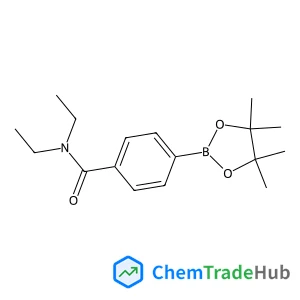
N,N-Diethyl-4-(4,4,5,5-tetramethyl-1,3,2-dioxaborolan-2-yl)benzamide
CAS号:
325142-99-2
分子式:
C17H26BNO3
推荐供应商





免责声明
本页面提供的学术期刊信息仅供参考和研究使用。我们与任何期刊出版商均无关联,也不处理投稿事宜。如有投稿相关咨询,请直接联系相关期刊出版商。
如发现页面信息有误,请发送邮件至 support@chemtradehub.com 联系我们。我们将及时核实并处理您的问题。