





Fabrication of mechanically improved hydrogels using a movable cross-linker based on vinyl modified polyrotaxane
文献信息
发布日期
2008-09-12
DOI
10.1039/B810290B
影响因子
6.222
作者
Abu Bin Imran, Takahiro Seki, Toshiyuki Kataoka, Masatoshi Kidowaki, Kohzo Ito, Yukikazu Takeoka
查看原文
摘要
This manuscript describes the preparation of new slide-ring gels by using a polyrotaxane as a cross-linker.
相关文献
The influence of manganese concentration on the sensitivity of bandshape and lifetime luminescent thermometers based on Y3Al5O12:Mn3+,Mn4+,Nd3+ nanocrystals
K. Trejgis, L. Marciniak
2018-03-07
Paper
DOI: 10.1039/C8CP00558C
A neural network potential energy surface for the F + CH4 reaction including multiple channels based on coupled cluster theory
Xin Xu, Shu Liu, Dong H. Zhang
2018-03-02
Paper
DOI: 10.1039/C7CP08365C
High-performance thermoelectric materials based on ternary TiO2/CNT/PANI composites
Hui Li, Xizu Wang, FuKe Wang
2018-03-01
Paper
DOI: 10.1039/C7CP07896J
Extracting multivalent detachment rates from heterogeneous nanoparticle populations
Mingqiu Wang
2018-07-30
Paper
DOI: 10.1039/C8CP03118E
Enhanced basepair dynamics pre-disposes protein-assisted flips of key bases in DNA strand separation during transcription initiation
Neeladri Sekhar Roy, Subrata Debnath, Abhijit Chakraborty, Prasenjit Chakraborty, Indrani Bera, Raka Ghosh, Nanda Ghoshal, Saikat Chakrabarti, Siddhartha Roy
2018-03-10
Paper
DOI: 10.1039/C8CP01119B
Tuning the surface of Au nanoparticles using poly(ethylene glycol)-block-poly(propylene glycol)-block-poly(ethylene glycol): enzyme free and label free sugar sensing in serum samples using resonance Rayleigh scattering spectroscopy
Riham El Kurdi, Digambara Patra
2018-03-16
Paper
DOI: 10.1039/C8CP01147H
Time dependence of NMR observables reveals salient differences in the accumulation of early aggregated species between human islet amyloid polypeptide and amyloid-β
Anaïs R. F. Hoffmann, Lucie Caillon, Lilian Shadai Salazar Vazquez, Pierre-Alexandre Spath, Ludovic Carlier, Lucie Khemtémourian, Olivier Lequin
2018-03-20
Paper
DOI: 10.1039/C7CP07516B
CAl3X (X = B/Al/Ga/In/Tl) with 16 valence electrons: can planar tetracoordinate carbon be stable?
Hai-feng Zheng, Shuang Yu, Tian-ding Hu, Jing Xu, Yi-hong Ding
2018-10-09
Paper
DOI: 10.1039/C8CP04774J
Visible light-triggered fluorescence and pH modulation using metastable-state photoacids and BODIPY
Parth K. Patel, Juan E. Arias, Renan S. Gongora, Aurélien Moncomble, Stéphane Aloïse, Karin Y. Chumbimuni-Torres
2018-08-08
Communication
DOI: 10.1039/C8CP03977A
您可能还喜欢
化合物问答
3 - (二氟甲基)-1 -氟苯(CAS号:26029-52-7)适用哪些法规指南?
3 - (二氟甲基)-1 -氟苯需遵循联合国全球化学品统一分类和标签制度(GHS),包括急性毒性、皮肤腐蚀/刺激、严重眼损伤/眼刺激等分类。同时,该化合物还需符...
26029-52-71-(Difluoromethyl)-3...
化合物问答
3,5-二甲基苯胺(CAS号:108-69-0)通常如何合成?
3,5-二甲基苯胺通常通过乙苯的氨解反应合成。反应中使用硫酸作为催化剂,反应温度为120-130°C。乙苯在硫酸存在下与氨反应,生成3,5-二甲基苯胺和苯胺副产...
108-69-03,5-Dimethylaniline
化合物问答
3-甲基异噻唑-5-胺(CAS号:24340-76-9)安全吗?
3-甲基异噻唑-5-胺在适当使用和储存条件下是相对安全的,但在操作时应注意防护措施。应避免吸入粉尘,避免与皮肤和眼睛直接接触。在操作过程中,应穿戴适当的防护装备...
24340-76-93-Methyl-1,2-thiazol...
化合物问答
3-(1,3-Thiazol-2-yl)-1H-indole(CAS号:135531-86-1)通常如何合成?
3-(1,3-噻唑-2-基)-1H-吲哚通常通过多步合成方法制备。首先,由噻唑-2-基溴化物和吲哚进行偶联反应,得到中间体。然后,通过还原反应将中间体转化为所需...
135531-86-13-(1,3-Thiazol-2-yl)...
化合物问答
4-溴-2-氟苯甲基氯(CAS号:85510-82-3)的主要用途是什么?
4-溴-2-氟苯甲基氯主要用于有机合成中间体,特别是在医药、农药和染料等领域。作为一种具有特定结构的化合物,它在合成复杂有机分子时扮演重要角色。
85510-82-34-Bromo-1-(chloromet...
化合物问答
处理Fmoc-β-(3-噻吩基)-D-Ala-OH(CAS号:220497-90-5)时应注意哪些实验室安全事项?
处理Fmoc-β-(3-噻吩基)-D-Ala-OH时,应佩戴防护手套、护目镜和实验服。操作应在通风橱内进行。如发生泄露,应立即用大量水冲洗,并通知实验室管理人员...
220497-90-5N-[(9H-Fluoren-9-ylm...
化合物问答
氮化硅(CAS号:12033-89-5)通常如何合成?
氮化硅通常通过氮化硅的直接反应合成,即在高温下将四氯化硅与氨气反应。具体步骤是将四氯化硅和氨气混合并加热至1300-1700℃,在该条件下,四氯化硅与氨气反应生...
12033-89-5Trisilicon tetranitr...
化合物问答
Cetirizine EP Impurity B DiHCl(CAS号:1000690-91-4)通常如何合成?
Cetirizine EP Impurity B DiHCl通常通过一锅法合成,首先将4-氯苯基-苯甲基氯甲酸酯与1-哌嗪乙酸反应,生成相应的酸,然后与盐酸反应...
1000690-91-4{4-[(4-Chlorophenyl)...
化合物问答
如何储存1-哌啶-4-基丁-1-酮(CAS号:3509-15-7)?
1-哌啶-4-基丁-1-酮应储存在阴凉、干燥的地方,避免阳光直射。存储容器应密封,并确保通风良好。建议储存温度不超过25℃,湿度保持在相对较低的水平。
3509-15-71-Piperidin-4-ylbuta...
化合物问答
如何处理含有VORUCICLIB(CAS号:1000023-04-0)的废料?
含有VORUCICLIB的废料应进行专业的收集和处理,包括使用适当的容器进行隔离,避免与其他化学品接触。处理方法通常包括化学中和、沉淀反应或吸附过程,随后进行焚...
1000023-04-02-[2-Chloro-4-(trifl...
来源期刊
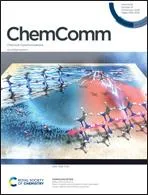
Chemical Communications
CiteScore:
8.6
自引率:
4.7%
年发文量:
2458
ChemComm publishes urgent research which is of outstanding significance and interest to experts in the field, while also appealing to the journal’s broad chemistry readership. Our communication format is ideally suited to short, urgent studies that are of such importance that they require accelerated publication. Our scope covers all topics in chemistry, and research at the interface of chemistry and other disciplines (such as materials science, nanoscience, physics, engineering and biology) where there is a significant novelty in the chemistry aspects. Major topic areas covered include: Analytical Chemistry Catalysis Chemical Biology and medicinal chemistry Computational Chemistry and Machine Learning Energy and sustainable chemistry Environmental Chemistry Green Chemistry Inorganic Chemistry Materials Chemistry Nanoscience Organic Chemistry Physical Chemistry Polymer Chemistry Supramolecular Chemistry
推荐化合物
![2,6-Bis({(2R)-2-[hydroxy(diphenyl)methyl]-1-pyrrolidinyl}methyl)-4-methylphenol structure](https://cnstatic.chemtradehub.com/structs/877/877395-58-9-70bf.webp "2,6-Bis({(2R)-2-[hydroxy(diphenyl)methyl]-1-pyrrolidinyl}methyl)-4-methylphenol structure")
推荐供应商




免责声明
本页面提供的学术期刊信息仅供参考和研究使用。我们与任何期刊出版商均无关联,也不处理投稿事宜。如有投稿相关咨询,请直接联系相关期刊出版商。
如发现页面信息有误,请发送邮件至 support@chemtradehub.com 联系我们。我们将及时核实并处理您的问题。