






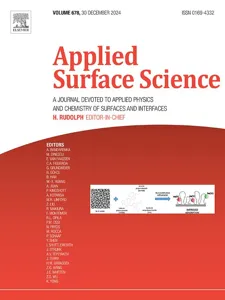

Intermolecular interactions in self-assembled monolayers of tetrathiafulvalene derivatives
文献信息
发布日期
2010-11-30
DOI
10.1039/C0CP01968B
影响因子
3.676
作者
Pierre-Yves Blanchard, Olivier Alévêque, Séverine Boisard, Christelle Gautier, Abdelkrim El-Ghayoury, Franck Le Derf, Tony Breton, Eric Levillain
查看原文
摘要
The elaboration of mixed self-assembled monolayers (SAMs) of tetrathiafulvalene derivatives allows the modulation of intermolecular interactions and provides evidence of segregated distribution of redox centers.
相关文献
Nanostructured hydrotreating catalysts for electrochemical hydrogen evolution
Carlos G. Morales-Guio, Lucas-Alexandre Stern, Xile Hu
2014-03-13
Review Article
DOI: 10.1039/C3CS60468C
Fluorine-free ionic liquid electrolytes for sustainable neodymium recovery using an electrochemical approach
Kalani Periyapperuma, Jennifer M. Pringle, Laura Sanchez-Cupido, Maria Forsyth, Cristina Pozo-Gonzalo
2021-04-21
Paper
DOI: 10.1039/D1GC00361E
Unraveling the structural and morphological stability of oxygen vacancy engineered leaf-templated CaTiO3 towards photocatalytic H2 evolution and N2 fixation reactions
Ashish Kumar, Manish Kumar, Vempuluru Navakoteswara Rao, Muthukonda Venkatakrishnan Shankar, Saswata Bhattacharya, Venkata Krishnan
2021-08-02
Paper
DOI: 10.1039/D1TA04180K
Advances and challenges in electrochemical CO2 reduction processes: an engineering and design perspective looking beyond new catalyst materials
Sahil Garg, Mengran Li, Adam Z. Weber, Liye Li, Victor Rudolph, Guoxiong Wang, Thomas E. Rufford
2019-12-12
Review Article
DOI: 10.1039/C9TA13298H
Conjugated polymers with controllable interfacial order and energetics enable tunable heterojunctions in organic and colloidal quantum dot photovoltaics
Ahmad R. Kirmani, Xinzheng Lan, Joshua Carpenter, Annabel Rong-Hui Chew, Muhammad R. Niazi, Oleksandr Voznyy, Guy Olivier Ngongang Ndjawa, Alberto Salleo, Harald Ade, Edward H. Sargent
2021-12-24
Paper
DOI: 10.1039/D1TA09544G
Historical corner. Analytical spectroscopy: the beginnings and the Scottish connection
Other
DOI: 10.1039/JA9860100100
Facile synthesis of Pd–Pt alloy concave nanocubes with high-index facets as electrocatalysts for methanol oxidation
Fangwei Zhan, Ting Bian, Wengao Zhao, Hui Zhang, Mingshang Jin, Deren Yang
2014-01-09
Paper
DOI: 10.1039/C3CE42362J
Ab initio investigation of the affinity of novel bipyrazolate-based MOFs towards H2 and CO2
J. Baima, R. Macchieraldo, C. Pettinari, S. Casassa
2014-11-07
Paper
DOI: 10.1039/C4CE01989J
您可能还喜欢
化合物问答
P11(CAS号:848644-86-0)安全吗?
P11作为一种化学化合物,需要谨慎处理。一般来说,该化合物无毒,但在操作过程中仍需遵循实验室安全规定,避免皮肤接触和吸入。建议在通风良好的环境中操作,并佩戴适当...
848644-86-0L-Histidyl-L-seryl-L...
化合物问答
氨甲环酸杂质C(CAS号:330838-52-3)通常如何合成?
氨甲环酸杂质C通常通过氨甲环酸的衍生物与环己烯进行缩合反应合成。常见的合成方法包括一步合成法和多步合成法,其中多步合成法可以提高产物的选择性和产率。反应通常在无...
330838-52-34-(Aminomethyl)-1-cy...
化合物问答
(±)-茉莉酸(CAS号:221682-41-3)通常如何合成?
(±)-茉莉酸的合成通常采用生物合成或者化学合成的方法。化学合成方法中,可以通过2-戊烯-1-醇与环戊酮的缩合反应,再经过氧化反应得到目标产物。该反应需要温和的...
221682-41-3{3-Oxo-2-[(2E)-2-pen...
化合物问答
(4S,4'S)-2,2'-(1,1-环己烷二基)双(4-异丙基-4,5-二氢-1,3-噁唑)(CAS号:1373357-00-6)安全吗?
(4S,4'S)-2,2'-(1,1-环己烷二基)双(4-异丙基-4,5-二氢-1,3-噁唑)属于有机化合物,应遵循实验室安全规范。在操作时应佩戴适当的个人防护...
1373357-00-6(4S,4'S)-2,2'-(1,1-C...
化合物问答
什么是6-苄氧基-5-甲氧基-2-羧基吲哚(CAS号:2495-92-3)?
6-苄氧基-5-甲氧基-2-羧基吲哚是一种有机化合物,分子式为C16H15NO3。它是一种含有苄氧基、甲氧基和羧基官能团的吲哚衍生物。
2495-92-36-(Benzyloxy)-5-meth...
化合物问答
丙二酸丁酯乙酯(CAS号:17373-84-1)安全吗?
丙二酸丁酯乙酯属于易燃物质,具有一定的毒性。在操作时应佩戴防护眼镜和手套,避免接触皮肤和眼睛。储存时应远离热源和火源,避免阳光直射,以减少火灾和爆炸的风险。
17373-84-1Butyl ethyl malonate
化合物问答
2-碘-3-甲基吡嗪(CAS号:58139-08-5)的市场或研究趋势如何?
2-碘-3-甲基吡嗪作为一种特殊结构的化合物,目前在工业和学术研究中的应用相对有限。然而,随着对特定化学结构及其潜在应用的深入研究,预计未来可能在农药、医药等领...
58139-08-52-Iodo-3-methylpyraz...
化合物问答
千层纸素A-7-0-β-D-葡萄糖醛酸苷甲酯(CAS号:82475-01-2)的物理化学性质是什么?
千层纸素A-7-0-β-D-葡萄糖醛酸苷甲酯是一种白色结晶固体,分子量为616.27 g/mol。该化合物在水中溶解度较低,在有机溶剂中溶解度较高。其反应活性主...
82475-01-25-Hydroxy-8-methoxy-...
化合物问答
什么是7-苄基-4,7-二氮杂螺[2.5]辛烷(CAS号:1222106-45-7)?
7-苄基-4,7-二氮杂螺[2.5]辛烷是一种有机化合物,其结构由一个环状的7-苄基-4,7-二氮杂螺环和一个苯基组成。该化合物的分子式为C14H16N2。它具...
1222106-45-77-Benzyl-4,7-diazasp...
化合物问答
在合成中是否有丁酰胺酸甲酯(CAS号:53171-39-4)的替代品?
丁酰胺酸甲酯的合成中可能的替代品包括其他氨基酸衍生物,如乙酰胺酸甲酯或丙酰胺酸甲酯。这些替代品在某些合成路线中可能更为便利或成本更低。
53171-39-4Methyl 4-amino-4-oxo...
来源期刊
Physical Chemistry Chemical Physics

CiteScore:
5.5
自引率:
10.3%
年发文量:
3036
Physical Chemistry Chemical Physics (PCCP) is an international journal co-owned by 19 physical chemistry and physics societies from around the world. This journal publishes original, cutting-edge research in physical chemistry, chemical physics and biophysical chemistry. To be suitable for publication in PCCP, articles must include significant innovation and/or insight into physical chemistry; this is the most important criterion that reviewers and Editors will judge against when evaluating submissions. The journal has a broad scope and welcomes contributions spanning experiment, theory, computation and data science. Topical coverage includes spectroscopy, dynamics, kinetics, statistical mechanics, thermodynamics, electrochemistry, catalysis, surface science, quantum mechanics, quantum computing and machine learning. Interdisciplinary research areas such as polymers and soft matter, materials, nanoscience, energy, surfaces/interfaces, and biophysical chemistry are welcomed if they demonstrate significant innovation and/or insight into physical chemistry. Joined experimental/theoretical studies are particularly appreciated when complementary and based on up-to-date approaches.
推荐化合物
![5,7-Dihydroxy-3-(4-hydroxyphenyl)-6-[(1R,6R)-3-methyl-6-prop-1-en-2-ylcyclohex-2-en-1-yl]chromen-4-one structure](https://cnstatic.chemtradehub.com/structs/191/1914963-20-4-2b05.webp "5,7-Dihydroxy-3-(4-hydroxyphenyl)-6-[(1R,6R)-3-methyl-6-prop-1-en-2-ylcyclohex-2-en-1-yl]chromen-4-one structure")
推荐供应商





免责声明
本页面提供的学术期刊信息仅供参考和研究使用。我们与任何期刊出版商均无关联,也不处理投稿事宜。如有投稿相关咨询,请直接联系相关期刊出版商。
如发现页面信息有误,请发送邮件至 support@chemtradehub.com 联系我们。我们将及时核实并处理您的问题。