







![5,7-Dihydroxy-3-(4-hydroxyphenyl)-6-[(1R,6R)-3-methyl-6-prop-1-en-2-ylcyclohex-2-en-1-yl]chromen-4-one structure](https://cnstatic.chemtradehub.com/structs/191/1914963-20-4-2b05.webp "5,7-Dihydroxy-3-(4-hydroxyphenyl)-6-[(1R,6R)-3-methyl-6-prop-1-en-2-ylcyclohex-2-en-1-yl]chromen-4-one structure")
Solvent states and spectroscopy of doped helium clusters as a quantum-chemistry-like problem
文献信息
发布日期
2013-03-25
DOI
10.1039/C3CP50282A
影响因子
3.676
作者
Néstor F. Aguirre, Pablo Villarreal, Gerardo Delgado-Barrio, Alexander O. Mitrushchenkov, María Pilar de Lara-Castells
查看原文
摘要
The Full-Configuration-Interaction Nuclear-Orbital (FCI-NO) approach [J. Chem. Phys., 2009, 131, 19401], as the implementation of the quantum-chemistry ansatz, is overviewed and applied to (He)N–Cl2(X) clusters (N ≤ 4). The ground and excited states of both fermionic 3He and bosonic 4He [see also, J. Phys. Chem. Lett., 2012, 2, 2145] clusters are studied. It is shown that the FCI-NO approach allows us to overcome three main difficulties: (1) the Fermi–Dirac (Bose–Einstein) nuclear statistics; (2) the wide (highly anharmonic) amplitudes of the He–dopant and He–He motions; and (3) both the weakly attractive (long-range) and the strongly repulsive (short-range) interaction between the helium atoms. Special emphasis is placed on the dependence of the cluster properties on the number of helium atoms, and on the comparison between the two helium isotopes. In particular, we analyze the analogies between quantum rings comprising electrons and 3He atoms. The synthetic vibro-rotational Raman spectra of Cl2(X) immersed in (3,4He)N clusters (N ≤ 4) are discussed as a function of the cluster size and the nuclear statistics. It is shown that the Coriolis couplings play a key role in modifying the spectral dopant profile in 3He. Finally, we point out possible directions for future research using the quantum-chemistry ansatz.
相关文献
Transition metal electrocatalysts encapsulated into N-doped carbon nanotubes on reduced graphene oxide nanosheets: efficient water splitting through synergistic effects
Wenchao Wan, Shiqian Wei, Jingguo Li, Carlos A. Triana, Ying Zhou, Greta R. Patzke
2019-06-10
Paper
DOI: 10.1039/C9TA03213D
Controllable fabrication of nanostructured materials for photoelectrochemical water splitting via atomic layer deposition
Tuo Wang, Zhibin Luo, Chengcheng Li, Jinlong Gong
2014-02-06
Tutorial Review
DOI: 10.1039/C3CS60370A
The intrinsic thermal-oxidative stabilization effect of chemically reduced graphene oxide on polypropylene
Junlong Yang, Yajiang Huang, Yadong Lv, Pengfei Zhao, Qi Yang, Guangxian Li
2013-07-24
Paper
DOI: 10.1039/C3TA11989K
Nanostructured hydrotreating catalysts for electrochemical hydrogen evolution
Carlos G. Morales-Guio, Lucas-Alexandre Stern, Xile Hu
2014-03-13
Review Article
DOI: 10.1039/C3CS60468C
Water-induced room-temperature transformation of straight Ge/Si core/shell nanowires into circular silica nanotubes
Byeong Geun Kim, Byung-Sung Kim, Dongmok Whang, Heon-Jin Choi, Soon-Mok Choi, Won-Seon Seo, Seong-Min Jeong
2015-07-07
Paper
DOI: 10.1039/C5CE00974J
Extraordinary role of Hg in enhancing the thermoelectric performance of p-type SnTe
Gangjian Tan, Fengyuan Shi, Jeff W. Doak, Hui Sun, Li-Dong Zhao, Pengli Wang, Ctirad Uher, Chris Wolverton, Vinayak P. Dravid
2014-10-23
Paper
DOI: 10.1039/C4EE01463D
An integrated approach between neutron diffraction and elemental imaging through neutron resonance transmission imaging: preliminary results on Chinese bimetallic sword fragments
Anna Fedrigo, Davide Raspino, Francesco Grazzi, Antonella Scherillo
2019-10-14
Paper
DOI: 10.1039/C9JA00300B
“Protrusions” or “holes” in graphene: which is the better choice for sodium ion storage?‡
Yijun Yang, Dai-Ming Tang, Chao Zhang, Yihui Zhang, Qifeng Liang, Shimou Chen, Qunhong Weng, Min Zhou, Yanming Xue, Jiangwei Liu, Jinghua Wu, Qiu Hong Cui, Chao Lian, Guolin Hou, Fangli Yuan, Xi Wang
2017-03-15
Paper
DOI: 10.1039/C7EE00329C
Anion-induced self-assembly of positively charged polycyclic aromatic hydrocarbons towards nanostructures with controllable two-dimensional morphologies
Chongqing Yang, Dongqing Wu, Wuxue Zhao, Weizhen Ye, Zhixiao Xu, Fan Zhang
2016-01-04
Communication
DOI: 10.1039/C5CE02171E
您可能还喜欢
化合物问答
P11(CAS号:848644-86-0)安全吗?
P11作为一种化学化合物,需要谨慎处理。一般来说,该化合物无毒,但在操作过程中仍需遵循实验室安全规定,避免皮肤接触和吸入。建议在通风良好的环境中操作,并佩戴适当...
848644-86-0L-Histidyl-L-seryl-L...
化合物问答
氨甲环酸杂质C(CAS号:330838-52-3)通常如何合成?
氨甲环酸杂质C通常通过氨甲环酸的衍生物与环己烯进行缩合反应合成。常见的合成方法包括一步合成法和多步合成法,其中多步合成法可以提高产物的选择性和产率。反应通常在无...
330838-52-34-(Aminomethyl)-1-cy...
化合物问答
(±)-茉莉酸(CAS号:221682-41-3)通常如何合成?
(±)-茉莉酸的合成通常采用生物合成或者化学合成的方法。化学合成方法中,可以通过2-戊烯-1-醇与环戊酮的缩合反应,再经过氧化反应得到目标产物。该反应需要温和的...
221682-41-3{3-Oxo-2-[(2E)-2-pen...
化合物问答
(4S,4'S)-2,2'-(1,1-环己烷二基)双(4-异丙基-4,5-二氢-1,3-噁唑)(CAS号:1373357-00-6)安全吗?
(4S,4'S)-2,2'-(1,1-环己烷二基)双(4-异丙基-4,5-二氢-1,3-噁唑)属于有机化合物,应遵循实验室安全规范。在操作时应佩戴适当的个人防护...
1373357-00-6(4S,4'S)-2,2'-(1,1-C...
化合物问答
什么是6-苄氧基-5-甲氧基-2-羧基吲哚(CAS号:2495-92-3)?
6-苄氧基-5-甲氧基-2-羧基吲哚是一种有机化合物,分子式为C16H15NO3。它是一种含有苄氧基、甲氧基和羧基官能团的吲哚衍生物。
2495-92-36-(Benzyloxy)-5-meth...
化合物问答
丙二酸丁酯乙酯(CAS号:17373-84-1)安全吗?
丙二酸丁酯乙酯属于易燃物质,具有一定的毒性。在操作时应佩戴防护眼镜和手套,避免接触皮肤和眼睛。储存时应远离热源和火源,避免阳光直射,以减少火灾和爆炸的风险。
17373-84-1Butyl ethyl malonate
化合物问答
2-碘-3-甲基吡嗪(CAS号:58139-08-5)的市场或研究趋势如何?
2-碘-3-甲基吡嗪作为一种特殊结构的化合物,目前在工业和学术研究中的应用相对有限。然而,随着对特定化学结构及其潜在应用的深入研究,预计未来可能在农药、医药等领...
58139-08-52-Iodo-3-methylpyraz...
化合物问答
千层纸素A-7-0-β-D-葡萄糖醛酸苷甲酯(CAS号:82475-01-2)的物理化学性质是什么?
千层纸素A-7-0-β-D-葡萄糖醛酸苷甲酯是一种白色结晶固体,分子量为616.27 g/mol。该化合物在水中溶解度较低,在有机溶剂中溶解度较高。其反应活性主...
82475-01-25-Hydroxy-8-methoxy-...
化合物问答
什么是7-苄基-4,7-二氮杂螺[2.5]辛烷(CAS号:1222106-45-7)?
7-苄基-4,7-二氮杂螺[2.5]辛烷是一种有机化合物,其结构由一个环状的7-苄基-4,7-二氮杂螺环和一个苯基组成。该化合物的分子式为C14H16N2。它具...
1222106-45-77-Benzyl-4,7-diazasp...
化合物问答
在合成中是否有丁酰胺酸甲酯(CAS号:53171-39-4)的替代品?
丁酰胺酸甲酯的合成中可能的替代品包括其他氨基酸衍生物,如乙酰胺酸甲酯或丙酰胺酸甲酯。这些替代品在某些合成路线中可能更为便利或成本更低。
53171-39-4Methyl 4-amino-4-oxo...
来源期刊
Physical Chemistry Chemical Physics

CiteScore:
5.5
自引率:
10.3%
年发文量:
3036
Physical Chemistry Chemical Physics (PCCP) is an international journal co-owned by 19 physical chemistry and physics societies from around the world. This journal publishes original, cutting-edge research in physical chemistry, chemical physics and biophysical chemistry. To be suitable for publication in PCCP, articles must include significant innovation and/or insight into physical chemistry; this is the most important criterion that reviewers and Editors will judge against when evaluating submissions. The journal has a broad scope and welcomes contributions spanning experiment, theory, computation and data science. Topical coverage includes spectroscopy, dynamics, kinetics, statistical mechanics, thermodynamics, electrochemistry, catalysis, surface science, quantum mechanics, quantum computing and machine learning. Interdisciplinary research areas such as polymers and soft matter, materials, nanoscience, energy, surfaces/interfaces, and biophysical chemistry are welcomed if they demonstrate significant innovation and/or insight into physical chemistry. Joined experimental/theoretical studies are particularly appreciated when complementary and based on up-to-date approaches.
推荐化合物
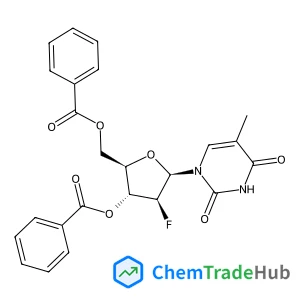
1-(3',5'-Di-O-benzoyl-2'-deoxy-2'-fluoro-b-D-arabinofuranosyl)thymine
CAS号:
97614-47-6
分子式:
C24H21FN2O7
![4-[(4-Bromophenyl)sulfonyl]thiomorpholine structure](https://cnstatic.chemtradehub.com/structs/223/223555-81-5-2d67.webp "4-[(4-Bromophenyl)sulfonyl]thiomorpholine structure")
![7-Bromo-5-chloro-1H-pyrazolo[4,3-b]pyridine structure](https://cnstatic.chemtradehub.com/structs/135/1351813-70-1-a716.webp "7-Bromo-5-chloro-1H-pyrazolo[4,3-b]pyridine structure")

推荐供应商





免责声明
本页面提供的学术期刊信息仅供参考和研究使用。我们与任何期刊出版商均无关联,也不处理投稿事宜。如有投稿相关咨询,请直接联系相关期刊出版商。
如发现页面信息有误,请发送邮件至 support@chemtradehub.com 联系我们。我们将及时核实并处理您的问题。