





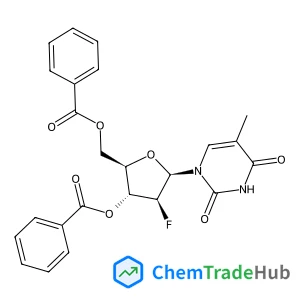
1-(3',5'-Di-O-benzoyl-2'-deoxy-2'-fluoro-b-D-arabinofuranosyl)thymine
CAS号:
97614-47-6
分子式:
C24H21FN2O7
Moran Raveh, Liang Liu, Daniel Mandler
Conductive polymers, such as polypyrrole (ppy), have been the subject of numerous studies due to their promising applications in organic solar cells, flexible electronics, electrochromic devices, super capacitors, etc. Yet, their application is still limited as a result of poor processability. Silica has been reported to improve the mechanical strength and adhesion of conductive polymer films. In this work, we propose a controllable electrochemical approach for preparing ppy–silica hybrid thin films from a solution containing both pyrrole and silane monomers. It is known that pyrrole can be electropolymerised using anodic potentials, while silica can be electrodeposited under cathodic potentials. Thus, we studied the formation of ppy–silica hybrid thin films on a stainless steel surface by applying alternating potentials, i.e. cathodic followed by anodic pulses (denoted C + A) or anodic followed by cathodic pulses (denoted A + C). We show that by controlling the deposition potential and time for the cathodic and anodic pulses, the film thickness and composition can be manipulated well as analysed using profilometry and EDX. The element depth profile of the films was characterized using secondary ion mass spectroscopy (SIMS). In essence, for the C + A process, pyrrole diffuses through the cathodically electrodeposited wet silica gel layer and undergoes anodic polymerisation on the substrate, while for the A + C process, silane can be electrodeposited both on top of the anodically electrodeposited conductive ppy films as well as on the stainless steel through the pinholes in the ppy film. This offers a simple approach for tuning the structure of conductive polymer–sol–gel composite films.
Bin Luo, Jun Ye, Chengbo Guan, Yang Zhao
DOI: 10.1039/C0CP00663G
Piotr S. Żuchowski, Michał Hapka, Marcin Modrzejewski, Małgorzata M. Szczęśniak, Grzegorz Chałasiński
DOI: 10.1039/C0CP00626B
Masao Gohdo, Tadashi Takamasu, Masanobu Wakasa
DOI: 10.1039/C0CP00077A
Jing Guo, Benjamin Koeppe
DOI: 10.1039/C0CP01659D
Gilles Frapper, Christian Bachmann, Yanlong Gu, Rodolphe Coval De Sousa, François Jérôme
DOI: 10.1039/B927015A
Edgar Leon-Gutierrez, Alfonso Sepúlveda, Gemma Garcia, Maria Teresa Clavaguera-Mora
DOI: 10.1039/C0CP00208A
Pierre-Yves Blanchard, Olivier Alévêque, Séverine Boisard, Christelle Gautier, Abdelkrim El-Ghayoury, Franck Le Derf, Tony Breton, Eric Levillain
DOI: 10.1039/C0CP01968B
Larissa S. Fenn, John A. McLean
DOI: 10.1039/C0CP01414A
P11作为一种化学化合物,需要谨慎处理。一般来说,该化合物无毒,但在操作过程中仍需遵循实验室安全规定,避免皮肤接触和吸入。建议在通风良好的环境中操作,并佩戴适当...
氨甲环酸杂质C通常通过氨甲环酸的衍生物与环己烯进行缩合反应合成。常见的合成方法包括一步合成法和多步合成法,其中多步合成法可以提高产物的选择性和产率。反应通常在无...
(±)-茉莉酸的合成通常采用生物合成或者化学合成的方法。化学合成方法中,可以通过2-戊烯-1-醇与环戊酮的缩合反应,再经过氧化反应得到目标产物。该反应需要温和的...
(4S,4'S)-2,2'-(1,1-环己烷二基)双(4-异丙基-4,5-二氢-1,3-噁唑)属于有机化合物,应遵循实验室安全规范。在操作时应佩戴适当的个人防护...
6-苄氧基-5-甲氧基-2-羧基吲哚是一种有机化合物,分子式为C16H15NO3。它是一种含有苄氧基、甲氧基和羧基官能团的吲哚衍生物。
丙二酸丁酯乙酯属于易燃物质,具有一定的毒性。在操作时应佩戴防护眼镜和手套,避免接触皮肤和眼睛。储存时应远离热源和火源,避免阳光直射,以减少火灾和爆炸的风险。
2-碘-3-甲基吡嗪作为一种特殊结构的化合物,目前在工业和学术研究中的应用相对有限。然而,随着对特定化学结构及其潜在应用的深入研究,预计未来可能在农药、医药等领...
千层纸素A-7-0-β-D-葡萄糖醛酸苷甲酯是一种白色结晶固体,分子量为616.27 g/mol。该化合物在水中溶解度较低,在有机溶剂中溶解度较高。其反应活性主...
7-苄基-4,7-二氮杂螺[2.5]辛烷是一种有机化合物,其结构由一个环状的7-苄基-4,7-二氮杂螺环和一个苯基组成。该化合物的分子式为C14H16N2。它具...
丁酰胺酸甲酯的合成中可能的替代品包括其他氨基酸衍生物,如乙酰胺酸甲酯或丙酰胺酸甲酯。这些替代品在某些合成路线中可能更为便利或成本更低。

Physical Chemistry Chemical Physics (PCCP) is an international journal co-owned by 19 physical chemistry and physics societies from around the world. This journal publishes original, cutting-edge research in physical chemistry, chemical physics and biophysical chemistry. To be suitable for publication in PCCP, articles must include significant innovation and/or insight into physical chemistry; this is the most important criterion that reviewers and Editors will judge against when evaluating submissions. The journal has a broad scope and welcomes contributions spanning experiment, theory, computation and data science. Topical coverage includes spectroscopy, dynamics, kinetics, statistical mechanics, thermodynamics, electrochemistry, catalysis, surface science, quantum mechanics, quantum computing and machine learning. Interdisciplinary research areas such as polymers and soft matter, materials, nanoscience, energy, surfaces/interfaces, and biophysical chemistry are welcomed if they demonstrate significant innovation and/or insight into physical chemistry. Joined experimental/theoretical studies are particularly appreciated when complementary and based on up-to-date approaches.