







Unprecedented scissor effect of macromolecular cross-linkers on the glass transition temperature of poly(N-vinylimidazole), crystallinity suppression of poly(tetrahydrofuran) and molecular mobility by solid state NMR in poly(N-vinylimidazole)-l-poly(tetrahydrofuran) conetworks
文献信息
发布日期
2013-04-03
DOI
10.1039/C3PY00299C
影响因子
5.582
作者
Csaba Fodor, Attila Domján, Béla Iván
查看原文
摘要
Unexpected correlations have been found between structural parameters and glass transition temperatures (Tg) of poly(N-vinylimidazole) (PVIm) and crystallinity of poly(tetrahydrofuran) (PTHF) in a series of novel, unique PVIm-l-PTHF amphiphilic conetworks synthesized in broad composition ranges via free radical copolymerisation of VIm and semicrystalline, methacrylate-telechelic PTHF macromolecular cross-linkers with varying Mn from 2170 to 10 000 g mol−1. Differential scanning calorimetry (DSC) investigations revealed microphase separation between the covalently bonded PVIm and PTHF components, that is two distinct Tgs corresponding to the respective polymers (PVIm and PTHF) were obtained in these optically clear, transparent materials. Complete microphase separation, i.e. absence of mixed phases, was also confirmed by solid state NMR measurements. The Tg of the PVIm phase significantly decreases with increasing PTHF content, and Fox–Flory type correlation was surprisingly found between the Tg of PVIm and its Mc (average molecular weight between cross-links). This striking finding indicates a unique, unpredicted scissor effect of the macromolecular PTHF cross-linker in these materials, i.e. with respect to glass transition, PVIm behaves as individual chains between cross-links. The molecular mobility in the PVIm chain segments obtained by solid state NMR investigations shows a similar trend as a function of Mc. In the DSC thermograms, the semicrystalline PTHF has a sharp endothermic melting peak (Tm) indicating partial crystallisation of this polymer. It was found that the Tm and the crystalline fraction (Xc) of the PTHF phase are suppressed by even a minimal content of PVIm phase in the conetworks. Even complete diminishing of Xc occurs in conetworks with lower than 40 wt% PTHF of the lowest Mn (2170 g mol−1). Unexpectedly, Tm linearly decreases with Mc in conetworks with constant Mn of PTHF. These data indicate that the decrease of both Tm and Xc of PTHF is not only composition dependent, but the MW of the macromolecular PTHF cross-linker and the Mc of the PVIm component also have effects on these parameters. These results also indicate that chemical bonding of polymer chains in conetworks yields novel materials with unprecedented property variation. This provides unique opportunities for fine tuning of the investigated fundamental material properties, i.e. Tg, Tm and Xc, within certain ranges in the novel PVIm-l-PTHF amphiphilic conetworks by selecting the proper synthesis parameters, that is, composition and MW of the telechelic PTHF macromonomer cross-linker.
相关文献
In the first proven SN2′ fullerene reaction, both C3 and C1 C60F36 hydrolyse to C1 isomers of C60F35OH that eliminate HF to give epoxides C60F34O; C60F36O oxides are shown to be ethers, and a fourth isomer of C60F36 exists
Anthony G. Avent, Ala'a K. Abdul-Sada, Brian W. Clare, David L. Kepert, Joan M. Street, Roger Taylor
2003-02-24
Paper
DOI: 10.1039/B209760P
Theoretical study of rhodium- and cobalt-catalyzed decarboxylative transformations of isoxazolones: origin of product selectivity
Wei Rong, Tian Zhang, Ting Li, Juan Li
2021-01-26
Research Article
DOI: 10.1039/D0QO01498B
Photoexcited molecular probes for selective and revertible imaging of cellular reactive oxygen species
Ying Wen, Zhiqing Long, Fangjun Huo, Caixia Yin
2021-01-20
Review Article
DOI: 10.1039/D0QO01260B
Copper-catalyzed three-component oxycyanation of alkenes
Yuehua Zeng, Yajun Li, Daqi Lv
2020-12-25
Research Article
DOI: 10.1039/D0QO01437K
Photochemical synthesis of 3-hydroxyphenanthro[9,10-c]furan-1(3H)-ones from α-keto acids and alkynes
Beibei Zhao, Zhen Zhang, Yu Ge, Pinhua Li, Tao Miao
2021-01-04
Research Article
DOI: 10.1039/D0QO01487G
Cascade intramolecular rearrangement/cycloaddition of nitrocyclopropane carboxylates with alkynes/alkenes: access to uncommon bi(hetero)cyclic systems
Rohit Kumar Varshnaya, Priyanka Singh, Navpreet Kaur, Prabal Banerjee
2021-01-21
Research Article
DOI: 10.1039/D0QO01535K
Direct determination of rate constants for coupling between aromatic radical anions and alkyl and benzyl radicals by laser-flash photolysis
Torben Lund, Peter Christensen, Robert Wilbrandt
2003-02-20
Paper
DOI: 10.1039/B209594G
Organocatalytic regio-, diastereo- and enantioselective γ-additions of isoxazol-5(4H)-ones to β,γ-alkynyl-α-imino esters for the synthesis of axially chiral tetrasubstituted α-amino allenoates
Fushuai Li, Shuai Liang, Yepeng Luan, Xuling Chen, Hanhui Zhao, Anqi Huang, Pengfei Li, Wenjun Li
2021-01-20
Research Article
DOI: 10.1039/D0QO01505A
Palladium catalyzed C–C and C–N bond forming reactions: an update on the synthesis of pharmaceuticals from 2015–2020
Jayachandra Rayadurgam, Sravani Sana, M. Sasikumar, Qiong Gu
2020-11-11
Review Article
DOI: 10.1039/D0QO01146K
您可能还喜欢
化合物问答
4-[4-三氟甲基苯基]恶唑(CAS号:1126636-40-5)通常如何合成?
4-[4-三氟甲基苯基]恶唑通常通过将4-三氟甲基苯酚与异硫氰酸苯酯在有机溶剂中进行酯化反应合成。该反应可在无水条件下,使用适当的催化剂,如四丁基氢氧化铵,以提...
1126636-40-54-(4-(Trifluoromethy...
59729-32-71-[3-(Dimethylamino)...
化合物问答
RockPhos Pd G3(CAS号:2009020-38-4)通常如何合成?
RockPhos Pd G3 通常通过钯催化偶联反应合成,使用配体 (2'-Amino-2-biphenylyl)(methanesulfonato-kappa...
2009020-38-4(2'-Amino-2-biphenyl...
化合物问答
1-哌啶甲酰胺(CAS号:2158-03-4)的市场或研究趋势如何?
1-哌啶甲酰胺作为有机合成中的重要中间体,其市场需求主要受医药、农药、染料等行业推动。近年来,随着新药开发和绿色化学的发展,该化合物的研究趋势集中在开发更高效、...
2158-03-41-Piperidinecarboxam...
化合物问答
2-(二苯基膦基)乙胺(CAS号:4848-43-5)适用哪些法规指南?
2-(二苯基膦基)乙胺适用于多种法规指南,包括但不限于《全球化学品统一分类和标签制度》(GHS),欧盟《化学品注册、评估、授权和限制》法规(REACH),以及美...
4848-43-52-(Diphenylphosphino...
化合物问答
如何储存间苯二甲酸二烯丙酯(CAS号:1087-21-4)?
间苯二甲酸二烯丙酯应储存在阴凉、干燥、通风良好的地方,远离火源和热源。储存容器应密封,避免光照和高温。储存温度应控制在25℃以下,相对湿度应低于80%。避免与其...
1087-21-4Diallyl isophthalate
化合物问答
什么是间甲苯异硫代异氰酸酯(CAS号:621-30-7)?
间甲苯异硫代异氰酸酯是一种有机化合物,分子式为C7H7NO2S,具有刺激性气味。它是一种重要的有机合成中间体,在合成其他化合物时广泛应用。
621-30-71-Isothiocyanato-3-m...
化合物问答
在合成中是否有N-Boc-D-苯丙氨醇(CAS号:106454-69-7)的替代品?
在合成中,可以考虑使用N-Cbz-D-苯丙氨醇或N-Fmoc-D-苯丙氨醇作为替代品。这些化合物同样具有保护氨基的功能,且在合成过程中表现出良好的反应性能。
106454-69-72-Methyl-2-propanyl ...
化合物问答
3-羟甲基-2-氧异丙基吡啶(CAS号:954240-50-7)的主要用途是什么?
3-羟甲基-2-氧异丙基吡啶主要用于有机合成领域,可以作为合成其他药物、农药或精细化学品的中间体。此外,它还可能在实验室研究中作为特定反应的前体或溶剂。
954240-50-7(2-Isopropoxy-3-pyri...
化合物问答
6-氨基-9-甲基嘌呤(CAS号:700-00-5)应用于哪些行业?
6-氨基-9-甲基嘌呤目前主要应用于医药行业,作为某些药物的中间体。此外,它还可能用于聚合物、传感器和半导体的某些领域,作为功能性单体或掺杂剂。
700-00-59-Methyl-9H-purin-6-...
来源期刊
Polymer Chemistry

CiteScore:
8.6
自引率:
7.3%
年发文量:
457
Polymer Chemistry welcomes submissions in all areas of polymer science that have a strong focus on macromolecular chemistry. Manuscripts may cover a broad range of fields, yet no direct application focus is required.
推荐化合物
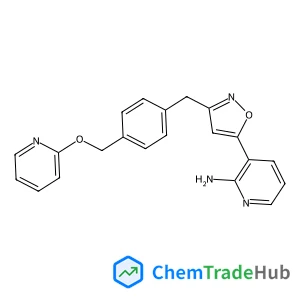
3-(3-(4-((Pyridin-2-yloxy)methyl)benzyl)isoxazol-5-yl)pyridin-2-amine
CAS号:
936339-60-5
分子式:
C21H18N4O2
推荐供应商






免责声明
本页面提供的学术期刊信息仅供参考和研究使用。我们与任何期刊出版商均无关联,也不处理投稿事宜。如有投稿相关咨询,请直接联系相关期刊出版商。
如发现页面信息有误,请发送邮件至 support@chemtradehub.com 联系我们。我们将及时核实并处理您的问题。