





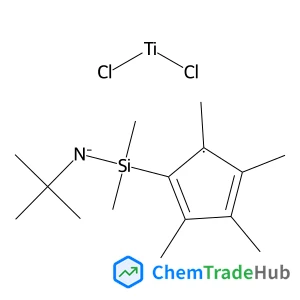
2,3,4,5-TETRAMETHYLCYCLOPENTADIENEDIMETHYLSILYL-TERT-BUTYLAMIDO TITANIUM DICHLORIDE
CAS号:
135072-61-6
分子式:
C15H27Cl2NSiTi-
Farid Ouhib, Simon Desbief, Roberto Lazzaroni, Sorin Melinte, Constantin Augustin Duţu, Christine Jerôme, Christophe Detrembleur
We report on a simple process for the chemisorption of poly(thiophene)-based block copolymers onto ITO substrates. Two poly(thiophene) block copolymers functionalized by acrylates on the second block are prepared by the Grignard Metathesis (GRIM) process. The first block is composed of poly(3-hexylthiophene) (P3HT) and the second block is either a polythiophene bearing an acrylate group on each monomer unit (PAcET), or a polythiophene bearing both acrylate and poly(ethylene glycol) side chains (P(AcET-co-PEGET)). After characterizing their macromolecular parameters and optical properties, we investigate their ability to self-assemble into micelles in DMF solutions. This solvent is required for the electrografting procedure that is used for strongly anchoring the polymer to ITO. These micelles are expected to be formed by a P3HT core and a PAcET or P(AcET-co-PEGET) shell. When PEG side chains are present in the second block, the copolymer nicely self-assembles into micelles decorated by acrylates. Cathodic polarization of ITO induces chemisorption and polymerization of acrylate groups, leading to an adherent organized film of poly(thiophene)-based micelles. The optical absorption spectra show that the electrografted polymer chains have a degree of π-electron conjugation similar to that of crystalline P3HT films. In the absence of the PEG chains, the copolymer does not organize into micelles, due to the low stabilizing ability of the second block in DMF.
Ying Wen, Zhiqing Long, Fangjun Huo, Caixia Yin
DOI: 10.1039/D0QO01260B
Ning Liu, Xiahe Chen, Liyuan Jin, Yun-Fang Yang, Yuan-Bin She
DOI: 10.1039/D0QO01442G
Shuki Araki, Masashi Kuzuya, Kenji Hamada, Masatoshi Nogura, Nayumi Ohata
DOI: 10.1039/B211000H
Donie Guiney, Colin L. Gibson, Colin J. Suckling
DOI: 10.1039/B211564F
Xu-Heng Yang, Jian Huang, Fang Wang, Zhuoliang Liu, Yujiao Li, Cheng-an Tao, Jianfang Wang
DOI: 10.1039/D0QO00837K
DOI: 10.1039/D0QO00723D
Rong Zhou, Lishuang Ma, Xiaona Yang, Jilei Cao
DOI: 10.1039/D0QO01299H
Pedro P. de Castro, Juliana A. dos Santos, Troels Skrydstrup, Giovanni W. Amarante
DOI: 10.1039/D0QO01226B
4-[4-三氟甲基苯基]恶唑通常通过将4-三氟甲基苯酚与异硫氰酸苯酯在有机溶剂中进行酯化反应合成。该反应可在无水条件下,使用适当的催化剂,如四丁基氢氧化铵,以提...
RockPhos Pd G3 通常通过钯催化偶联反应合成,使用配体 (2'-Amino-2-biphenylyl)(methanesulfonato-kappa...
1-哌啶甲酰胺作为有机合成中的重要中间体,其市场需求主要受医药、农药、染料等行业推动。近年来,随着新药开发和绿色化学的发展,该化合物的研究趋势集中在开发更高效、...
2-(二苯基膦基)乙胺适用于多种法规指南,包括但不限于《全球化学品统一分类和标签制度》(GHS),欧盟《化学品注册、评估、授权和限制》法规(REACH),以及美...
间苯二甲酸二烯丙酯应储存在阴凉、干燥、通风良好的地方,远离火源和热源。储存容器应密封,避免光照和高温。储存温度应控制在25℃以下,相对湿度应低于80%。避免与其...
间甲苯异硫代异氰酸酯是一种有机化合物,分子式为C7H7NO2S,具有刺激性气味。它是一种重要的有机合成中间体,在合成其他化合物时广泛应用。
在合成中,可以考虑使用N-Cbz-D-苯丙氨醇或N-Fmoc-D-苯丙氨醇作为替代品。这些化合物同样具有保护氨基的功能,且在合成过程中表现出良好的反应性能。
3-羟甲基-2-氧异丙基吡啶主要用于有机合成领域,可以作为合成其他药物、农药或精细化学品的中间体。此外,它还可能在实验室研究中作为特定反应的前体或溶剂。
6-氨基-9-甲基嘌呤目前主要应用于医药行业,作为某些药物的中间体。此外,它还可能用于聚合物、传感器和半导体的某些领域,作为功能性单体或掺杂剂。

Polymer Chemistry welcomes submissions in all areas of polymer science that have a strong focus on macromolecular chemistry. Manuscripts may cover a broad range of fields, yet no direct application focus is required.
![(4-{[(2-Methyl-2-propanyl)oxy]methyl}phenyl)boronic acid structure](https://cnstatic.chemtradehub.com/structs/102/1024017-53-5-41c0.webp "(4-{[(2-Methyl-2-propanyl)oxy]methyl}phenyl)boronic acid structure")