












3D printed metal columns for capillary liquid chromatography
文献信息
发布日期
2014-09-30
DOI
10.1039/C4AN01476F
影响因子
4.616
作者
S. Sandron, B. Heery, V. Gupta, D. A. Collins, E. P. Nesterenko, P. N. Nesterenko, M. Talebi, S. Beirne, F. Thompson, G. G. Wallace, D. Brabazon, F. Regan, B. Paull
查看原文
摘要
Coiled planar capillary chromatography columns (0.9 mm I.D. × 60 cm L) were 3D printed in stainless steel (316L), and titanium (Ti–6Al–4V) alloys (external dimensions of ∼5 × 30 × 58 mm), and either slurry packed with various sized reversed-phase octadecylsilica particles, or filled with an in situ prepared methacrylate based monolith. Coiled printed columns were coupled directly with 30 × 30 mm Peltier thermoelectric direct contact heater/cooler modules. Preliminary results show the potential of using such 3D printed columns in future portable chromatographic devices.
相关文献
Evidences in favour of a single electron transfer (SET) mechanism in the TiO2 sensitized photo-oxidation of α-hydroxy- and α,β-dihydroxybenzyl derivatives in water
Marta Bettoni, Cesare Rol, Giovanni V. Sebastiani
2010-04-06
Paper
DOI: 10.1039/B920785F
The effect of Mn oxidation state on metal core electron excitations in manganese dimers: a time-dependent density functional investigation
Adrian R. Jaszewski, Rob Stranger, Ronald J. Pace
2009-04-30
Paper
DOI: 10.1039/B900694J
Understanding microwave heating effects in single mode type cavities—theory and experiment
John Robinson, Sam Kingman, Derek Irvine, Peter Licence, Alastair Smith, Georgios Dimitrakis, David Obermayer, C. Oliver Kappe
2010-03-16
Paper
DOI: 10.1039/B922797K
Thermodynamic theory of two-dimensional to three-dimensional growth transition in quantum dotsself-assembly
Xinlei Li, Yuanyuan Cao, Guowei Yang
2010-03-16
Paper
DOI: 10.1039/B927189A
IM-19: a new flexible microporous gallium based-MOF framework with pressure- and temperature-dependent openings
Gérald Chaplais, Angélique Simon-Masseron, Claude Lecomte, Delphine Bazer-Bachi, Nicolas Bats, Joël Patarin
2009-04-24
Communication
DOI: 10.1039/B822163D
In situXAS and IR studies on Cu:SAPO-5 and Cu:SAPO-11: the contributory role of monomeric linear copper(i) species in the selective catalytic reduction of NOx by propene
Karina Mathisen, David G. Nicholson
2009-04-24
Paper
DOI: 10.1039/B902491C
Oxidization states of metal atoms in linear bimetallic multi-sandwich molecules Vn(FeCp2)(n+1) and magnetic moment enhancement mechanism of its 1D wire
Hongmei Jin, Valeri Ligatchev, Shuo-Wang Yang, Michael B. Sullivan, Yuanping Feng
2010-03-15
Communication
DOI: 10.1039/B927272K
Evolution of the structures and stabilities of boron-doped lithium cluster cations: ab initio and DFT studies
Ying Li, Yong-Jun Liu, Di Wu, Zhi-Ru Li
2009-04-29
Paper
DOI: 10.1039/B901333D
Dynamics of ionic liquid mediated quantised charging of monolayer-protected clusters
Stijn F. L. Mertens, Thomas Wandlowski
2010-04-07
Paper
DOI: 10.1039/B921368F
您可能还喜欢
化合物问答
十二烷基磺酸钠(CAS号:2386-53-0)的主要用途是什么?
十二烷基磺酸钠主要用作表面活性剂,广泛应用于洗涤剂、肥皂、化妆品和工业清洁产品中。它能有效去除油脂和污垢,常用于制造洗发水、沐浴露、洗衣粉和金属清洗剂。此外,它...
2386-53-01-Dodecanesulfonic a...
化合物问答
5-羟基异喹啉(CAS号:2439-04-5)适用哪些法规指南?
5-羟基异喹啉作为化学品,主要适用的法规包括GHS全球化学品统一分类和标签制度,REACH法规等。GHS将5-羟基异喹啉分类为皮肤腐蚀/刺激类别2,严重眼损伤/...
2439-04-55-Isoquinolinol
化合物问答
在合成中是否有FIDAS-5 | Wnt(CAS号:1391934-98-7)的替代品?
合成中可以考虑使用类似结构的化合物,如4-[(E)-2-(2-氯-6-氟苯基)乙烯基]-N-甲基苯胺的类似物或衍生物作为替代品。这类化合物可能具有相似的生物活性...
1391934-98-74-[(E)-2-(2-Chloro-6...
化合物问答
(R)-tert-Butyl 2-(5-bromo-1H-imidazol-2-yl)pyrrolidine-1-carboxylate(CAS号:1370600-56-8)通常如何合成?
该化合物通常通过如下步骤合成:首先,将4-溴-1H-咪唑与对甲苯磺酸在乙酸乙酯中反应,得到中间体5-溴-1H-咪唑-2-甲酸乙酯。然后,该中间体与2-甲基-2-...
1370600-56-82-Methyl-2-propanyl ...
化合物问答
处理4-(吡咯烷-1-基)环己酮(CAS号:10421-18-8)时应注意哪些实验室安全事项?
处理4-(吡咯烷-1-基)环己酮时,应佩戴手套、护目镜和实验室外套,以防止直接接触或吸入。在通风橱中操作,确保良好的通风条件。一旦发生泄漏,应立即清理并使用适当...
10421-18-84-(Pyrrolidin-1-yl)c...
化合物问答
如何处理含有异麦芽糖醇(CAS号:534-73-6)的废料?
含有异麦芽糖醇的废液应首先进行分类收集,避免与其他化学品混合。对于小规模的废液,可以通过焚烧或加入特定的化学试剂进行无害化处理。对于大规模的废液,建议联系专业的...
534-73-66-O-alpha-D-Glucopyr...
化合物问答
7-甲基壬酸(CAS号:41653-89-8)的主要用途是什么?
7-甲基壬酸主要用于有机合成领域,作为合成其他化合物的原料。此外,它还可能作为一种中间体用于药品制造和香料合成,但具体用途需要根据其具体的化学结构和反应特性来确...
41653-89-87-Methylnonanoic aci...
化合物问答
N-甲氧基-N-甲基甲基吡啶羧酰胺(CAS号:148493-07-6)应用于哪些行业?
N-甲氧基-N-甲基甲基吡啶羧酰胺在医药领域有一定的应用,作为一种潜在的药物前体或中间体。此外,该化合物也可能应用于聚合物改性剂、传感器材料等。由于其独特的化学...
148493-07-6N-Methoxy-N-methylpi...
化合物问答
什么是惕各酸香叶酯(CAS号:7785-33-3)?
惕各酸香叶酯是一种化合物,化学名称为(2E)-3,7-二甲基-2,6-辛二烯-1-基(2E)-2-甲基-2-丁烯酸酯。它是一种具有香叶香气的化合物,分子式为C1...
7785-33-3(2E)-3,7-Dimethyl-2,...
化合物问答
1-环丁基哌嗪(CAS号:132800-13-6)安全吗?
1-环丁基哌嗪在适当的操作条件下是相对安全的,但如遇明火或高热会释放有毒气体。操作时应佩戴防护眼镜和手套,避免吸入或接触皮肤、眼睛。
132800-13-61-Cyclobutylpiperazi...
来源期刊
Analyst

CiteScore:
7.8
自引率:
5.6%
年发文量:
653
Analyst publishes analytical and bioanalytical research that reports premier fundamental discoveries and inventions, and the applications of those discoveries, unconfined by traditional discipline barriers.
推荐化合物
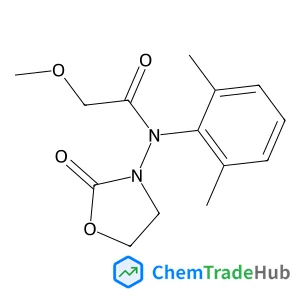
N-(2,6-Dimethylphenyl)-2-methoxy-N-(2-oxo-1,3-oxazolidin-3-yl)acetamide
CAS号:
77732-09-3
分子式:
C14H18N2O4
推荐供应商



免责声明
本页面提供的学术期刊信息仅供参考和研究使用。我们与任何期刊出版商均无关联,也不处理投稿事宜。如有投稿相关咨询,请直接联系相关期刊出版商。
如发现页面信息有误,请发送邮件至 support@chemtradehub.com 联系我们。我们将及时核实并处理您的问题。