






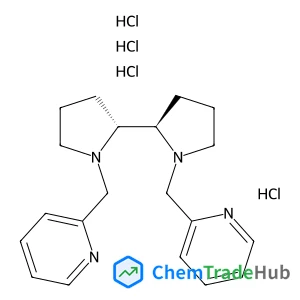
(2R,2'R)-1,1'-Bis(2-pyridinylmethyl)-2,2'-bipyrrolidine tetrahydrochloride
CAS号:
1228077-88-0
分子式:
C20H30Cl4N4
Yun Li
The atmospheric oxidation mechanism of 1,2,4-trimethylbenzene (1,2,4-TMB) initiated by OH radicals is investigated using quantum chemistry calculations at M06-2X and ROCBS-QB3 levels. The calculations show that the initiation of the reaction is dominated by OH addition to C1, C3 and C5 to form 1,2,4-TMB-OH adducts R1, R3, and R5 with branching ratios of 0.22, 0.19, and 0.38, respectively, using ROCBS-QB3 energies. In the troposphere, the adducts react with O2 by irreversible H-abstraction to form phenolic compounds and by reversible addition to TMB-OH-O2 peroxy radicals, which will cyclize to bicyclic radicals, similar to those in benzene, toluene, and xylenes. The bicyclic radicals can further recombine with O2 to generate bicyclic peroxy and alkoxyl radicals. The bicyclic alkoxyl radicals would break the ring directly to form 1,2-dicarbonyl products and unsaturated 1,4-dicarbonyl co-products, or undergo another cyclization to form an epoxy group, followed by the ring-breakage to form 1,2-dicarbonyl products and epoxy-1,4-dicarbonyl co-products. The predicted yields of products agree reasonably with the previous experimental measurements, while considerable discrepancies also exist for the yields of nitrates, biacetyl, 4-oxo-2-pentenal, and butenedial, etc. Our mechanism also predicts a new type of epoxy-1,4-dicarbonyl compounds with a total yield of ∼0.32. The epoxy-1,4-dicarbonyl compounds have not been suggested or reported in previous studies.
Elena A. Zakharova, Olga I. Shmatova, Irina V. Kutovaya, Valentine G. Nenajdenko
DOI: 10.1039/C9OB00229D
Katharina Schmölzer, Melanie Weingarten, Kai Baldenius
DOI: 10.1039/C9OB90088H
Sagar Satpathi, Subrahmanyam Sappati, Konoya Das
DOI: 10.1039/C9OB01020C
Shivani Sharma, Anuj Sharma
DOI: 10.1039/C9OB00092E
Shota Yanagi, Tomoya Sugai, Takuma Noguchi, Masato Kawakami, Makoto Sasaki, Shinsuke Niwa, Asako Sugimoto, Haruhiko Fuwa
DOI: 10.1039/C9OB01276A
Christopher R. Travis, Lauren E. Mazur, Emily M. Peairs, Gillian H. Gaunt, Douglas D. Young
DOI: 10.1039/C9OB00327D
Jian-Yun Lin, Juan-Juan Gao, Xin-Yan Wu
DOI: 10.1039/C9OB00736A
Yuan Huang, Allison M. Bergmann, M. Kevin Brown
DOI: 10.1039/C9OB00961B
随着环保要求的提高和安全意识的增强,该化合物的研究和应用趋势正逐渐转向更安全、更环境友好的替代品。市场关注点主要集中在开发新型合成方法和绿色化学路径,以减少有害...
处理含有2,9 - 二苯基 - 1,10 - 菲罗啉的废料时,应先将其收集在适当的容器中,避免与其他化学品混合。随后,可以通过水解或氧化等方法进行处理,直至达到...
处理(6-氯-吡嗪-3-基)-(4-乙基-哌嗪-1-基)-甲酮时,应穿戴适当的个人防护装备(PPE),包括手套、护目镜和实验室外套。在通风橱中操作以确保良好的通...
在处理(R)-2-氯-1-(2,4-二氯苯基)乙醇时,应佩戴防护眼镜、实验室外套和手套,确保通风橱开启以减少接触和吸入的风险。避免直接接触皮肤和眼睛。处理过程中...
可考虑使用类似结构的化合物作为替代品,如3-氯-6-(哌啶-1-基)吡嗪或3-氯-6-(2-氯哌啶-1-基)吡嗪,这些化合物在结构上与目标化合物相似,可能具有相...
该化合物可以通过乙酸乙酯与5-溴-1H-苯并三氮唑的反应合成,通常在无水条件下进行。合成过程中,需要使用适当的溶剂如乙酸乙酯,并在适当的温度下反应。该反应具有较...
一水硫酸镁是一种无机化合物,化学式为MgSO₄·H₂O,CAS号为14168-73-1。它由镁离子、硫酸根离子和一个结晶水分子组成,通常呈现为白色粉末或颗粒状固...
氘代-1,3-二氯-2-丙醇主要应用于医药和有机合成领域,作为研究化合物的氘代替代品,用于标记和追踪反应过程。此外,在聚合物和半导体生产中也有一定的应用潜力。
氰乙酸环己酯应储存在阴凉、干燥、通风良好的环境中,远离火源和热源,防止阳光直射。储存容器应密封良好,避免与空气接触,防止发生不必要的反应。
目前,2-碘-4-硝基苯胺在医药和农药领域有一定的研究和应用,尤其是在开发新型药物和农药产品方面。然而,由于其潜在的环境和健康风险,行业正趋向于寻找更为安全和环...

Physical Chemistry Chemical Physics (PCCP) is an international journal co-owned by 19 physical chemistry and physics societies from around the world. This journal publishes original, cutting-edge research in physical chemistry, chemical physics and biophysical chemistry. To be suitable for publication in PCCP, articles must include significant innovation and/or insight into physical chemistry; this is the most important criterion that reviewers and Editors will judge against when evaluating submissions. The journal has a broad scope and welcomes contributions spanning experiment, theory, computation and data science. Topical coverage includes spectroscopy, dynamics, kinetics, statistical mechanics, thermodynamics, electrochemistry, catalysis, surface science, quantum mechanics, quantum computing and machine learning. Interdisciplinary research areas such as polymers and soft matter, materials, nanoscience, energy, surfaces/interfaces, and biophysical chemistry are welcomed if they demonstrate significant innovation and/or insight into physical chemistry. Joined experimental/theoretical studies are particularly appreciated when complementary and based on up-to-date approaches.
![4,4-Difluoro-2-methyl-1-{[(2-methyl-2-propanyl)oxy]carbonyl}-L-proline structure](https://cnstatic.chemtradehub.com/structs/119/1194032-23-9-f426.webp "4,4-Difluoro-2-methyl-1-{[(2-methyl-2-propanyl)oxy]carbonyl}-L-proline structure")