













Microscopic interactions of the imidazolium-based ionic liquid with molecular liquids depending on their electron-donicity
文献信息
发布日期
2014-09-11
DOI
10.1039/C4CP03565H
影响因子
3.676
作者
Toshiyuki Takamuku, Hiroshi Hoke, Abdenacer Idrissi, Myriam Moreau, Yusuke Honda, Tatsuya Umecky, Takuya Shimomura
查看原文
摘要
Microscopic interactions of an imidazolium-based ionic liquid, 1-ethyl-3-methylimidazolium bis(trifluoromethanesulfonyl)imide (C2mimTFSI), with dimethyl sulfoxide (DMSO), methanol (MeOH), and acetonitrile (AN) have been analyzed by means of Raman, attenuated total reflectance infrared (ATR-IR), 1H and 13C NMR spectroscopy techniques. The magnitude of the red-shift of the C2–H vibration mode of the imidazolium ring and the deshielding of the C2–H hydrogen and carbon atoms, compared with that of the other atoms of the ring or the anion, indicated a strong interaction between the C2–H hydrogen atom and the molecular liquids in the following order; DMSO ≫ MeOH > AN. This correlates with the order of the electron donicities of these molecular liquids which allows us to suggest a hydrogen bonding character of these interactions. The behavior of SO vibration of DMSO as a function of the DMSO molar fraction xDMSO also suggested that DMSO molecules are stoichiometrically hydrogen-bonded with the three hydrogen atoms, C2,4,5–H, of the ring. In contrast, the hydrogen bonding between MeOH and the C4,5–H atoms is much weaker than that in DMSO. AN hardly forms hydrogen bonds with the C4,5–H atoms. Instead, AN molecules may interact with the imidazolium ring through the π–π interaction. The interactions between the imidazolium ring and the molecular liquids lead to the loosening of the TFSI anion from the cation; this correlates with both the blue-shift of the SO stretching vibration of TFSI and the deshielding of the trifluoromethyl carbon atoms with an increase in the molar fraction of the molecular liquid xML. The latter is weak in the MeOH solutions, and may be explained by the possible hydrogen bonding of the MeOH hydroxyl group as an electron-acceptor with the TFSI anion. Furthermore, the organization of MeOH molecules around the ethyl and methyl groups of the cation is discussed in terms of the chemical shift of the hydrogen and carbon atoms in these groups as a function of xML.
相关文献
Surface-enhanced spatially-offset Raman spectroscopy (SESORS) for detection of neurochemicals through the skull at physiologically relevant concentrations
Amber S. Moody, Taylor D. Payne, Brian A. Barth, Bhavya Sharma
2020-01-16
Paper
DOI: 10.1039/C9AN01708A
Mass spectrometric quantification of microRNAs in biological samples based on multistage signal amplification
Xiangtang Li, Rui Xu, Li Pan, Yi-Ming Liu
2019-12-30
Paper
DOI: 10.1039/C9AN02064K
An FcεRI-IgE-based genetically encoded microfluidic cell sensor for fast Gram-negative bacterial screening in food samples
Jun Yang, Donglei Jiang, Xiulan Sun
2020-01-18
Paper
DOI: 10.1039/C9AN02289A
A study of separation selectivity using embedded ester-bonded stationary phases for liquid chromatography
Szymon Bocian, Katarzyna Krzemińska, Bogusław Buszewski
2016-04-27
Paper
DOI: 10.1039/C6AN00139D
Selective mercury(ii) detection in aqueous solutions upon the absorption changes corresponding to the transition moments polarized along the short axis of an azobenzene chemosensor
Lei Zhang, Zhenyu Tang, LiLi Hou, Yang Qu, Yawen Deng, Chenghao Zhang, Congxia Xie, Zhongtao Wu
2020-01-06
Communication
DOI: 10.1039/C9AN02286D
Cobalt oxyhydroxide nanoflake based fluorescence sensing platform for label-free detection of DNA
Zhe Zhang, Jilin Tang
2016-05-20
Paper
DOI: 10.1039/C6AN00745G
Live-cell quantification and comparison of mammalian oocyte cytosolic lipid content between species, during development, and in relation to body composition using nonlinear vibrational microscopy
Joshua Jasensky, Andrew P. Boughton, Alexander Khmaladze, Jun Ding, Chi Zhang, Jason E. Swain, George W. Smith
2016-06-01
Paper
DOI: 10.1039/C6AN00629A
A FT-NIR spectroscopy methodology to estimate firing distance based on the direct analysis of the bullet impact surface
Jorge M. G. Sarraguça, Catarina Lima, Filipe Machado, João A. Lopes, Agostinho Almeida, Luís Fernandes
2016-05-11
Paper
DOI: 10.1039/C6AN00247A
Investigating CC positions and hydroxylation sites in lipids using Paternò–Büchi functionalization mass spectrometry
Patrick Esch, Sven Heiles
2020-01-23
Paper
DOI: 10.1039/C9AN02260K
您可能还喜欢
化合物问答
什么是2,6-二溴-4,8-双[(2-乙基己基)氧基]苯并[1,2-b:4,5-b']二噻吩(CAS号:1226782-13-3)?
2,6-二溴-4,8-双[(2-乙基己基)氧基]苯并[1,2-b:4,5-b']二噻吩是一种有机化合物,分子式为C23H32Br2O2S2。该化合物具有芳香性和...
1226782-13-32,6-Dibromo-4,8-bis[...
化合物问答
木聚硫钠(CAS号:37319-17-8)的物理化学性质是什么?
木聚硫钠通常为无色或白色结晶性粉末,具有吸湿性。其分子量约为121.11 g/mol。木聚硫钠易溶于水,不溶于醇类和其他非极性溶剂。在酸性或碱性溶液中,木聚硫钠...
37319-17-8Pentosan
化合物问答
2-甲氧基-4-(三氟甲基)苄溴, JRD(CAS号:886500-59-0)适用哪些法规指南?
该化合物在合成、储存和运输过程中需遵循《全球化学品统一分类和标签制度》(GHS)的健康、环境和物理危险分类。在欧洲还需符合《化学品注册、评估、授权和限制》(RE...
886500-59-02-Methoxy-4-(trifluo...
化合物问答
1,4-Diazoniabicyclo[2.2.2]octane-1,4-disulfinate(CAS号:119752-83-9)的主要用途是什么?
1,4-二氮杂双环[2.2.2]辛烷-1,4-二硫酸二酯主要用于有机合成中的保护基团,特别是在保护胺基和硫醇基方面具有广泛应用。此外,它还用于一些特殊化学反应的...
119752-83-91,4-Diazabicyclo[2.2...
化合物问答
如何处理含有4-(Bromomethyl)-2-fluorobenzenesulphonamide(CAS号:1645275-47-3)的废料?
含有4-(Bromomethyl)-2-fluorobenzenesulphonamide的废液应首先进行中和处理,以降低pH值,避免对环境造成腐蚀性影响。随后...
1645275-47-34-(Bromomethyl)-2-fl...
化合物问答
Loureiriol(CAS号:479195-44-3)的物理化学性质是什么?
Loureiriol是一种天然化合物,其分子式为C15H22O4。Loureiriol为无色结晶性粉末,具有较高的熔点和良好的热稳定性。其相对分子质量为262....
479195-44-3Loureiriol
化合物问答
在合成中是否有3-氨基苯甲酰苯胺(CAS号:14315-16-3)的替代品?
在合成过程中,可以考虑使用类似结构的化合物作为3-氨基苯甲酰苯胺的替代品,例如N-苯基-3-氰基苯胺或N-苯基-3-硝基苯胺等,这些化合物具有相似的化学性质,可...
14315-16-33-Amino-N-phenylbenz...
化合物问答
4-异氰酰苯基硼酸频哪醇酯(CAS号:380430-64-8)的市场或研究趋势如何?
4-异氰酰苯基硼酸频哪醇酯主要应用于有机合成、药物化学和材料科学领域。随着绿色化学的发展,该化合物因其高效的官能团转化能力和环境友好性而受到越来越多的关注。近年...
380430-64-82-(4-Isocyanatopheny...
化合物问答
如何储存3β-乙酰氧基-7,25-甘遂二烯-24(R)-醇(CAS号:1352001-09-2)?
3β-乙酰氧基-7,25-甘遂二烯-24(R)-醇应储存在阴凉、干燥、通风良好的地方,避免直接光照。储存容器应密封,防止空气中的水分和氧气影响化合物的稳定性。建...
1352001-09-23β-acetoxy-eupha- 7,...
化合物问答
如何储存4-氟-2-甲基-1H-吲哚(CAS号:1260383-51-4)?
应将4-氟-2-甲基-1H-吲哚存放在阴凉、干燥、通风良好的地方,避免直接暴露在光照下。容器应密封,避免与空气中的水蒸气接触。建议在避光、温度不超过25℃的环境...
1260383-51-44-Fluoro-2-methyl-1H...
来源期刊
Physical Chemistry Chemical Physics

CiteScore:
5.5
自引率:
10.3%
年发文量:
3036
Physical Chemistry Chemical Physics (PCCP) is an international journal co-owned by 19 physical chemistry and physics societies from around the world. This journal publishes original, cutting-edge research in physical chemistry, chemical physics and biophysical chemistry. To be suitable for publication in PCCP, articles must include significant innovation and/or insight into physical chemistry; this is the most important criterion that reviewers and Editors will judge against when evaluating submissions. The journal has a broad scope and welcomes contributions spanning experiment, theory, computation and data science. Topical coverage includes spectroscopy, dynamics, kinetics, statistical mechanics, thermodynamics, electrochemistry, catalysis, surface science, quantum mechanics, quantum computing and machine learning. Interdisciplinary research areas such as polymers and soft matter, materials, nanoscience, energy, surfaces/interfaces, and biophysical chemistry are welcomed if they demonstrate significant innovation and/or insight into physical chemistry. Joined experimental/theoretical studies are particularly appreciated when complementary and based on up-to-date approaches.
推荐化合物



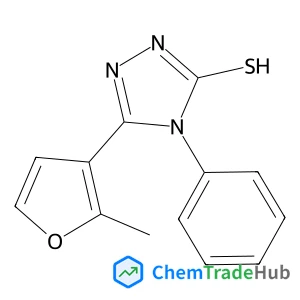
5-(2-Methyl-3-furyl)-4-phenyl-2,4-dihydro-3H-1,2,4-triazole-3-thione
CAS号:
346464-59-3
分子式:
C13H11N3OS
推荐供应商






免责声明
本页面提供的学术期刊信息仅供参考和研究使用。我们与任何期刊出版商均无关联,也不处理投稿事宜。如有投稿相关咨询,请直接联系相关期刊出版商。
如发现页面信息有误,请发送邮件至 support@chemtradehub.com 联系我们。我们将及时核实并处理您的问题。