






Amplified fluorescence detection of adenosine via catalyzed hairpin assembly and host–guest interactions between β-cyclodextrin polymer and pyrene
文献信息
发布日期
2016-03-07
DOI
10.1039/C5AN02658J
影响因子
4.616
作者
Haihua Huang, Xiaohai Yang, Kemin Wang, Qing Wang, Qiuping Guo, Jin Huang, Jianbo Liu, Chunxia Song
查看原文
摘要
Nowadays, enzyme-free nucleic acid-based signal amplification strategies are frequently utilized in the design of biosensors due to their excellent sensitivity. Developing more extended analytical methods is fundamental for basic studies in the biological and biomedical fields. Herein, we introduce an enzyme-free amplified detection strategy for the small molecule adenosine. The approach is based on adenosine–aptamer binding triggered catalyzed hairpin assembly and host–guest interactions between β-cyclodextrin polymer (β-CDP) and pyrene. Two hairpin probes (probe H1 and probe H2) and an aptamer-trigger/inhibitor duplex probe were employed in the system and the pyrene-labeled probe H1 was chosen as the signal unit. In the absence of adenosine, the aptamer-trigger was inhibited by the inhibitor strand. The hairpin probes were in the closed hairpin formation without activation of the trigger strand. Pyrene labeled at the 5′-termini of the single-stranded stem of probe H1 could be easily trapped in the hydrophobic cavity of β-CDP because of weak steric hindrance, leading to a significant fluorescence enhancement. Once the hairpin assembly was catalyzed by the adenosine–aptamer binding event, a hybridized DNA duplex H1/H2 was created continuously. Pyrene labeled at the 5′-termini of the DNA duplex H1/H2 finds it difficult to enter the cavity of β-CDP due to steric hindrance, leading to a weaker fluorescence signal. Thus, the target could be detected by this simple mix-and-detect amplification method without a need for expensive and perishable protein enzymes. As low as 42 nM of adenosine was detected by this assay, which is comparable to that of some reported colorimetric methods. Meanwhile, the proposed method was further successfully applied to detect adenosine in human serum samples, showing great potential for adenosine detection from complex fluids.
相关文献
Energetics of conformational conversion between 1,1,2-trichloroethane polymorphs
Maciej Bujak, Marcin Podsiadło, Andrzej Katrusiak
2008-07-22
Communication
DOI: 10.1039/B807372D
Activatable imaging probes with amplified fluorescent signals
Seulki Lee, Kyeongsoon Park, Kwangmeyung Kim, Kuiwon Choi, Ick Chan Kwon
2008-07-25
Feature Article
DOI: 10.1039/B806854M
Cyclometallated platinum(ii) complexes incorporating ethynyl–flavoneligands: switching between triplet and singlet emission induced by selective binding of Pb2+ ions
Pierre-Henri Lanoë, Jean-Luc Fillaut, Loïc Toupet, J. A. Gareth Williams, Hubert Le Bozec, Véronique Guerchais
2008-07-16
Communication
DOI: 10.1039/B806935B
Direct functionalization at the boron center of antiaromatic chloroborole
Holger Braunschweig, Thomas Kupfer
2008-07-30
Communication
DOI: 10.1039/B808483A
Strategic synthesis of SBA-15 nanorods
Xiulei Ji, Kyu T. Lee, Muguette Monjauze, Linda F. Nazar
2008-06-20
Communication
DOI: 10.1039/B804327B
An electrochemical sensor for 3,4-dihydroxyphenylacetic acid with carbon nanotubes as electronic transducer and synthetic cyclophane as recognition element
Jie Yan, Yucheng Zhou, Ping Yu, Lei Su, Lanqun Mao, Deqing Zhang, Daoben Zhu
2008-07-17
Communication
DOI: 10.1039/B805958F
Enantioselective regulation of a metal complex in reversible binding to serum albumin: dynamic helicity inversion signalled by circularly polarised luminescence
Craig P. Montgomery, Elizabeth J. New, David Parker, Robert D. Peacock
2008-09-10
Communication
DOI: 10.1039/B810978H
Subtractive assembly of DNA nanoarchitectures driven by fuel strand displacement
Zhe Li, Yonggang Ke, Chenxiang Lin, Hao Yan, Yan Liu
2008-07-17
Communication
DOI: 10.1039/B807933A
Selective mono reduction of bis-phosphine oxides under mild conditions
Maria J. Petersson, Wendy A. Loughlin, Ian D. Jenkins
2008-07-30
Communication
DOI: 10.1039/B807695B
Nanoparticles of iron(ii) spin-crossover
Thibaut Forestier, Stéphane Mornet, Nathalie Daro, Taishi Nishihara, Shin-ichiro Mouri, Koichiro Tanaka, Olivier Fouché, Eric Freysz, Jean-François Létard
2008-07-16
Communication
DOI: 10.1039/B806347H
您可能还喜欢
化合物问答
6-氯-2H-1,4-苯并噁嗪-3(4H)-酮(CAS号:7652-29-1)应用于哪些行业?
6-氯-2H-1,4-苯并噁嗪-3(4H)-酮主要应用于医药、农药和聚合物等领域。在医药领域,该化合物可用于合成抗菌药物;在农药领域,可用作杀虫剂的中间体;在聚...
7652-29-16-Chloro-2H-1,4-benz...
化合物问答
活性氧化铝(CAS号:1302-74-5)应用于哪些行业?
活性氧化铝广泛应用于医药、聚合物、传感器、半导体和催化等领域。在医药行业,活性氧化铝用作吸附剂和干燥剂,有助于去除杂质和水分。在聚合物行业,它用作增白剂和抗结块...
1302-74-5aluminum;trihydrate
化合物问答
什么是硅胶(CAS号:112926-00-8)?
硅胶(Silica gel, pptd.,cryst.-free)是一种无定形、多孔的硅酸盐材料,主要成分为二氧化硅(SiO₂)。其结构由硅氧四面体构成,通过酸...
112926-00-8Silica gel, pptd.,cr...
化合物问答
二乙基甲基一氢硅烷(CAS号:760-32-7)的主要用途是什么?
二乙基甲基一氢硅烷主要用于有机合成、表面处理以及作为溶剂。它还被用作合成其他硅烷化合物的原料,以及在涂料、粘合剂和密封剂中的应用。
760-32-7Diethyl(methyl)silan...
化合物问答
在合成中是否有N-花生四烯酰基甘氨酸(CAS号:179113-91-8)的替代品?
在合成过程中,可以考虑使用类似结构的化合物作为替代品,例如N-亚油酰基甘氨酸或N-花生二烯酰基甘氨酸。这些替代品在结构上有类似的双键位置,但可能具有不同的物理化...
179113-91-8Glycine, N-[(5Z,8Z,1...
化合物问答
在合成中是否有1-(4-甲氧基苯基)丙烷-1,2-二酮(CAS号:10557-27-4)的替代品?
在合成过程中,可以考虑使用类似结构的化合物作为替代品,例如1-(3-甲氧基苯基)丙烷-1,2-二酮或1-(4-羟基苯基)丙烷-1,2-二酮。这些替代品具有相似的...
10557-27-41-(4-Methoxyphenyl)p...
化合物问答
N-(4-氨基-1-苄基-3-羟基-5-苯基戊基)-3-甲基-2-(2-氧代四氢嘧啶-1-基)-丁酰胺 5-氧代吡咯烷-2-甲酸(CAS号:192726-06-0)通常如何合成?
该化合物通常通过一系列复杂的有机合成步骤获得。首先,通过芳香族化合物的羟基化反应获得羟基化产物,然后通过酰化反应形成酰胺中间体,最后通过环化反应得到目标产物。常...
192726-06-05-Oxo-L-proline - (2...
化合物问答
(S)-2-氨基-3-喹啉-2-丙酸(CAS号:161513-46-8)的市场或研究趋势如何?
该化合物作为生物活性化合物,尤其是在药物化学领域表现出色。近年来,随着对新型抗炎、抗病毒和抗癌药物的研究增加,其市场和研究趋势持续增长。此外,其在神经科学领域的...
161513-46-8(S)-2-Amino-3-quinol...
化合物问答
核黄素磷酸钠(CAS号:130-40-5)安全吗?
核黄素磷酸钠在常规使用条件下安全,但高剂量可能引起刺激性反应。操作时需佩戴防护手套和护目镜,避免吸入粉尘。若接触皮肤或眼睛,应立即用大量清水冲洗。急救时需根据接...
130-40-5Sodium 1-deoxy-1-(7,...
化合物问答
盐酸丙胺卡因杂质A(EP) 标准品(CAS号:19281-31-3)通常如何合成?
盐酸丙胺卡因杂质A(EP) 标准品可通过重氮化反应和随后的酰胺化反应合成。首先,利用氯化反应将苯环上的氢原子转化为氯原子,然后通过芳香族重氮化反应引入氨基,最后...
19281-31-32-Chloro-N-(2-methyl...
来源期刊
Analyst

CiteScore:
7.8
自引率:
5.6%
年发文量:
653
Analyst publishes analytical and bioanalytical research that reports premier fundamental discoveries and inventions, and the applications of those discoveries, unconfined by traditional discipline barriers.
推荐化合物
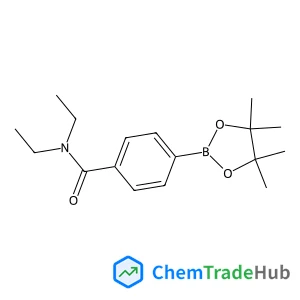
N,N-Diethyl-4-(4,4,5,5-tetramethyl-1,3,2-dioxaborolan-2-yl)benzamide
CAS号:
325142-99-2
分子式:
C17H26BNO3
推荐供应商






免责声明
本页面提供的学术期刊信息仅供参考和研究使用。我们与任何期刊出版商均无关联,也不处理投稿事宜。如有投稿相关咨询,请直接联系相关期刊出版商。
如发现页面信息有误,请发送邮件至 support@chemtradehub.com 联系我们。我们将及时核实并处理您的问题。