







Ru(ii)-Catalyzed C7-acyloxylation of indolines with carboxylic acids
文献信息
发布日期
2018-07-30
DOI
10.1039/C8OB01603H
影响因子
3.876
作者
Pinaki Bhusan De, Sonbidya Banerjee, Sourav Pradhan, Tharmalingam Punniyamurthy
查看原文
摘要
Ruthenium(II)-catalyzed site-selective C7-acyloxylation of indolines with carboxylic acids is presented. The substrate scope and functional group tolerance are important practical features. The kinetic isotope studies suggest that C–H bond activation may be the rate-determining step.
相关文献
Theoretical free energy profile and benchmarking of functionals for amino-thiourea organocatalyzed nitro-Michael addition reaction
2020-05-05
Paper
DOI: 10.1039/D0CP00481B
Structure and bonding of molecular stirrers with formula B7M2− and B8M2 (M = Zn, Cd, Hg)
Rui Yu, Jorge Barroso, Meng-hui Wang, Wei-yan Liang, Chen Chen, Ximena Zarate, Mesías Orozco-Ic, Gabriel Merino
2020-05-11
Paper
DOI: 10.1039/D0CP01603A
Correlation effects in parallel tempering and the role of the swapping frequency
2020-04-15
Paper
DOI: 10.1039/C9CP06772H
Mixed uranyl and neptunyl cation–cation interaction-driven clusters: structures, energetic stability, and nuclear quadrupole interactions
Paweł Tecmer, Frank Schindler, Aleksandra Leszczyk, Katharina Boguslawski
2020-05-02
Paper
DOI: 10.1039/D0CP01068E
Thermodynamics of mixing methanol with supercritical CO2 as seen from computer simulations and thermodynamic integration
Réka A. Horváth, George Horvai, Abdenacer Idrissi, Pál Jedlovszky
2020-04-28
Paper
DOI: 10.1039/D0CP01241F
Surface-orientation- and ligand-dependent quenching of the spin magnetic moment of Co porphyrins adsorbed on Cu substrates
Md. Ehesan Ali, Matthias Bernien, Nino Hatter, Fabian Nickel, Lalminthang Kipgen, Christian F. Hermanns, Timo Bißwanger, Philip Loche, Benjamin W. Heinrich, Katharina J. Franke, Peter M. Oppeneer, Wolfgang Kuch
2020-05-18
Paper
DOI: 10.1039/D0CP00854K
Analytical magnetostatic model for 2D arrays of interacting magnetic nanowires and nanotubes
Yenni Velázquez-Galván, Armando Encinas
2020-06-02
Paper
DOI: 10.1039/D0CP00808G
Influence of alkaline-earth metal substitution on structure, electrical conductivity and oxygen transport properties of perovskite-type oxides La0.6A0.4FeO3−δ (A = Ca, Sr and Ba)
Jia Song, De Ning, Henny J. M. Bouwmeester
2020-05-07
Paper
DOI: 10.1039/D0CP00247J
Tunable relativistic quasiparticle electronic and excitonic behavior of the FAPb(I1−xBrx)3 alloy
Peitao Liu, Saeid Jalali Asadabadi, Cesare Franchini
2020-05-01
Paper
DOI: 10.1039/D0CP00496K
Highly branched triple-chain surfactant-mediated electrochemical exfoliation of graphite to obtain graphene oxide: colloidal behaviour and application in water treatment
Nur Amirah Jamaluddin, Suriani Abu Bakar, Tretya Ardyani, Masanobu Sagisaka, Shota Suhara, Mohamad Hafiz Mamat, Mohd Khairul Ahmad, Stephen M. King, Sarah E. Rogers, Julian Eastoe
2020-05-19
Paper
DOI: 10.1039/D0CP01243B
您可能还喜欢
化合物问答
如何储存1,2-环己二酮环乙缩醛(CAS号:4746-96-7)?
1,2-环己二酮环乙缩醛应储存在阴凉、干燥、通风良好的地方,避免阳光直射。建议使用密封容器保存,并保持环境温度在室温范围内,远离火源和热源。
4746-96-71,4-Dioxaspiro[4.5]d...
化合物问答
Ecopladib(CAS号:381683-92-7)的市场或研究趋势如何?
Ecopladib作为一种新型的药物,主要应用于治疗高胆固醇等疾病。目前,市场和研究趋势显示,Ecopladib因其独特的药理作用而受到关注。随着对心血管疾病治...
381683-92-7Ecopladib
化合物问答
2,3-Dimethyl-3H-imidazo[4,5-c]pyridine(CAS号:52538-09-7)通常如何合成?
2,3-二甲基-3H-咪唑[4,5-c]吡啶通常通过咪唑和2,3-二甲基吡啶的缩合反应合成。具体来说,将咪唑和2,3-二甲基吡啶在适当的溶剂中进行加热或加压反应...
52538-09-72,3-Dimethyl-3H-imid...
化合物问答
2,3,4,5-tetrahydro-1H-3-苯并氮杂环;盐酸盐(CAS号:17379-01-0)的市场或研究趋势如何?
该化合物在药物化学和有机合成中有一定的应用。近年来,随着对新型药物化合物的需求增加,该化合物的研究趋势主要集中在探索其生物活性,尤其是其在神经系统疾病治疗中的潜...
17379-01-02,3,4,5-Tetrahydro-1...
68-90-6(2-Ethyl-1-benzofura...
化合物问答
如何储存盐酸甘氨酸丁酯(CAS号:13048-99-2)?
盐酸甘氨酸丁酯应储存在阴凉、干燥、通风良好的地方,避免阳光直射和高温环境,温度应控制在25℃以下。储存容器应密封,避免与空气中的水分和酸性物质接触,以防发生水解...
13048-99-2Butyl glycinate hydr...
化合物问答
什么是2-Iodo-N,N-dimethylbenzamide(CAS号:54616-46-5)?
2-碘-N,N-二甲基苯胺是一种有机化合物,化学名为2-Iodo-N,N-dimethylbenzamide。其分子式为C<sub>9</sub>H<sub>1...
54616-46-52-Iodo-N,N-dimethylb...
16817-90-6N-Cyclohexylglycinam...
化合物问答
5-溴-2-(4H-1,2,4-三唑-4-基)吡啶(CAS号:959240-99-4)的市场或研究趋势如何?
随着医药、农药和新材料领域的发展,该化合物作为关键中间体的应用日益增多。特别是在药物合成中,由于其独特的化学性质,可以用于合成多种药物分子。未来的研究趋势可能集...
959240-99-45-Bromo-2-(4H-1,2,4-...
化合物问答
2,4-二溴-6-三氟甲基嘧啶(CAS号:785778-00-9)通常如何合成?
2,4-二溴-6-三氟甲基嘧啶通常通过溴化反应合成。首先,将6-三氟甲基嘧啶与溴化剂(如液溴)在适当的溶剂(如二氯甲烷、四氢呋喃)中反应,加入适当的催化剂(如四...
785778-00-92,4-Dibromo-6-(trifl...
来源期刊
Organic & Biomolecular Chemistry

CiteScore:
3.4
自引率:
10.3%
年发文量:
1041
Organic & Biomolecular Chemistry (OBC) publishes original and high impact research and reviews in organic chemistry. We welcome research that shows new or significantly improved protocols or methodologies in total synthesis, synthetic methodology or physical and theoretical organic chemistry as well as research that shows a significant advance in the organic chemistry or molecular design aspects of chemical biology, catalysis, supramolecular and macromolecular chemistry, theoretical chemistry, mechanism-oriented physical organic chemistry, medicinal chemistry or natural products. Articles published in the journal should report new work which makes a highly-significant impact in the field. Routine and incremental work is generally not suitable for publication in the journal. More details about key areas of our scope are below. In all cases authors should include in their article clear rationale for why their research has been carried out.
推荐化合物


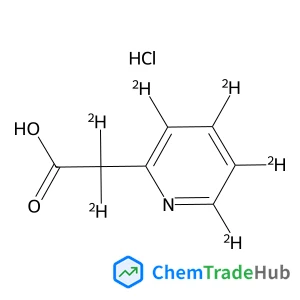
2,2-dideuterio-2-(3,4,5,6-tetradeuterio-2-pyridyl)acetic acid;hydrochloride
CAS号:
1329799-67-8
分子式:
C7H2ClD6NO2
推荐供应商






免责声明
本页面提供的学术期刊信息仅供参考和研究使用。我们与任何期刊出版商均无关联,也不处理投稿事宜。如有投稿相关咨询,请直接联系相关期刊出版商。
如发现页面信息有误,请发送邮件至 support@chemtradehub.com 联系我们。我们将及时核实并处理您的问题。