


An experimental study on the influence of trace impurities on ionization of atmospheric noble gas dielectric barrier discharges
文献信息
发布日期
2016-08-04
DOI
10.1039/C6AN01352J
影响因子
4.616
作者
F. D. Klute, A. Schütz, A. Michels, C. Vadla, D. Veza, V. Horvatic, J. Franzke
查看原文
摘要
While the influence of trace impurities in noble gas discharges is well established in theoretical work, experimental approaches are difficult. Particularly the effects of trace concentrations of N2 on He discharges are complicated to investigate due to the fact that for He 5.0 the purity of He is only 99.999%. This corresponds to a residual concentration of 10 ppm, thereof 3 ppm of N2, in He. Matters are made difficult by the fact that He DBD plasmajets are normally operated under an ambient atmosphere, which has a high abundance of N2. This work tackles these problems from two sides. The first approach is to operate a DBD plasmajet under a quasi-controlled He atmosphere, therefore diminishing the effect of atmospheric N2 and making a defined contamination with N2 possible. The second approach is using Ar as the operating gas and introducing propane (C3H8) as a suitable substitute impurity like N2 in He. As will be shown both discharges in either He or Ar, with their respective impurity show the same qualitative behaviour.
期刊推荐
Proceedings of the National Academy of Sciences of the United States of America
Molecular Pharmacology
Israel Journal of Chemistry
Fibre Chemistry
Russian Chemical Reviews
Pure and Applied Chemistry
Journal of Organometallic Chemistry
Journal of Medicinal Chemistry
Pharmacological Reviews
Journal of Heterocyclic Chemistry
相关文献
Chirality transfer through hydrogen-bonding: Experimental and ab initio analyses of vibrational circular dichroismspectra of methyl lactate in water
Martin Losada, Yunjie Xu
2007-05-03
Paper
DOI: 10.1039/B703368K
19F Magic angle spinning NMR reporter molecules: empirical measures of surface shielding, polarisability and H-bonding
Vitaliy L. Budarin, James H. Clark, Fabien E. I. Deswarte, Karl T. Mueller, Stewart J. Tavener
2007-04-16
Paper
DOI: 10.1039/B701023K
Salt-induced protein resistance of polyelectrolyte brushes studied using fluorescence correlation spectroscopy and neutron reflectometry
C. Czeslik, G. Jackler, T. Hazlett, E. Gratton, R. Steitz, A. Wittemann, M. Ballauff
2004-09-16
Paper
DOI: 10.1039/B410805A
Water dissociation at MgO sub-monolayers on silver: a periodic model study
2007-03-07
Paper
DOI: 10.1039/B700526A
Phase field modeling of CH4hydrate conversion into CO2 hydrate in the presence of liquid CO2
B. Kvamme
2007-04-27
Paper
DOI: 10.1039/B700423K
Anodic electron transfer mechanisms in microbial fuel cells and their energy efficiency
2007-05-09
Invited Article
DOI: 10.1039/B703627M
Electroactivity of a starburst hole-transport material in Langmuir–Blodgett films. Solid state effects and intervalence charge transfer
Vicente Parra, Teodosio Del Caño, María L. Rodríguez-Méndez, José A. De Saja, Marcel Bouvet, Yasuhiko Shirota
2007-03-09
Paper
DOI: 10.1039/B618509F
Real time quantitative Raman spectroscopy of supported metal oxidecatalysts without the need of an internal standard
S. J. Tinnemans, M. H. F. Kox, T. A. Nijhuis, T. Visser, B. M. Weckhuysen
2004-11-18
Paper
DOI: 10.1039/B414427A
Accurate quantum-chemical calculations using Gaussian-type geminal and Gaussian-type orbital basis sets: applications to atoms and diatomics
Pål Dahle, Trygve Helgaker, Dan Jonsson, Peter R. Taylor
2007-05-29
Paper
DOI: 10.1039/B616488A
您可能还喜欢
化合物问答
十二烷基磺酸钠(CAS号:2386-53-0)的主要用途是什么?
十二烷基磺酸钠主要用作表面活性剂,广泛应用于洗涤剂、肥皂、化妆品和工业清洁产品中。它能有效去除油脂和污垢,常用于制造洗发水、沐浴露、洗衣粉和金属清洗剂。此外,它...
2386-53-01-Dodecanesulfonic a...
化合物问答
5-羟基异喹啉(CAS号:2439-04-5)适用哪些法规指南?
5-羟基异喹啉作为化学品,主要适用的法规包括GHS全球化学品统一分类和标签制度,REACH法规等。GHS将5-羟基异喹啉分类为皮肤腐蚀/刺激类别2,严重眼损伤/...
2439-04-55-Isoquinolinol
化合物问答
在合成中是否有FIDAS-5 | Wnt(CAS号:1391934-98-7)的替代品?
合成中可以考虑使用类似结构的化合物,如4-[(E)-2-(2-氯-6-氟苯基)乙烯基]-N-甲基苯胺的类似物或衍生物作为替代品。这类化合物可能具有相似的生物活性...
1391934-98-74-[(E)-2-(2-Chloro-6...
化合物问答
(R)-tert-Butyl 2-(5-bromo-1H-imidazol-2-yl)pyrrolidine-1-carboxylate(CAS号:1370600-56-8)通常如何合成?
该化合物通常通过如下步骤合成:首先,将4-溴-1H-咪唑与对甲苯磺酸在乙酸乙酯中反应,得到中间体5-溴-1H-咪唑-2-甲酸乙酯。然后,该中间体与2-甲基-2-...
1370600-56-82-Methyl-2-propanyl ...
化合物问答
处理4-(吡咯烷-1-基)环己酮(CAS号:10421-18-8)时应注意哪些实验室安全事项?
处理4-(吡咯烷-1-基)环己酮时,应佩戴手套、护目镜和实验室外套,以防止直接接触或吸入。在通风橱中操作,确保良好的通风条件。一旦发生泄漏,应立即清理并使用适当...
10421-18-84-(Pyrrolidin-1-yl)c...
化合物问答
如何处理含有异麦芽糖醇(CAS号:534-73-6)的废料?
含有异麦芽糖醇的废液应首先进行分类收集,避免与其他化学品混合。对于小规模的废液,可以通过焚烧或加入特定的化学试剂进行无害化处理。对于大规模的废液,建议联系专业的...
534-73-66-O-alpha-D-Glucopyr...
化合物问答
7-甲基壬酸(CAS号:41653-89-8)的主要用途是什么?
7-甲基壬酸主要用于有机合成领域,作为合成其他化合物的原料。此外,它还可能作为一种中间体用于药品制造和香料合成,但具体用途需要根据其具体的化学结构和反应特性来确...
41653-89-87-Methylnonanoic aci...
化合物问答
N-甲氧基-N-甲基甲基吡啶羧酰胺(CAS号:148493-07-6)应用于哪些行业?
N-甲氧基-N-甲基甲基吡啶羧酰胺在医药领域有一定的应用,作为一种潜在的药物前体或中间体。此外,该化合物也可能应用于聚合物改性剂、传感器材料等。由于其独特的化学...
148493-07-6N-Methoxy-N-methylpi...
化合物问答
什么是惕各酸香叶酯(CAS号:7785-33-3)?
惕各酸香叶酯是一种化合物,化学名称为(2E)-3,7-二甲基-2,6-辛二烯-1-基(2E)-2-甲基-2-丁烯酸酯。它是一种具有香叶香气的化合物,分子式为C1...
7785-33-3(2E)-3,7-Dimethyl-2,...
化合物问答
1-环丁基哌嗪(CAS号:132800-13-6)安全吗?
1-环丁基哌嗪在适当的操作条件下是相对安全的,但如遇明火或高热会释放有毒气体。操作时应佩戴防护眼镜和手套,避免吸入或接触皮肤、眼睛。
132800-13-61-Cyclobutylpiperazi...
来源期刊
Analyst

CiteScore:
7.8
自引率:
5.6%
年发文量:
653
Analyst publishes analytical and bioanalytical research that reports premier fundamental discoveries and inventions, and the applications of those discoveries, unconfined by traditional discipline barriers.
推荐化合物
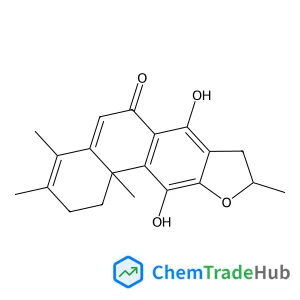
![Ethyl 2-[(3-bromo-4-pyridinyl)sulfanyl]-2-methylpropanoate structure](https://cnstatic.chemtradehub.com/structs/135/1352794-86-5-a8aa.webp "Ethyl 2-[(3-bromo-4-pyridinyl)sulfanyl]-2-methylpropanoate structure")
推荐供应商






免责声明
本页面提供的学术期刊信息仅供参考和研究使用。我们与任何期刊出版商均无关联,也不处理投稿事宜。如有投稿相关咨询,请直接联系相关期刊出版商。
如发现页面信息有误,请发送邮件至 support@chemtradehub.com 联系我们。我们将及时核实并处理您的问题。