


Photoprotection and triplet energy transfer in higher plants: the role of electronic and nuclear fluctuations
文献信息
发布日期
2016-03-29
DOI
10.1039/C6CP01437B
影响因子
3.676
作者
Lorenzo Cupellini, Sandro Jurinovich, Ingrid G. Prandi, Stefano Caprasecca, Benedetta Mennucci
查看原文
摘要
Photosynthetic organisms employ several photoprotection strategies to avoid damage due to the excess energy in high light conditions. Among these, quenching of triplet chlorophylls by neighboring carotenoids (Cars) is fundamental in preventing the formation of singlet oxygen. Cars are able to accept the triplets from chlorophylls by triplet energy transfer (TET). We have here studied TET rates in CP29, a minor light-harvesting complex (LHC) of the Photosystem II in plants. A fully atomistic strategy combining classical molecular dynamics of the LHC in its natural environment with a hybrid time-dependent density functional theory/polarizable MM description of the TET is used. We find that the structural fluctuations of the pigment–protein complex can largely enhance the transfer rates with respect to those predicted using the crystal structure, reducing the triplet quenching times in the subnanosecond scale. These findings add a new perspective for the interpretation of the photoprotection function and its relation with structural motions of the LHC.
期刊推荐
Drug Discovery Today
Nature Medicine
New Journal of Chemistry

Chemical Communications

Current Opinion in Solid State & Materials Science

Chemistry Education Research and Practice
Current Opinion in Colloid & Interface Science
Russian Chemical Bulletin
Russian Journal of Bioorganic Chemistry
Russian Journal of General Chemistry
相关文献
Modification of polybutadiene with trifluoromethyl and clickable azide groups in one shot
Shengfei Wang, Sen Zhang, Chun Feng, Guolin Lu, Xiaoyu Huang
2021-09-16
Paper
DOI: 10.1039/D1PY01016F
Inspired by mussel adhesive protein: hydrophilic cationic copoly(2-oxazoline)s carrying catecholic side chains
Nils Lüdecke, Helmut Schlaad
2021-08-24
Paper
DOI: 10.1039/D1PY00679G
Unprecedentedly high active organocatalysts for the copolymerization of carbonyl sulfide and propylene oxide: steric hindrance effect of tertiary amines
Jiraya Kiriratnikom, Xin-Chen Yue, Jia-Liang Yang, Ying Wang, Shuo-Hong Chen, Ke-Ke Zhang, Cheng-Jian Zhang, Munir Ullah Khan
2021-08-23
Paper
DOI: 10.1039/D1PY01013A
Identifying competitive tin- or metal-free catalyst combinations to tailor polyurethane prepolymer and network properties
Priscilla Arnould, Lionel Bosco, Federico Sanz, Frédéric N. Simon, Stéphane Fouquay, Guillaume Michaud, Jean Raynaud, Vincent Monteil
2020-08-25
Paper
DOI: 10.1039/D0PY00864H
PNIPAM-immobilized gold-nanoparticles with colorimetric temperature-sensing and reusable temperature-switchable catalysis properties
Si Wu, Lei Lei, Yuzheng Xia, Susan Oliver, Xiaonong Chen, Cyrille Boyer, Zhiyong Nie, Shuxian Shi
2021-11-12
Paper
DOI: 10.1039/D1PY01180D
Porous polycaprolactone and polycarbonate poly(urethane urea)s via emulsion templating: structures, properties, cell growth‡
Katya Kapilov-Buchman, Tslil Bialystocki, Danna Niezni, Luba Perry, Shulamit Levenberg, Michael S. Silverstein
2021-11-01
Paper
DOI: 10.1039/D1PY01106E
Highly efficient UV-Vis light activated three-component photoinitiators composed of tris(trimethylsilyl)silane for polymerization of acrylates
Alicja Balcerak, Dominika Kwiatkowska, Katarzyna Iwińska, Janina Kabatc
2020-07-23
Paper
DOI: 10.1039/D0PY00763C
Amino-acid-substituted polyacetylene-based chiral core–shell microspheres: helix structure induction and application for chiral resolution and adsorption
Lijie Yin, Huimin Duan, Tao Chen, Dongming Qi, Jianping Deng
2021-09-20
Paper
DOI: 10.1039/D1PY01067K
Divergence of polycondensation by a tandem reaction based on sequential conjugate substitutions
Keito Hagiwara
2020-07-08
Communication
DOI: 10.1039/D0PY00648C
Facile synthesis of well-controlled poly(1-vinyl imidazole) by the RAFT process
Bo Fan, Jing Wan, Alasdair McKay, Zhenyuan Qu, San H. Thang
2020-07-28
Paper
DOI: 10.1039/D0PY00985G
您可能还喜欢
化合物问答
(5-氨基吡唑-3-基)乙酸(CAS号:174891-10-2)的物理化学性质是什么?
(5-氨基吡唑-3-基)乙酸是一种无色至白色固体,分子量为174.15 g/mol。它在水中具有较好的溶解性,在有机溶剂中的溶解度较低。该化合物具有较好的反应活...
174891-10-2(3-Amino-1H-pyrazol-...
化合物问答
3-氟-4,5-二氯苯胺(CAS号:35754-38-2)适用哪些法规指南?
3-氟-4,5-二氯苯胺受到多项法规指南的约束,包括但不限于GHS(全球化学品统一分类和标签制度)的危险分类标准、欧盟的REACH法规(注册、评估、授权和限制)...
35754-38-23,4-Dichloro-5-fluor...
化合物问答
什么是(R)-(+)-2,2',6,6'-四甲氧基-4,4'-联(二(3,5-二甲苯基基)膦基)-3,3'-二联吡啶(CAS号:442905-33-1)?
这是一种有机化合物,化学名为(R)-(+)-2,2',6,6'-四甲氧基-4,4'-联(二(3,5-二甲苯基基)膦基)-3,3'-二联吡啶,CAS号为44290...
442905-33-14,4'-Bis[bis(3,5-dim...
化合物问答
1-氨基-2-氰基萘(CAS号:3100-67-2)应用于哪些行业?
1-氨基-2-氰基萘在医药、聚合物、传感器和半导体等行业中有应用。在医药领域,它可用作中间体合成某些药物。在聚合物行业,它可以用于制备具有特定性能的聚合物。此外...
3100-67-21-Amino-2-naphthonit...
化合物问答
如何处理含有1-溴-4-(异丙氧基甲基)苯(CAS号:98446-84-5)的废料?
处理含1-溴-4-(异丙氧基甲基)苯的废料时,首先应确保废液收集在防渗漏的容器中,避免泄露。然后,可以考虑采用化学降解法或物理吸附法进行处理。在特定条件下,可通...
98446-84-51-Bromo-4-(isopropox...
化合物问答
6-Chloro-8-(trifluoromethyl)chroman-4-one(CAS号:1344889-75-3)的主要用途是什么?
6-氯-8-三氟甲基-2,3-二氢-4H-色喃-4-酮主要用于有机合成中的中间体,也可作为研究试剂使用。
1344889-75-36-Chloro-8-(trifluor...
化合物问答
7-乙氧基-2-萘酚(CAS号:57944-44-2)通常如何合成?
7-乙氧基-2-萘酚通常通过N-乙氧基化反应合成,首先将2-萘酚与乙醇钠在乙醇中反应生成7-乙氧基-2-萘酚钠盐,再通过酸化进一步得到7-乙氧基-2-萘酚。该合...
57944-44-27-Ethoxy-2-naphthol
化合物问答
4-(1,1-二氧硫代吗啉)丁醇(CAS号:59801-41-1)适用哪些法规指南?
该化合物需遵循一系列的法规指南,包括但不限于GHS全球统一分类和标签制度,其分类可能包括易燃液体和可能危害水生环境。在欧洲,还需遵循REACH法规,确保物质和混...
59801-41-14-(4-Hydroxybutyl)th...
化合物问答
4-甲氧基苄基叠氮甲酸酯(CAS号:25474-85-5)的物理化学性质是什么?
4-甲氧基苄基叠氮甲酸酯是一种无色液体,具有一定的挥发性。其分子量为198.16,熔点为-69°C,沸点为105°C。该化合物在水中溶解度较低,在有机溶剂如乙醇...
25474-85-54-Methoxybenzyl carb...
化合物问答
如何处理含有4-氯-2-氟嘧啶(CAS号:51422-00-5)的废料?
含有4-氯-2-氟嘧啶的废料应按照危险废物处理。首先,应收集并分类这些废料,避免与其他废物混合。然后,可以采用焚烧处理或者交由专业机构进行处置。在处理过程中,需...
51422-00-54-Chloro-2-fluoropyr...
来源期刊
Physical Chemistry Chemical Physics

CiteScore:
5.5
自引率:
10.3%
年发文量:
3036
Physical Chemistry Chemical Physics (PCCP) is an international journal co-owned by 19 physical chemistry and physics societies from around the world. This journal publishes original, cutting-edge research in physical chemistry, chemical physics and biophysical chemistry. To be suitable for publication in PCCP, articles must include significant innovation and/or insight into physical chemistry; this is the most important criterion that reviewers and Editors will judge against when evaluating submissions. The journal has a broad scope and welcomes contributions spanning experiment, theory, computation and data science. Topical coverage includes spectroscopy, dynamics, kinetics, statistical mechanics, thermodynamics, electrochemistry, catalysis, surface science, quantum mechanics, quantum computing and machine learning. Interdisciplinary research areas such as polymers and soft matter, materials, nanoscience, energy, surfaces/interfaces, and biophysical chemistry are welcomed if they demonstrate significant innovation and/or insight into physical chemistry. Joined experimental/theoretical studies are particularly appreciated when complementary and based on up-to-date approaches.
推荐化合物
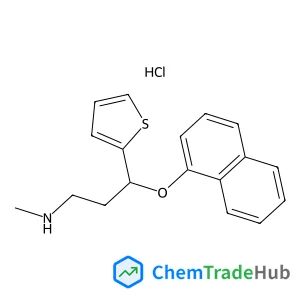
N-Methyl-3-(1-naphthyloxy)-3-(2-thienyl)-1-propanamine hydrochloride (1:1)
CAS号:
1188266-11-6
分子式:
C18H20ClNOS
推荐供应商





免责声明
本页面提供的学术期刊信息仅供参考和研究使用。我们与任何期刊出版商均无关联,也不处理投稿事宜。如有投稿相关咨询,请直接联系相关期刊出版商。
如发现页面信息有误,请发送邮件至 support@chemtradehub.com 联系我们。我们将及时核实并处理您的问题。