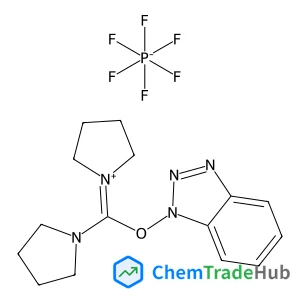
(1H-Benzotriazol-1-yloxy)(di-1-pyrrolidinyl)methylium hexafluorophosphate
CAS号:
105379-24-6
分子式:
C15H21F6N5OP
Screened electrostatic surface forces, also called double layer forces, between surfaces in ionic liquids can, depending on the circumstances, decay in an exponentially damped, oscillatory manner or in a plain exponential way (the latter as in dilute electrolyte solutions where ion–ion correlations are very weak). The occurrence of both of these behaviors in dense ionic liquids, where ion–ion correlations are very strong, is analyzed in the current work using exact statistical mechanics formulated in a manner that is physically transparent. A vital ingredient in understanding the decay behaviors is the fact that electrostatics in dense electrolytes have a non-local nature caused by the strong correlations. It is shown that the effects of non-locality can be elucidated by a remarkably simple, general expression for the decay parameter κ that replaces the classical expression for the inverse Debye length κDH of the Debye–Hückel (DH) and non-linear Poisson–Boltzmann approximations. This exact expression is valid for both the plain exponential and the oscillatory cases. It shows how strong correlations can give rise to plain exponential decay with a long decay length. Such a decay can arise from anion–cation associations of various kinds, for instance transient ion pairing or association caused by many-body correlations; ion pairing is a possibility but not a necessity for this to occur. Theoretical analysis is done for systems consisting of ions with an arbitrary shape and internal charge density and immersed planar walls with arbitrary internal charge distribution and any short-range ion–surface interaction. The screened electrostatic surface force between two walls is at large separations proportional to the product of effective surface charge densities of each wall. For the oscillatory case, each wall contributes with a phase shift to the oscillations of the interaction.

Chinese Journal of Chemistry
Critical Reviews in Solid State and Materials Sciences

Main Group Chemistry
Acta Metallurgica Sinica-English Letters
Bioorganic & Medicinal Chemistry
Journal of Chemical Sciences

Journal of Asian Natural Products Research

Heteroatom Chemistry

Polycyclic Aromatic Compounds

Topics in Catalysis
Amitaksha Saha, Chellappan Vijila, Rajan Jose, Zhang Jie, Seeram Ramakrishna
DOI: 10.1039/C3CP50994J
Dong Jun Kim, Sang Jin Kim, Dong Kyu Roh, Jong Hak Kim
DOI: 10.1039/C3CP44308F
Bin Wang, Thomas J. Richardson, Guoying Chen
DOI: 10.1039/C3CP50992C
Luis Gómez-Hortigüela, Furio Corà, C. Richard A. Catlow
DOI: 10.1039/C3CP51079D
Shinji Aono, Takashi Hosoya, Shigeyoshi Sakaki
DOI: 10.1039/C3CP43892A
Dong Myung Jang, Hyung Soon Im, Yoon Myung, Yong Jae Cho, Han Sung Kim, Seung Hyuk Back, Jeunghee Park, Eun Hee Cha, Minyung Lee
DOI: 10.1039/C3CP50769F
Nina O. C. Winter, Nora K. Graf, Samuel Leutwyler, Christof Hättig
DOI: 10.1039/C2CP42694C
Andrew P. Ault, Defeng Zhao, Carlena J. Ebben, Michael J. Tauber, Franz M. Geiger, Vicki H. Grassian
DOI: 10.1039/C3CP43899F
Stephanie J. Harris, Daniel Murdock, Yuyuan Zhang, Thomas A. A. Oliver, Michael P. Grubb, Andrew J. Orr-Ewing, Gregory M. Greetham, Ian P. Clark, Michael Towrie, Stephen E. Bradforth, Michael N. R. Ashfold
DOI: 10.1039/C3CP50756D
M. Sadeghi
DOI: 10.1039/C3CP44563A
6-氯-2H-1,4-苯并噁嗪-3(4H)-酮主要应用于医药、农药和聚合物等领域。在医药领域,该化合物可用于合成抗菌药物;在农药领域,可用作杀虫剂的中间体;在聚...
活性氧化铝广泛应用于医药、聚合物、传感器、半导体和催化等领域。在医药行业,活性氧化铝用作吸附剂和干燥剂,有助于去除杂质和水分。在聚合物行业,它用作增白剂和抗结块...
硅胶(Silica gel, pptd.,cryst.-free)是一种无定形、多孔的硅酸盐材料,主要成分为二氧化硅(SiO₂)。其结构由硅氧四面体构成,通过酸...
二乙基甲基一氢硅烷主要用于有机合成、表面处理以及作为溶剂。它还被用作合成其他硅烷化合物的原料,以及在涂料、粘合剂和密封剂中的应用。
在合成过程中,可以考虑使用类似结构的化合物作为替代品,例如N-亚油酰基甘氨酸或N-花生二烯酰基甘氨酸。这些替代品在结构上有类似的双键位置,但可能具有不同的物理化...
在合成过程中,可以考虑使用类似结构的化合物作为替代品,例如1-(3-甲氧基苯基)丙烷-1,2-二酮或1-(4-羟基苯基)丙烷-1,2-二酮。这些替代品具有相似的...
该化合物通常通过一系列复杂的有机合成步骤获得。首先,通过芳香族化合物的羟基化反应获得羟基化产物,然后通过酰化反应形成酰胺中间体,最后通过环化反应得到目标产物。常...
该化合物作为生物活性化合物,尤其是在药物化学领域表现出色。近年来,随着对新型抗炎、抗病毒和抗癌药物的研究增加,其市场和研究趋势持续增长。此外,其在神经科学领域的...
核黄素磷酸钠在常规使用条件下安全,但高剂量可能引起刺激性反应。操作时需佩戴防护手套和护目镜,避免吸入粉尘。若接触皮肤或眼睛,应立即用大量清水冲洗。急救时需根据接...
盐酸丙胺卡因杂质A(EP) 标准品可通过重氮化反应和随后的酰胺化反应合成。首先,利用氯化反应将苯环上的氢原子转化为氯原子,然后通过芳香族重氮化反应引入氨基,最后...

Physical Chemistry Chemical Physics (PCCP) is an international journal co-owned by 19 physical chemistry and physics societies from around the world. This journal publishes original, cutting-edge research in physical chemistry, chemical physics and biophysical chemistry. To be suitable for publication in PCCP, articles must include significant innovation and/or insight into physical chemistry; this is the most important criterion that reviewers and Editors will judge against when evaluating submissions. The journal has a broad scope and welcomes contributions spanning experiment, theory, computation and data science. Topical coverage includes spectroscopy, dynamics, kinetics, statistical mechanics, thermodynamics, electrochemistry, catalysis, surface science, quantum mechanics, quantum computing and machine learning. Interdisciplinary research areas such as polymers and soft matter, materials, nanoscience, energy, surfaces/interfaces, and biophysical chemistry are welcomed if they demonstrate significant innovation and/or insight into physical chemistry. Joined experimental/theoretical studies are particularly appreciated when complementary and based on up-to-date approaches.