





![{3-[Bis(4-hydroxyphenyl)methyl]-1-[2-(dimethylamino)ethyl]-1H-indol-2-yl}[4-(2-chlorophenyl)-1-piperazinyl]methanone structure](https://cnstatic.chemtradehub.com/structs/170/170365-25-0-e4d7.webp "{3-[Bis(4-hydroxyphenyl)methyl]-1-[2-(dimethylamino)ethyl]-1H-indol-2-yl}[4-(2-chlorophenyl)-1-piperazinyl]methanone structure")
Charge-transfer and isomerization reactions of trans-4-(N-arylamino)stilbenes
文献信息
发布日期
2016-09-21
DOI
10.1039/C6CP05514A
影响因子
3.676
作者
Hsuan-Hsiao Yao, Hsu-Hsiang Cheng, Chao-Han Cheng, Cheng-Kai Lin, Jye-Shane Yang, I-Chia Chen
查看原文
摘要
We studied the excited-state dynamics of trans-4-(N-arylamino)stilbenes with aryl = phenyl (p1H), 4-methoxyphenyl (p1OM), or 4-cyanophenyl (p1CN) in solvents of varied polarity and viscosity by using femtosecond transient absorption and time-correlated single photon counting techniques. In nonpolar solvents the decay is triexponential, in which the rapid component corresponds to vibrational cooling combined with solvation, the intermediate temporal component 41–120 ps to trans–cis isomerization, and the long one ∼1 ns to fluorescence decay of the S1 state. The S1 state has a delocalized geometry and charge-transfer characteristics, corresponding to a planar intramolecular charge transfer (PICT) state. In polar solvents, an excited-state absorption band appears near 520 and 480 nm for p1OM and p1CN, respectively but not for p1H. This band has a rise lifetime of 4.3/7.5, 16.3/9.4, and 29.5/16 ps for p1CN/p1OM in acetonitrile (ACN), dimethylformamide (DMF), and dimethyl sulfoxide (DMSO), respectively and matches the decay of the 600 nm PICT band. This band is thus assigned to the absorption of a singlet twisted intramolecular charge transfer state (TICT). The conversion rate decreases as the solvent viscosity is increased and is consistent with a large structural variation amplitude. Theoretical calculations using density functional theory (DFT), method PEB0, were employed to obtain the optimized structures and energies of those states. The PICT state possesses delocalized π electrons along the molecule. The TICT for p1CN is formed by twisting about the aminostilbene–benzonitrile C–N bond by ∼90°, but it is about the stilbene–aniline C–N bond for p1OM. We observed faster conversion rates for p1CN in alcoholic solvents, in which the lifetimes for both the PICT and TICT states are shortened to 20–99 ps and 120–660 ps, respectively, as a result of solvent–solute H-bonding interactions. In p1OM, the TICT state has an elongated CC bond in the stilbene moiety, which might facilitate the trans–cis isomerization reaction and thus account for the relatively short lifetime of 58–420 ps in polar solvents.
相关文献
Small-angle neutron scattering study of micropore collapse in amorphous solid water
Christian Mitterdorfer, Marion Bauer, Tristan G. A. Youngs, Daniel T. Bowron, Catherine R. Hill, Helen J. Fraser, John L. Finney, Thomas Loerting
2014-06-17
Paper
DOI: 10.1039/C4CP00593G
High response and selectivity of a Cu–ZnO nanowire nanogenerator as a self-powered/active H2S sensor
Yongming Fu, Yayu Zhao, Penglei Wang, Lili Xing, Xinyu Xue
2014-11-28
Paper
DOI: 10.1039/C4CP04983G
Constraints to the flat band potential of hematite photo-electrodes
A. Hankin, J. C. Alexander, G. H. Kelsall
2014-06-26
Paper
DOI: 10.1039/C4CP00096J
Steric self-assembly of laterally confined organic semiconductor molecule analogues
Björn Arnold, Matt Bumstead, Ayse Turak
2014-08-07
Paper
DOI: 10.1039/C4CP02331E
Flexible and stretchable thin-film transistors based on molybdenum disulphide
Jiang Pu, Lain-Jong Li
2014-02-27
Perspective
DOI: 10.1039/C3CP55270E
Towards bulk thermodynamics via non-equilibrium methods: gaseous methane as a case study
Mirco Zerbetto, Diego Frezzato
2014-12-05
Paper
DOI: 10.1039/C4CP03815K
Highly monodisperse multiple twinned AuCu–Pt trimetallic nanoparticles with high index surfaces
Subarna Khanal, Nabraj Bhattarai, David McMaster, Daniel Bahena, J. Jesus Velazquez-Salazar, Miguel Jose-Yacaman
2014-06-24
Paper
DOI: 10.1039/C4CP02208D
Hydrogen bond dynamics of superheated water and methanol by ultrafast IR-pump and EUV-photoelectron probe spectroscopy
E. Vöhringer-Martinez, O. Link, K. R. Siefermann, F. Wiederschein, H. Grubmüller
2014-07-17
Paper
DOI: 10.1039/C4CP02063D
Theoretical studies on the effect of a bithiophene bridge with different substituent groups (R = H, CH3, OCH3 and CN) in donor–π–acceptor copolymers for organic solar cell applications
Zhiyong Fu, Wei Shen, Rongxing He, Xiaorui Liu, Huili Sun, Wanqiang Yin, Ming Li
2014-11-26
Paper
DOI: 10.1039/C4CP04103H
您可能还喜欢
化合物问答
什么是3-表南美楝属二醇(CAS号:19942-04-2)?
3-表南美楝属二醇是一种具有特定立体化学结构的化合物,其分子式为C31H52O2,属于甾醇类化合物。它具有光学活性,是一种复杂的有机分子,主要存在于一些植物中。
19942-04-2(3S,5R,8R,9R,10R,13R...
化合物问答
3-羧基-5-碘苯甲酸甲酯(CAS号:50765-22-5)应用于哪些行业?
3-羧基-5-碘苯甲酸甲酯主要应用于医药行业,作为合成某些药物中间体的重要原料。此外,它还可能用于聚合物的改性、传感器的制备以及半导体材料的制备等领域。
50765-22-5Methyl 3-hydroxy-5-i...
化合物问答
什么是3-Bromoindolin-2-one(CAS号:22942-87-6)?
3-Bromoindolin-2-one是一种含有溴代基团的吲哚酮衍生物,分子式为C9H7BrNO。它是一种无色固体,具有一定的挥发性,熔点为158-159°C...
22942-87-63-Bromoindolin-2-one
化合物问答
如何处理含有L-Lysyl-L-phenylalanyl-L-isoleucylglycyl-L-leucyl-L-methioninamide(CAS号:2990-43-4)的废料?
对于含有该化合物的废液,应先进行中和处理,然后根据其毒性和活性选择合适的处置方法。可以考虑焚烧处理或由专业的化学品废物处理公司进行无害化处理。处理过程中需注意环...
2990-43-4L-Lysyl-L-phenylalan...
化合物问答
ANGIOTENSIN 1/2 + A (2 - 8)(CAS号:51833-76-2)的物理化学性质是什么?
ANGIOTENSIN 1/2 + A (2 - 8)是一种蛋白质类化合物,具有典型的蛋白质性质。它的分子量约为5900 Da。该化合物在水中具有一定的溶解性,...
51833-76-2ANGIOTENSIN 1/2 + A ...
化合物问答
如何储存2-甲基硫代嘧啶-5-硼酸频那酯(CAS号:940284-18-4)?
应将该化合物存放在阴凉干燥、通风良好的地方,避免阳光直射。建议将化合物密封保存在避光的、干燥的容器中,远离火源和高温环境。
940284-18-42-(Methylthio)-5-(4,...
化合物问答
什么是苏丹红IV氘代物 标准品(CAS号:1014689-18-9)?
苏丹红IV氘代物 标准品是一种含有氘代标记的苏丹红IV化合物,是一种用于化合物分析、结构确证以及代谢研究的标准物质。
1014689-18-91-[(E)-{2-Methyl-4-[...
化合物问答
(+)-2-Amino-6-propionamido-d3-tetrahydrobenzothiazole(CAS号:1217680-69-7)适用哪些法规指南?
该化合物需要遵循《全球化学品统一分类和标签制度》(GHS)中的分类和标签要求,具体分类需依据其毒性和物理化学性质。此外,还需要符合《欧盟化学品注册、评估、授权和...
1217680-69-7(+)-2-Amino-6-propio...
化合物问答
如何储存2-氨基-2-(2-吡啶)乙酸乙酯(CAS号:55243-15-7)?
2-氨基-2-(2-吡啶)乙酸乙酯应储存于阴凉、干燥、通风良好的环境中,避免高温和光照。应使用密封容器储存,并远离易燃物、氧化剂和其他危险化学品。
55243-15-7Ethyl 2-amino-2-(pyr...
化合物问答
3-羟基-4-甲氧基吡啶-2-羧酸(CAS号:210300-09-7)的主要用途是什么?
3-羟基-4-甲氧基吡啶-2-羧酸主要用于合成其他有机化合物,如药物合成、农药合成和染料合成等。此外,它还可用作中间体和试剂,在化学研究领域也有一定的应用。
210300-09-73-Hydroxy-4-methoxy-...
来源期刊
Physical Chemistry Chemical Physics

CiteScore:
5.5
自引率:
10.3%
年发文量:
3036
Physical Chemistry Chemical Physics (PCCP) is an international journal co-owned by 19 physical chemistry and physics societies from around the world. This journal publishes original, cutting-edge research in physical chemistry, chemical physics and biophysical chemistry. To be suitable for publication in PCCP, articles must include significant innovation and/or insight into physical chemistry; this is the most important criterion that reviewers and Editors will judge against when evaluating submissions. The journal has a broad scope and welcomes contributions spanning experiment, theory, computation and data science. Topical coverage includes spectroscopy, dynamics, kinetics, statistical mechanics, thermodynamics, electrochemistry, catalysis, surface science, quantum mechanics, quantum computing and machine learning. Interdisciplinary research areas such as polymers and soft matter, materials, nanoscience, energy, surfaces/interfaces, and biophysical chemistry are welcomed if they demonstrate significant innovation and/or insight into physical chemistry. Joined experimental/theoretical studies are particularly appreciated when complementary and based on up-to-date approaches.
推荐化合物
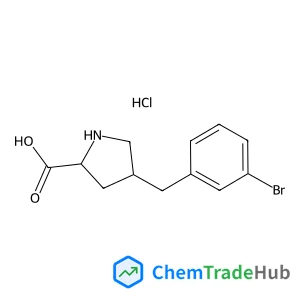
(2S,4R)-4-(3-Bromobenzyl)pyrrolidine-2-carboxylic acid hydrochloride
CAS号:
1049734-10-2
分子式:
C12H15BrClNO2
推荐供应商




免责声明
本页面提供的学术期刊信息仅供参考和研究使用。我们与任何期刊出版商均无关联,也不处理投稿事宜。如有投稿相关咨询,请直接联系相关期刊出版商。
如发现页面信息有误,请发送邮件至 support@chemtradehub.com 联系我们。我们将及时核实并处理您的问题。