



Electrochemically mediated atom transfer radical polymerization of n-butyl acrylate on non-platinum cathodes
文献信息
发布日期
2016-07-15
DOI
10.1039/C6PY01032F
影响因子
5.582
作者
Francesca Lorandi, Abdirisak A. Isse, Armando Gennaro
查看原文
摘要
Traditionally, electrochemically mediated atom transfer radical polymerization (eATRP) is performed with Pt electrodes, but extensive use of such an expensive, rare, and non-functionalizable metal may pose some limitations to the method, owing mainly to the high cost of the experimental setup and the limited natural resources of platinum. As a further development of eATRP, polymerization of n-butyl acrylate in dimethylformamide was investigated employing different cathodic materials: glassy carbon, gold, iron, nickel–chromium, and stainless steel. With all these electrodes, eATRP was fast (conversion >85% in 2 h) and well-controlled (dispersity <1.2) under a wide range of experimental setups. To show the robustness of eATRP with inexpensive non-noble electrodes (i) the catalyst loading was reduced to less than 75 ppm, (ii) the same cathode was reused several times without reactivation, and (iii) undivided cells with all non-platinum electrodes were used. Lastly, all electrodes were stable and did not significantly release metal ions in solution, merely acting as an electron sink for the reduction of the catalyst.
相关文献
A library of heptyl mannose-functionalized copolymers with distinct compositions, microstructures and neighboring non-sugar motifs as potent antiadhesives of type 1 piliated E. coli
Sébastien G. Gouin, Julie Bouckaert
2016-03-16
Paper
DOI: 10.1039/C6PY00118A
Colored single-chain polymeric nanoparticles via intramolecular copper phthalocyanine formation
Jonghwa Jeong, Yun-Jung Lee, Bohyun Kim, Byoungjae Kim, Ki-Suck Jung, Hyun-jong Paik
2015-02-19
Paper
DOI: 10.1039/C4PY01559B
The leading role of cation–π interactions in polymer chemistry: the control of the helical sense in solution
Sandra Arias, Félix Freire, Emilio Quiñoá, Ricardo Riguera
2015-04-27
Paper
DOI: 10.1039/C5PY00587F
Highly alkynyl-functionalization of cellulose nanocrystals and advanced nanocomposites thereof via click chemistry
Jun Chen, Jin Huang
2015-05-05
Paper
DOI: 10.1039/C5PY00367A
Photocontrollable induction of supramolecular chirality in achiral side chain Azo-containing polymers through preferential chiral solvation‡
Shunqin Jiang, Yin Zhao, Laibing Wang, Lu Yin, Zhengbiao Zhang, Jian Zhu, Wei Zhang, Xiulin Zhu
2015-04-23
Paper
DOI: 10.1039/C5PY00496A
Dextrin and poly(lactide)-based biocompatible and biodegradable nanogel for cancer targeted delivery of doxorubicin hydrochloride
Dipankar Das, Priyapratim Patra, Paulomi Ghosh, Arun Prabhu Rameshbabu, Santanu Dhara, Sagar Pal
2016-03-24
Paper
DOI: 10.1039/C6PY00213G
Modification of block copolymer vesicles: what will happen when AB diblock copolymer is block-extended to an ABC triblock terpolymer?
Xiaoyan Shen, Fei Huo, Haijiao Kang, Shifeng Zhang, Jianzhang Li, Wangqing Zhang
2015-03-17
Paper
DOI: 10.1039/C5PY00208G
Copolymerization of propylene with Si-containing α,ω-diolefins: how steric hindrance of diolefins affects long chain branch formation
Bin Wang, Yi-Ming Zhang, Zhe Ma, Li Pan, Shi-Jun Yu
2016-03-24
Paper
DOI: 10.1039/C6PY00333H
您可能还喜欢
化合物问答
如何储存1,2-环己二酮环乙缩醛(CAS号:4746-96-7)?
1,2-环己二酮环乙缩醛应储存在阴凉、干燥、通风良好的地方,避免阳光直射。建议使用密封容器保存,并保持环境温度在室温范围内,远离火源和热源。
4746-96-71,4-Dioxaspiro[4.5]d...
化合物问答
Ecopladib(CAS号:381683-92-7)的市场或研究趋势如何?
Ecopladib作为一种新型的药物,主要应用于治疗高胆固醇等疾病。目前,市场和研究趋势显示,Ecopladib因其独特的药理作用而受到关注。随着对心血管疾病治...
381683-92-7Ecopladib
化合物问答
2,3-Dimethyl-3H-imidazo[4,5-c]pyridine(CAS号:52538-09-7)通常如何合成?
2,3-二甲基-3H-咪唑[4,5-c]吡啶通常通过咪唑和2,3-二甲基吡啶的缩合反应合成。具体来说,将咪唑和2,3-二甲基吡啶在适当的溶剂中进行加热或加压反应...
52538-09-72,3-Dimethyl-3H-imid...
化合物问答
2,3,4,5-tetrahydro-1H-3-苯并氮杂环;盐酸盐(CAS号:17379-01-0)的市场或研究趋势如何?
该化合物在药物化学和有机合成中有一定的应用。近年来,随着对新型药物化合物的需求增加,该化合物的研究趋势主要集中在探索其生物活性,尤其是其在神经系统疾病治疗中的潜...
17379-01-02,3,4,5-Tetrahydro-1...
68-90-6(2-Ethyl-1-benzofura...
化合物问答
如何储存盐酸甘氨酸丁酯(CAS号:13048-99-2)?
盐酸甘氨酸丁酯应储存在阴凉、干燥、通风良好的地方,避免阳光直射和高温环境,温度应控制在25℃以下。储存容器应密封,避免与空气中的水分和酸性物质接触,以防发生水解...
13048-99-2Butyl glycinate hydr...
化合物问答
什么是2-Iodo-N,N-dimethylbenzamide(CAS号:54616-46-5)?
2-碘-N,N-二甲基苯胺是一种有机化合物,化学名为2-Iodo-N,N-dimethylbenzamide。其分子式为C<sub>9</sub>H<sub>1...
54616-46-52-Iodo-N,N-dimethylb...
16817-90-6N-Cyclohexylglycinam...
化合物问答
5-溴-2-(4H-1,2,4-三唑-4-基)吡啶(CAS号:959240-99-4)的市场或研究趋势如何?
随着医药、农药和新材料领域的发展,该化合物作为关键中间体的应用日益增多。特别是在药物合成中,由于其独特的化学性质,可以用于合成多种药物分子。未来的研究趋势可能集...
959240-99-45-Bromo-2-(4H-1,2,4-...
化合物问答
2,4-二溴-6-三氟甲基嘧啶(CAS号:785778-00-9)通常如何合成?
2,4-二溴-6-三氟甲基嘧啶通常通过溴化反应合成。首先,将6-三氟甲基嘧啶与溴化剂(如液溴)在适当的溶剂(如二氯甲烷、四氢呋喃)中反应,加入适当的催化剂(如四...
785778-00-92,4-Dibromo-6-(trifl...
来源期刊
Polymer Chemistry

CiteScore:
8.6
自引率:
7.3%
年发文量:
457
Polymer Chemistry welcomes submissions in all areas of polymer science that have a strong focus on macromolecular chemistry. Manuscripts may cover a broad range of fields, yet no direct application focus is required.
推荐化合物
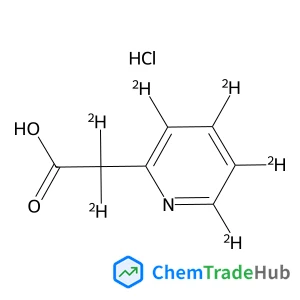
2,2-dideuterio-2-(3,4,5,6-tetradeuterio-2-pyridyl)acetic acid;hydrochloride
CAS号:
1329799-67-8
分子式:
C7H2ClD6NO2
![1-[(4-Methylphenyl)sulfonyl]-3-(4,4,5,5-tetramethyl-1,3,2-dioxaborolan-2-yl)-1H-pyrrolo[2,3-b]pyridine-5-carbonitrile structure](https://cnstatic.chemtradehub.com/structs/143/1434747-57-5-fc0d.webp "1-[(4-Methylphenyl)sulfonyl]-3-(4,4,5,5-tetramethyl-1,3,2-dioxaborolan-2-yl)-1H-pyrrolo[2,3-b]pyridine-5-carbonitrile structure")
推荐供应商



免责声明
本页面提供的学术期刊信息仅供参考和研究使用。我们与任何期刊出版商均无关联,也不处理投稿事宜。如有投稿相关咨询,请直接联系相关期刊出版商。
如发现页面信息有误,请发送邮件至 support@chemtradehub.com 联系我们。我们将及时核实并处理您的问题。