







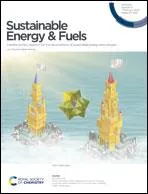
Improving the activity of CoxP nanoparticles for the electrochemical hydrogen evolution by hydrogenation
文献信息
发布日期
2017-01-05
DOI
10.1039/C6SE00058D
影响因子
6.367
作者
James Murowchick, Xiaobo Chen
查看原文
摘要
Hydrogenation has recently been demonstrated on various oxide nanomaterials to enhance their optical and electrochemical properties. Here, we demonstrate that the activity of cobalt phosphide nanoparticles in the electrochemical hydrogen evolution reaction (HER) can be improved by hydrogenation. The hydrogenation apparently introduces nanoscale disordering near the surface of the crystalline nanoparticles without introducing any bulk phase change. The enhanced activity is due to the reduced hydrogen adsorption resistance and the enhanced electrochemically active surface area after hydrogenation, likely from the formation of the crystalline/disordered structure.
相关文献
Lithium doped tubular structure in LiB20 and LiB20−: a viable global minimum
Wei-yan Liang, Anita Das, Xue Dong, Zhong-hua Cui
2018-05-23
Paper
DOI: 10.1039/C8CP01376D
Enhanced fluorescence of phthalimide compounds induced by the incorporation of electron-donating alicyclic amino groups
Ryoji Orita, Marius Franckevičius, Aurimas Vyšniauskas, Vidmantas Gulbinas, Haruki Sugiyama, Hidehiro Uekusa, Kenta Kanosue, Ryohei Ishige, Shinji Ando
2018-05-14
Paper
DOI: 10.1039/C8CP01999A
Theoretical study on photophysical properties of three high water solubility polypyridyl complexes for two-photon photodynamic therapy
Ying-Tao Liu, Xue Yin, Xiao-Yong Lai, Xin Wang
2018-06-18
Paper
DOI: 10.1039/C8CP01069B
Electrical property and Schottky behavior of a flexible Schiff-base compound: X-ray structure and stabilization of 1D water chain
Basudeb Dutta, Joydeep Datta, Suvendu Maity, Chittaranjan Sinha, Di Sun, Partha Pratim Ray, Mohammad Hedayetullah Mir
2018-09-03
Paper
DOI: 10.1039/C8CP04569K
Supramolecular multicompartment gels formed by ABC graft copolymers: high toughness and recovery properties
Pengxiang Xu, Jiaping Lin, Liangshun Zhang
2018-05-08
Paper
DOI: 10.1039/C8CP02062K
Reply to the ‘Comment on “Spectroscopic properties and location of the Ce3+ energy levels in Y3Al2Ga3O12 and Y3Ga5O12 at ambient and high hydrostatic pressure”’ by Y. Wang, M. Głowacki, M. Berkowski, A. Kamińska and A. Suchocki, Phys. Chem. Chem. Phys., 2019, 21, DOI: 10.1039/C8CP06154H
Sebastian Mahlik, Agata Lazarowska, Jumpei Ueda, Setsuhisa Tanabe, Marek Grinberg
2019-01-21
Comment
DOI: 10.1039/C8CP07122E
Tuning the photoreactivity of Z-hexatriene photoswitches by substituents – a non-adiabatic molecular dynamics study
Enrico Tapavicza, Travis Thompson, Kenneth Redd, Dan Kim
2018-09-13
Paper
DOI: 10.1039/C8CP05181J
Model – free approach to quadrupole spin relaxation in solid 209Bi-aryl compounds
Danuta Kruk, Christian Goesweiner, Elzbieta Masiewicz, Evrim Umut, Carina Sampl, Hermann Scharfetter
2018-09-04
Paper
DOI: 10.1039/C8CP03848A
Screening heteroatom distributions in zeotype materials using an effective Hamiltonian approach: the case of aluminogermanate PKU-9
Ricardo Grau-Crespo, Dewi W. Lewis, A. Rabdel Ruiz-Salvador
2018-06-06
Paper
DOI: 10.1039/C8CP01369A
Most favorable cumulenic structures in iron-capped linear carbon chains are short singlet odd-carbon dications: a theoretical view
Liang Pu, Zhong Zhang, R. Bruce King, Wesley D. Allen
2018-05-21
Paper
DOI: 10.1039/C7CP08673C
您可能还喜欢
化合物问答
什么是3-表南美楝属二醇(CAS号:19942-04-2)?
3-表南美楝属二醇是一种具有特定立体化学结构的化合物,其分子式为C31H52O2,属于甾醇类化合物。它具有光学活性,是一种复杂的有机分子,主要存在于一些植物中。
19942-04-2(3S,5R,8R,9R,10R,13R...
化合物问答
3-羧基-5-碘苯甲酸甲酯(CAS号:50765-22-5)应用于哪些行业?
3-羧基-5-碘苯甲酸甲酯主要应用于医药行业,作为合成某些药物中间体的重要原料。此外,它还可能用于聚合物的改性、传感器的制备以及半导体材料的制备等领域。
50765-22-5Methyl 3-hydroxy-5-i...
化合物问答
什么是3-Bromoindolin-2-one(CAS号:22942-87-6)?
3-Bromoindolin-2-one是一种含有溴代基团的吲哚酮衍生物,分子式为C9H7BrNO。它是一种无色固体,具有一定的挥发性,熔点为158-159°C...
22942-87-63-Bromoindolin-2-one
化合物问答
如何处理含有L-Lysyl-L-phenylalanyl-L-isoleucylglycyl-L-leucyl-L-methioninamide(CAS号:2990-43-4)的废料?
对于含有该化合物的废液,应先进行中和处理,然后根据其毒性和活性选择合适的处置方法。可以考虑焚烧处理或由专业的化学品废物处理公司进行无害化处理。处理过程中需注意环...
2990-43-4L-Lysyl-L-phenylalan...
化合物问答
ANGIOTENSIN 1/2 + A (2 - 8)(CAS号:51833-76-2)的物理化学性质是什么?
ANGIOTENSIN 1/2 + A (2 - 8)是一种蛋白质类化合物,具有典型的蛋白质性质。它的分子量约为5900 Da。该化合物在水中具有一定的溶解性,...
51833-76-2ANGIOTENSIN 1/2 + A ...
化合物问答
如何储存2-甲基硫代嘧啶-5-硼酸频那酯(CAS号:940284-18-4)?
应将该化合物存放在阴凉干燥、通风良好的地方,避免阳光直射。建议将化合物密封保存在避光的、干燥的容器中,远离火源和高温环境。
940284-18-42-(Methylthio)-5-(4,...
化合物问答
什么是苏丹红IV氘代物 标准品(CAS号:1014689-18-9)?
苏丹红IV氘代物 标准品是一种含有氘代标记的苏丹红IV化合物,是一种用于化合物分析、结构确证以及代谢研究的标准物质。
1014689-18-91-[(E)-{2-Methyl-4-[...
化合物问答
(+)-2-Amino-6-propionamido-d3-tetrahydrobenzothiazole(CAS号:1217680-69-7)适用哪些法规指南?
该化合物需要遵循《全球化学品统一分类和标签制度》(GHS)中的分类和标签要求,具体分类需依据其毒性和物理化学性质。此外,还需要符合《欧盟化学品注册、评估、授权和...
1217680-69-7(+)-2-Amino-6-propio...
化合物问答
如何储存2-氨基-2-(2-吡啶)乙酸乙酯(CAS号:55243-15-7)?
2-氨基-2-(2-吡啶)乙酸乙酯应储存于阴凉、干燥、通风良好的环境中,避免高温和光照。应使用密封容器储存,并远离易燃物、氧化剂和其他危险化学品。
55243-15-7Ethyl 2-amino-2-(pyr...
化合物问答
3-羟基-4-甲氧基吡啶-2-羧酸(CAS号:210300-09-7)的主要用途是什么?
3-羟基-4-甲氧基吡啶-2-羧酸主要用于合成其他有机化合物,如药物合成、农药合成和染料合成等。此外,它还可用作中间体和试剂,在化学研究领域也有一定的应用。
210300-09-73-Hydroxy-4-methoxy-...
来源期刊
推荐化合物
![2-(5-Bromo-1H-pyrrolo[2,3-B]pyridin-3-YL)acetic acid structure](https://cnstatic.chemtradehub.com/structs/106/1060795-03-0-0589.webp "2-(5-Bromo-1H-pyrrolo[2,3-B]pyridin-3-YL)acetic acid structure")
![2-Methyl-2-propanyl 4-oxo-3,9-diazabicyclo[4.2.1]nonane-9-carboxylate structure](https://cnstatic.chemtradehub.com/structs/131/1312456-05-5-9a15.webp "2-Methyl-2-propanyl 4-oxo-3,9-diazabicyclo[4.2.1]nonane-9-carboxylate structure")
2-Methyl-2-propanyl 4-oxo-3,9-diazabicyclo[4.2.1]nonane-9-carboxylate
CAS号:
1312456-05-5
分子式:
C12H20N2O3
推荐供应商





免责声明
本页面提供的学术期刊信息仅供参考和研究使用。我们与任何期刊出版商均无关联,也不处理投稿事宜。如有投稿相关咨询,请直接联系相关期刊出版商。
如发现页面信息有误,请发送邮件至 support@chemtradehub.com 联系我们。我们将及时核实并处理您的问题。