







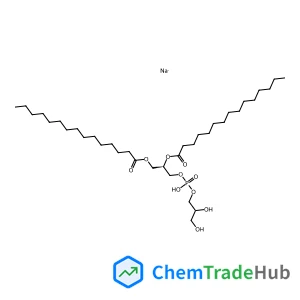
1,2-dipentadecanoyl-sn-glycero-3-phospho-(1'-rac-glycerol) (sodiuM salt)
CAS号:
322647-32-5
分子式:
C36H71NaO10P
Jun Dai, Liang Ma, Minggang Ju, Jinsong Huang
Double perovskites in the form of A2B′B′′X6 (A = Cs, B′ = Ag, B′′ = Bi) have been reported as potential alternatives to lead-containing organometal trihalide perovskites. However, all double perovskites synthesized to date exhibit indirect bandgaps >1.95 eV, which are undesirable for photovoltaic and optoelectronic applications. Herein, we report a comprehensive computer-aided screening of In- and Ga-based double perovskites for potential photovoltaic applications. To this end, several preconditions are implemented for the screening of optimal candidates, which include structural stability, electronic bandgaps, and optical absorption. Importantly, four In- and Ga-based double perovskites are identified to possess direct bandgaps within the desirable range of 0.9–1.6 eV for photovoltaic applications. Dominant optical absorption of the four double perovskites is found to be in the UV range. The structural and thermal stability of the four double perovskites are examined using both the empirical Goldschmidt ratio and convex-hull calculations. Only Cs2AgInBr6 is predicted to be thermodynamically stable.
DOI: 10.1039/C5PY01937K
So Young Lee, Sukjae Hong, Jong Hyun Jang, Dirk Henkensmeier, Sung Jong Yoo, Hyoung-Juhn Kim, Sung-Hyun Kim
DOI: 10.1039/C4PY01218F
Marianne S. Rolph, Anaïs Pitto-Barry, Rachel K. O'Reilly
DOI: 10.1039/C7PY00219J
Weihong Lu, Xiangqiang Pan, Zhengbiao Zhang, Jian Zhu, Nianchen Zhou, Xiulin Zhu
DOI: 10.1039/C7PY00719A
Benoit Louage, Liesa Tack, Yadong Wang, Bruno G. De Geest
DOI: 10.1039/C6PY02192A
Peng-Yun Li, Jia-Min Li, Lian-Wei Li, Xiao-Dong Ye, Wei-Dong He
DOI: 10.1039/C7PY00551B
Renquan Gu, Xiaoyu Ma, Yuming Zhao
DOI: 10.1039/C6PY01095D
Xiujuan Shi, Yuecheng Cui, Weikang Yang, Lin Yuan, Hong Chen
DOI: 10.1039/C6PY00882H
1,2-环己二酮环乙缩醛应储存在阴凉、干燥、通风良好的地方,避免阳光直射。建议使用密封容器保存,并保持环境温度在室温范围内,远离火源和热源。
Ecopladib作为一种新型的药物,主要应用于治疗高胆固醇等疾病。目前,市场和研究趋势显示,Ecopladib因其独特的药理作用而受到关注。随着对心血管疾病治...
2,3-二甲基-3H-咪唑[4,5-c]吡啶通常通过咪唑和2,3-二甲基吡啶的缩合反应合成。具体来说,将咪唑和2,3-二甲基吡啶在适当的溶剂中进行加热或加压反应...
该化合物在药物化学和有机合成中有一定的应用。近年来,随着对新型药物化合物的需求增加,该化合物的研究趋势主要集中在探索其生物活性,尤其是其在神经系统疾病治疗中的潜...
盐酸甘氨酸丁酯应储存在阴凉、干燥、通风良好的地方,避免阳光直射和高温环境,温度应控制在25℃以下。储存容器应密封,避免与空气中的水分和酸性物质接触,以防发生水解...
2-碘-N,N-二甲基苯胺是一种有机化合物,化学名为2-Iodo-N,N-dimethylbenzamide。其分子式为C<sub>9</sub>H<sub>1...
随着医药、农药和新材料领域的发展,该化合物作为关键中间体的应用日益增多。特别是在药物合成中,由于其独特的化学性质,可以用于合成多种药物分子。未来的研究趋势可能集...
2,4-二溴-6-三氟甲基嘧啶通常通过溴化反应合成。首先,将6-三氟甲基嘧啶与溴化剂(如液溴)在适当的溶剂(如二氯甲烷、四氢呋喃)中反应,加入适当的催化剂(如四...

Physical Chemistry Chemical Physics (PCCP) is an international journal co-owned by 19 physical chemistry and physics societies from around the world. This journal publishes original, cutting-edge research in physical chemistry, chemical physics and biophysical chemistry. To be suitable for publication in PCCP, articles must include significant innovation and/or insight into physical chemistry; this is the most important criterion that reviewers and Editors will judge against when evaluating submissions. The journal has a broad scope and welcomes contributions spanning experiment, theory, computation and data science. Topical coverage includes spectroscopy, dynamics, kinetics, statistical mechanics, thermodynamics, electrochemistry, catalysis, surface science, quantum mechanics, quantum computing and machine learning. Interdisciplinary research areas such as polymers and soft matter, materials, nanoscience, energy, surfaces/interfaces, and biophysical chemistry are welcomed if they demonstrate significant innovation and/or insight into physical chemistry. Joined experimental/theoretical studies are particularly appreciated when complementary and based on up-to-date approaches.
![2-Methyl-2-propanyl (2R)-2-[(methylamino)methyl]-1-piperidinecarboxylate structure](https://cnstatic.chemtradehub.com/structs/783/783325-29-1-0f9b.webp "2-Methyl-2-propanyl (2R)-2-[(methylamino)methyl]-1-piperidinecarboxylate structure")
![2-Methyl-2-propanyl 3-(2-{2-[(4-formylbenzoyl)amino]ethoxy}ethoxy)propanoate structure](https://cnstatic.chemtradehub.com/structs/180/1807521-09-0-71f3.webp "2-Methyl-2-propanyl 3-(2-{2-[(4-formylbenzoyl)amino]ethoxy}ethoxy)propanoate structure")





