



Tuning the singlet fission relevant energetic levels of quinoidal bithiophene compounds by means of backbone modifications and functional group introduction
文献信息
发布日期
2018-01-23
DOI
10.1039/C7CP08313K
影响因子
3.676
作者
Li Shen, Xuemin Wang, Heyuan Liu, Xiyou Li
查看原文
摘要
Efficient singlet fission (SF) has been obtained in quinoidal bithiophene, end-capped with dicyanomethylene groups (QBT). However, QBT suffers from low triplet state energy [E(T1)] because of its biradicaloid nature, which results in a great driving force for SF but also a large loss of energy during the SF process. This is not favorable for the application of SF in solar cells. Modifications to the molecular structure of QBT were performed to optimize the SF relevant excited state energy levels and its diradical character in the present study. This includes chalcogen replacement, the fusing of the heterocyclic ring between the two thiophene rings, and the introduction of side substituents. Detailed analysis focused on the correlation between the molecular structure of the QBT derivatives and their diradical character y0, bond length alternation (BLA), molecular orbitals, and SF relevant excited state energy levels. The results show that electron-donating substituents, particularly groups introduced at the inner β-positions of the thiophene ring, can increase E(T1) and reduce the energy loss of SF significantly under the premise of exothermic SF. These results would be beneficial to the development of new SF candidates for application in solar cells.
相关文献
A density functional theory study of catalytic sites for oxygen reduction in Fe/N/C catalysts used in H2/O2 fuel cells
Csaba E. Szakacs, Michel Lefèvre, Jean-Pol Dodelet, François Vidal
2014-03-14
Paper
DOI: 10.1039/C3CP55331K
A cyclopenta[1,2-b:5,4-b′]dithiophene–porphyrin conjugate for mesoscopic solar cells: a D–π–D–A approach
Jianfeng Lu, Bingyan Zhang, Shuangshuang Liu, Hao Li, Huailiang Yuan, Yan Shen, Jie Xu, Mingkui Wang
2014-10-06
Paper
DOI: 10.1039/C4CP03425B
A quantum Monte Carlo study on electron correlation in all-metal aromatic clusters MAl4− (M = Li, Na, K, Rb, Cu, Ag and Au)
Bráulio Gabriel A. Brito, J. N. Teixeira Rabelo, Ladir Cândido
2014-03-21
Paper
DOI: 10.1039/C4CP00416G
Band-gap engineering by molecular mechanical strain-induced giant tuning of the luminescence in colloidal amorphous porous silicon nanostructures
A. Mughal, J. K. El Demellawi, Sahraoui Chaieb
2014-09-09
Paper
DOI: 10.1039/C4CP02966F
Optical activity in the scattering of structured light
Robert P. Cameron, Stephen M. Barnett
2014-10-07
Paper
DOI: 10.1039/C4CP03505D
Surface sites on Pt–CeO2 mixed oxide catalysts probed by CO adsorption: a synchrotron radiation photoelectron spectroscopy study
Armin Neitzel, Yaroslava Lykhach, Tomáš Skála, Nataliya Tsud, Mykhailo Vorokhta, Daniel Mazur, Vladimír Matolín
2014-10-06
Paper
DOI: 10.1039/C4CP03346A
An isomeric reaction benchmark set to test if the performance of state-of-the-art density functionals can be regarded as independent of the external potential
2014-03-18
Paper
DOI: 10.1039/C4CP00772G
Imaging the stereodynamics of methyl iodide photodissociation in the second absorption band: fragment polarization and the interplay between direct and predissociation
Marta G. González, Javier D. Rodríguez, Luis Rubio-Lago, Luis Bañares
2014-10-22
Paper
DOI: 10.1039/C4CP03823A
On the macromolecular cellulosic network of paper: changes induced by acid hydrolysis studied by NMR diffusometry and relaxometry
Allegra Conti, Giovanna Poggi, Piero Baglioni, Francesco De Luca
2014-03-14
Paper
DOI: 10.1039/C4CP00377B
Coupled organic–inorganic nanostructures (COIN)
W. Brütting
2014-11-05
Perspective
DOI: 10.1039/C4CP03094J
您可能还喜欢
化合物问答
3 - (二氟甲基)-1 -氟苯(CAS号:26029-52-7)适用哪些法规指南?
3 - (二氟甲基)-1 -氟苯需遵循联合国全球化学品统一分类和标签制度(GHS),包括急性毒性、皮肤腐蚀/刺激、严重眼损伤/眼刺激等分类。同时,该化合物还需符...
26029-52-71-(Difluoromethyl)-3...
化合物问答
3,5-二甲基苯胺(CAS号:108-69-0)通常如何合成?
3,5-二甲基苯胺通常通过乙苯的氨解反应合成。反应中使用硫酸作为催化剂,反应温度为120-130°C。乙苯在硫酸存在下与氨反应,生成3,5-二甲基苯胺和苯胺副产...
108-69-03,5-Dimethylaniline
化合物问答
3-甲基异噻唑-5-胺(CAS号:24340-76-9)安全吗?
3-甲基异噻唑-5-胺在适当使用和储存条件下是相对安全的,但在操作时应注意防护措施。应避免吸入粉尘,避免与皮肤和眼睛直接接触。在操作过程中,应穿戴适当的防护装备...
24340-76-93-Methyl-1,2-thiazol...
化合物问答
3-(1,3-Thiazol-2-yl)-1H-indole(CAS号:135531-86-1)通常如何合成?
3-(1,3-噻唑-2-基)-1H-吲哚通常通过多步合成方法制备。首先,由噻唑-2-基溴化物和吲哚进行偶联反应,得到中间体。然后,通过还原反应将中间体转化为所需...
135531-86-13-(1,3-Thiazol-2-yl)...
化合物问答
4-溴-2-氟苯甲基氯(CAS号:85510-82-3)的主要用途是什么?
4-溴-2-氟苯甲基氯主要用于有机合成中间体,特别是在医药、农药和染料等领域。作为一种具有特定结构的化合物,它在合成复杂有机分子时扮演重要角色。
85510-82-34-Bromo-1-(chloromet...
化合物问答
处理Fmoc-β-(3-噻吩基)-D-Ala-OH(CAS号:220497-90-5)时应注意哪些实验室安全事项?
处理Fmoc-β-(3-噻吩基)-D-Ala-OH时,应佩戴防护手套、护目镜和实验服。操作应在通风橱内进行。如发生泄露,应立即用大量水冲洗,并通知实验室管理人员...
220497-90-5N-[(9H-Fluoren-9-ylm...
化合物问答
氮化硅(CAS号:12033-89-5)通常如何合成?
氮化硅通常通过氮化硅的直接反应合成,即在高温下将四氯化硅与氨气反应。具体步骤是将四氯化硅和氨气混合并加热至1300-1700℃,在该条件下,四氯化硅与氨气反应生...
12033-89-5Trisilicon tetranitr...
化合物问答
Cetirizine EP Impurity B DiHCl(CAS号:1000690-91-4)通常如何合成?
Cetirizine EP Impurity B DiHCl通常通过一锅法合成,首先将4-氯苯基-苯甲基氯甲酸酯与1-哌嗪乙酸反应,生成相应的酸,然后与盐酸反应...
1000690-91-4{4-[(4-Chlorophenyl)...
化合物问答
如何储存1-哌啶-4-基丁-1-酮(CAS号:3509-15-7)?
1-哌啶-4-基丁-1-酮应储存在阴凉、干燥的地方,避免阳光直射。存储容器应密封,并确保通风良好。建议储存温度不超过25℃,湿度保持在相对较低的水平。
3509-15-71-Piperidin-4-ylbuta...
化合物问答
如何处理含有VORUCICLIB(CAS号:1000023-04-0)的废料?
含有VORUCICLIB的废料应进行专业的收集和处理,包括使用适当的容器进行隔离,避免与其他化学品接触。处理方法通常包括化学中和、沉淀反应或吸附过程,随后进行焚...
1000023-04-02-[2-Chloro-4-(trifl...
来源期刊
Physical Chemistry Chemical Physics

CiteScore:
5.5
自引率:
10.3%
年发文量:
3036
Physical Chemistry Chemical Physics (PCCP) is an international journal co-owned by 19 physical chemistry and physics societies from around the world. This journal publishes original, cutting-edge research in physical chemistry, chemical physics and biophysical chemistry. To be suitable for publication in PCCP, articles must include significant innovation and/or insight into physical chemistry; this is the most important criterion that reviewers and Editors will judge against when evaluating submissions. The journal has a broad scope and welcomes contributions spanning experiment, theory, computation and data science. Topical coverage includes spectroscopy, dynamics, kinetics, statistical mechanics, thermodynamics, electrochemistry, catalysis, surface science, quantum mechanics, quantum computing and machine learning. Interdisciplinary research areas such as polymers and soft matter, materials, nanoscience, energy, surfaces/interfaces, and biophysical chemistry are welcomed if they demonstrate significant innovation and/or insight into physical chemistry. Joined experimental/theoretical studies are particularly appreciated when complementary and based on up-to-date approaches.
推荐化合物
![Pyrazolo[1,5-a]pyridine-3-carbothioamide structure](https://cnstatic.chemtradehub.com/structs/885/885275-44-5-aae0.webp "Pyrazolo[1,5-a]pyridine-3-carbothioamide structure")
![2,6-Di(thiophen-2-yl)dithieno[3,2-b:2',3'-d]thiophene structure](https://cnstatic.chemtradehub.com/structs/910/910788-24-8-5b70.webp "2,6-Di(thiophen-2-yl)dithieno[3,2-b:2',3'-d]thiophene structure")
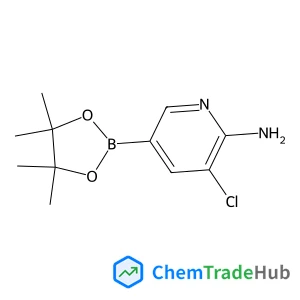
3-Chloro-5-(4,4,5,5-tetramethyl-1,3,2-dioxaborolan-2-yl)-2-pyridinamine
CAS号:
1032758-99-8
分子式:
C11H16BClN2O2
![tert-Butyl N-[(2-chloropyridin-4-yl)methyl]carbamate structure](https://cnstatic.chemtradehub.com/structs/916/916210-27-0-9f95.webp "tert-Butyl N-[(2-chloropyridin-4-yl)methyl]carbamate structure")
推荐供应商



免责声明
本页面提供的学术期刊信息仅供参考和研究使用。我们与任何期刊出版商均无关联,也不处理投稿事宜。如有投稿相关咨询,请直接联系相关期刊出版商。
如发现页面信息有误,请发送邮件至 support@chemtradehub.com 联系我们。我们将及时核实并处理您的问题。