



Drug induced self-assembly of triblock copolymers into polymersomes for the synergistic dual-drug delivery of platinum drugs and paclitaxel
文献信息
发布日期
2017-09-20
DOI
10.1039/C7PY01162H
影响因子
5.582
作者
Sandy Wong, Hongxu Lu, Martina H. Stenzel
查看原文
摘要
Co-delivery of two drugs in one nanoparticle is increasingly used to overcome, for example, multi-drug resistance in cancer therapy and therefore suitable drug carriers need to be developed. In this work, a well-known polymer based on poly(glutamic acid) (PGA) and poly(ethylene glycol) (PEG), PGA-PEG-PGA, was employed as a reactive scaffold for the attachment of paclitaxel (Ptx) and platinum(IV) prodrugs. While the polymer itself is water-soluble, the chemical conjugation of both drugs induces self-assembly into polymersomes with a high drug loading content of 28 wt% of Ptx and 11 wt% of the platinum drug. These polymersomes were found to be stable against enzymatic degradation, yet allowed the release of the platinum drugs in a reductive environment. Twenty-two percent of platinum was released after 48 hours, suggesting a two-step model where Pt-drugs are released within a few days, while Ptx has a slower, prolonged, release. Using traditional A549 and LNCap cell lines in 2D culture to test cytotoxicity, the free Ptx drug performed better than Ptx delivered in nanoparticles, as expected, due to the slow cleavage of the drug. However, experiments in 3D cell culture models with A549 spheroids revealed that the drug carrier enabled a higher accumulation of Pt-drugs inside the cells, and after 14 days incubation, the drug-loaded carrier performed slightly better than the free drugs over the longer timeframe. Further, Chou–Talalay analysis confirmed the synergistic effect of the combination of platinum drug and Ptx in the nanoparticle system.
相关文献
Correction: Fused ambipolar aza-isoindigos with NIR absorption
Danlei Zhu, Hailiang Liao, Sheik Haseena, Mahesh Kumar Ravva, Shengyu Cong, Liuyuan Lan, Yazhou Wang, Zhengke Li, Lang Jiang, Wan Yue
2021-03-03
Correction
DOI: 10.1039/D1QO90017J
Xanthanoltrimer A–C: three xanthanolide sesquiterpene trimers from the fruits of Xanthium italicum Moretti isolated by HPLC-MS-SPE-NMR
Jiang Fu, Ya-Nan Wang, Shuang-Gang Ma, Li Li, Xiao-Jing Wang, Yong Li, Yun-Bao Liu, Jing Qu, Shi-Shan Yu
2021-01-26
Research Article
DOI: 10.1039/D0QO01541E
Theozyme for antibody aldolases. Characterization of the transition-state analogue
Manuel Arnó, Luis R. Domingo
2003-01-27
Paper
DOI: 10.1039/B209636F
Synthetic developments on the preparation of sulfides from thiol-free reagents
Pedro P. de Castro, Juliana A. dos Santos, Troels Skrydstrup, Giovanni W. Amarante
2020-11-12
Review Article
DOI: 10.1039/D0QO01226B
A self-assembled tetrathiafulvalene box
Vincent Croué, Olivier Alévêque, Eric Levillain, Magali Allain, Cécile Mézière, Vincent Carré, Frédéric Aubriet, Zoia Voïtenko, Sébastien Goeb, Marc Sallé
2021-01-08
Research Article
DOI: 10.1039/D0QO01543A
Metallaphotoredox-catalyzed C–H activation: regio-selective annulation of allenes with benzamide‡
Zihao Zhu, Yuyuan Chen, Xueyao Li, Qingyun Yang, Jie Xia, Wenxuan Zhang, Chao Zhang, Song Wu
2021-01-04
Research Article
DOI: 10.1039/D0QO01127D
Enantioselection in peptide bond formation
Roger R. Hill, David Birch, Graham E. Jeffs, Michael North
2003-02-25
Paper
DOI: 10.1039/B211914E
您可能还喜欢
化合物问答
4-[4-三氟甲基苯基]恶唑(CAS号:1126636-40-5)通常如何合成?
4-[4-三氟甲基苯基]恶唑通常通过将4-三氟甲基苯酚与异硫氰酸苯酯在有机溶剂中进行酯化反应合成。该反应可在无水条件下,使用适当的催化剂,如四丁基氢氧化铵,以提...
1126636-40-54-(4-(Trifluoromethy...
59729-32-71-[3-(Dimethylamino)...
化合物问答
RockPhos Pd G3(CAS号:2009020-38-4)通常如何合成?
RockPhos Pd G3 通常通过钯催化偶联反应合成,使用配体 (2'-Amino-2-biphenylyl)(methanesulfonato-kappa...
2009020-38-4(2'-Amino-2-biphenyl...
化合物问答
1-哌啶甲酰胺(CAS号:2158-03-4)的市场或研究趋势如何?
1-哌啶甲酰胺作为有机合成中的重要中间体,其市场需求主要受医药、农药、染料等行业推动。近年来,随着新药开发和绿色化学的发展,该化合物的研究趋势集中在开发更高效、...
2158-03-41-Piperidinecarboxam...
化合物问答
2-(二苯基膦基)乙胺(CAS号:4848-43-5)适用哪些法规指南?
2-(二苯基膦基)乙胺适用于多种法规指南,包括但不限于《全球化学品统一分类和标签制度》(GHS),欧盟《化学品注册、评估、授权和限制》法规(REACH),以及美...
4848-43-52-(Diphenylphosphino...
化合物问答
如何储存间苯二甲酸二烯丙酯(CAS号:1087-21-4)?
间苯二甲酸二烯丙酯应储存在阴凉、干燥、通风良好的地方,远离火源和热源。储存容器应密封,避免光照和高温。储存温度应控制在25℃以下,相对湿度应低于80%。避免与其...
1087-21-4Diallyl isophthalate
化合物问答
什么是间甲苯异硫代异氰酸酯(CAS号:621-30-7)?
间甲苯异硫代异氰酸酯是一种有机化合物,分子式为C7H7NO2S,具有刺激性气味。它是一种重要的有机合成中间体,在合成其他化合物时广泛应用。
621-30-71-Isothiocyanato-3-m...
化合物问答
在合成中是否有N-Boc-D-苯丙氨醇(CAS号:106454-69-7)的替代品?
在合成中,可以考虑使用N-Cbz-D-苯丙氨醇或N-Fmoc-D-苯丙氨醇作为替代品。这些化合物同样具有保护氨基的功能,且在合成过程中表现出良好的反应性能。
106454-69-72-Methyl-2-propanyl ...
化合物问答
3-羟甲基-2-氧异丙基吡啶(CAS号:954240-50-7)的主要用途是什么?
3-羟甲基-2-氧异丙基吡啶主要用于有机合成领域,可以作为合成其他药物、农药或精细化学品的中间体。此外,它还可能在实验室研究中作为特定反应的前体或溶剂。
954240-50-7(2-Isopropoxy-3-pyri...
化合物问答
6-氨基-9-甲基嘌呤(CAS号:700-00-5)应用于哪些行业?
6-氨基-9-甲基嘌呤目前主要应用于医药行业,作为某些药物的中间体。此外,它还可能用于聚合物、传感器和半导体的某些领域,作为功能性单体或掺杂剂。
700-00-59-Methyl-9H-purin-6-...
来源期刊
Polymer Chemistry

CiteScore:
8.6
自引率:
7.3%
年发文量:
457
Polymer Chemistry welcomes submissions in all areas of polymer science that have a strong focus on macromolecular chemistry. Manuscripts may cover a broad range of fields, yet no direct application focus is required.
推荐化合物
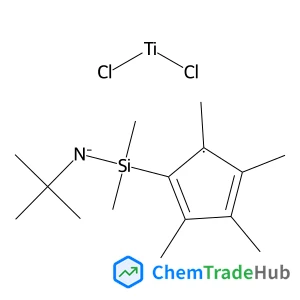
2,3,4,5-TETRAMETHYLCYCLOPENTADIENEDIMETHYLSILYL-TERT-BUTYLAMIDO TITANIUM DICHLORIDE
CAS号:
135072-61-6
分子式:
C15H27Cl2NSiTi-
推荐供应商






免责声明
本页面提供的学术期刊信息仅供参考和研究使用。我们与任何期刊出版商均无关联,也不处理投稿事宜。如有投稿相关咨询,请直接联系相关期刊出版商。
如发现页面信息有误,请发送邮件至 support@chemtradehub.com 联系我们。我们将及时核实并处理您的问题。