








![1,2-Diphenyl-4-[2-(phenylsulfinyl)ethyl]-3,5-pyrazolidinedione structure](https://cnstatic.chemtradehub.com/structs/57-/57-96-5-efcc.webp "1,2-Diphenyl-4-[2-(phenylsulfinyl)ethyl]-3,5-pyrazolidinedione structure")
A supramolecular peptide polymer from hydrogen-bond and coordination-driven self-assembly
文献信息
发布日期
2017-12-05
DOI
10.1039/C7PY01901G
影响因子
5.582
作者
Xiaomin Zhu, Rongfeng Zou, Peng Sun, Qi Wang, Junchen Wu
查看原文
摘要
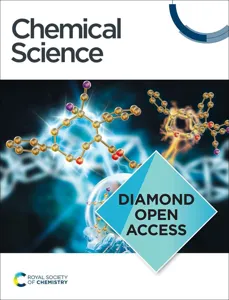
A terpyridine- and guanine-functionalized peptide was developed that could form different morphologies by self-assembly or coordination with Fe2+ in dimethyl sulfoxide. The self-assembly of the peptide is attributed to the G-quartet formation of a guanine moiety and intermolecular terpyridine π–π stacking. Upon the addition of Fe2+, a Fe2+–(terpyridine)2 complex is formed that turns the square-planar self-assembly to a three-dimensional self-assembly. As a consequence, a variety of interesting morphologies and chemical properties were observed. The self-assembled polymers were studied by nuclear magnetic resonance spectroscopy, ultraviolet-visible and fluorescence spectroscopy, viscosity measurement, circular dichroism, Fourier transform infrared spectroscopy, X-ray diffraction, scanning electron microscopy, transmission electron microscopy, dynamic light scattering, and atomic force microscopy. This external stimuli driven self-assembly of a peptide may be further applied to drug delivery applications.
相关文献
Constrained control landscape for population transfer in a two-level system
Katharine Moore Tibbetts, Herschel Rabitz
2014-12-11
Paper
DOI: 10.1039/C4CP04792C
Molecular understanding of ion specificity at the peptide bond
Chuanyu Yan, Tiancheng Mu
2014-11-07
Paper
DOI: 10.1039/C4CP04055D
Oxygen-participated electrochemistry of new lithium-rich layered oxides Li3MRuO5 (M = Mn, Fe)
S. Laha, S. Natarajan, J. Gopalakrishnan, E. Morán, R. Sáez-Puche, A. J. Dos Santos-Garcia, J. C. Pérez-Flores, A. Kuhn, F. García-Alvarado
2014-12-17
Paper
DOI: 10.1039/C4CP05052E
Self-assembly polymorphism of 2,7-bis-nonyloxy-9-fluorenone: solvent induced the diversity of intermolecular dipole–dipole interactions
Lihua Cui, Xinrui Miao, Li Xu, Yi Hu, Wenli Deng
2014-12-09
Paper
DOI: 10.1039/C4CP04773G
Ab initio multiple cloning simulations of pyrrole photodissociation: TKER spectra and velocity map imaging
2014-12-11
Paper
DOI: 10.1039/C4CP04571H
Adsorbate-driven morphological changes on Cu(111) nano-pits
F. M. Hoffmann, J. Hrbek, I. Waluyo, J. A. Boscoboinik, D. J. Stacchiola
2014-12-09
Paper
DOI: 10.1039/C4CP05088F
The effect of sugar stereochemistry on protein self-assembly: the case of β-casein micellization in different aldohexose solutions
Ofer Setter
2014-12-16
Paper
DOI: 10.1039/C4CP03686G
Reducing optical losses in organic solar cells using microlens arrays: theoretical and experimental investigation of microlens dimensions
Yuqing Chen, Stephen Bergeson, Max Noack, Joong-Mok Park, Andrew C. Hillier
2014-12-18
Paper
DOI: 10.1039/C4CP05221H
Phosphine and phosphine oxide groups in metal–organic frameworks detected by P K-edge XAS
F. L. Morel, S. Pin, T. Huthwelker, M. Ranocchiari
2014-12-19
Paper
DOI: 10.1039/C4CP05151C
Correction: Theoretical study and design of multifunctional phosphorescent platinum(ii) complexes containing triarylboron moieties for efficient OLED emitters
Yong Wu, Guo-Gang Shan, Hai-Bin Li, Shui-Xing Wu, Xin-Yao Ren, Yun Geng, Zhong-Min Su
2015-01-09
Correction
DOI: 10.1039/C4CP90185A
您可能还喜欢
化合物问答
6-氯-2H-1,4-苯并噁嗪-3(4H)-酮(CAS号:7652-29-1)应用于哪些行业?
6-氯-2H-1,4-苯并噁嗪-3(4H)-酮主要应用于医药、农药和聚合物等领域。在医药领域,该化合物可用于合成抗菌药物;在农药领域,可用作杀虫剂的中间体;在聚...
7652-29-16-Chloro-2H-1,4-benz...
化合物问答
活性氧化铝(CAS号:1302-74-5)应用于哪些行业?
活性氧化铝广泛应用于医药、聚合物、传感器、半导体和催化等领域。在医药行业,活性氧化铝用作吸附剂和干燥剂,有助于去除杂质和水分。在聚合物行业,它用作增白剂和抗结块...
1302-74-5aluminum;trihydrate
化合物问答
什么是硅胶(CAS号:112926-00-8)?
硅胶(Silica gel, pptd.,cryst.-free)是一种无定形、多孔的硅酸盐材料,主要成分为二氧化硅(SiO₂)。其结构由硅氧四面体构成,通过酸...
112926-00-8Silica gel, pptd.,cr...
化合物问答
二乙基甲基一氢硅烷(CAS号:760-32-7)的主要用途是什么?
二乙基甲基一氢硅烷主要用于有机合成、表面处理以及作为溶剂。它还被用作合成其他硅烷化合物的原料,以及在涂料、粘合剂和密封剂中的应用。
760-32-7Diethyl(methyl)silan...
化合物问答
在合成中是否有N-花生四烯酰基甘氨酸(CAS号:179113-91-8)的替代品?
在合成过程中,可以考虑使用类似结构的化合物作为替代品,例如N-亚油酰基甘氨酸或N-花生二烯酰基甘氨酸。这些替代品在结构上有类似的双键位置,但可能具有不同的物理化...
179113-91-8Glycine, N-[(5Z,8Z,1...
化合物问答
在合成中是否有1-(4-甲氧基苯基)丙烷-1,2-二酮(CAS号:10557-27-4)的替代品?
在合成过程中,可以考虑使用类似结构的化合物作为替代品,例如1-(3-甲氧基苯基)丙烷-1,2-二酮或1-(4-羟基苯基)丙烷-1,2-二酮。这些替代品具有相似的...
10557-27-41-(4-Methoxyphenyl)p...
化合物问答
N-(4-氨基-1-苄基-3-羟基-5-苯基戊基)-3-甲基-2-(2-氧代四氢嘧啶-1-基)-丁酰胺 5-氧代吡咯烷-2-甲酸(CAS号:192726-06-0)通常如何合成?
该化合物通常通过一系列复杂的有机合成步骤获得。首先,通过芳香族化合物的羟基化反应获得羟基化产物,然后通过酰化反应形成酰胺中间体,最后通过环化反应得到目标产物。常...
192726-06-05-Oxo-L-proline - (2...
化合物问答
(S)-2-氨基-3-喹啉-2-丙酸(CAS号:161513-46-8)的市场或研究趋势如何?
该化合物作为生物活性化合物,尤其是在药物化学领域表现出色。近年来,随着对新型抗炎、抗病毒和抗癌药物的研究增加,其市场和研究趋势持续增长。此外,其在神经科学领域的...
161513-46-8(S)-2-Amino-3-quinol...
化合物问答
核黄素磷酸钠(CAS号:130-40-5)安全吗?
核黄素磷酸钠在常规使用条件下安全,但高剂量可能引起刺激性反应。操作时需佩戴防护手套和护目镜,避免吸入粉尘。若接触皮肤或眼睛,应立即用大量清水冲洗。急救时需根据接...
130-40-5Sodium 1-deoxy-1-(7,...
化合物问答
盐酸丙胺卡因杂质A(EP) 标准品(CAS号:19281-31-3)通常如何合成?
盐酸丙胺卡因杂质A(EP) 标准品可通过重氮化反应和随后的酰胺化反应合成。首先,利用氯化反应将苯环上的氢原子转化为氯原子,然后通过芳香族重氮化反应引入氨基,最后...
19281-31-32-Chloro-N-(2-methyl...
来源期刊
Polymer Chemistry

CiteScore:
8.6
自引率:
7.3%
年发文量:
457
Polymer Chemistry welcomes submissions in all areas of polymer science that have a strong focus on macromolecular chemistry. Manuscripts may cover a broad range of fields, yet no direct application focus is required.
推荐化合物
![[4-Amino-2-(methylsulfanyl)-5-pyrimidinyl]methanol structure](https://cnstatic.chemtradehub.com/structs/588/588-36-3-fc73.webp "[4-Amino-2-(methylsulfanyl)-5-pyrimidinyl]methanol structure")
![[4-(Heptyloxy)phenyl]boronic acid structure](https://cnstatic.chemtradehub.com/structs/136/136370-19-9-ad33.webp "[4-(Heptyloxy)phenyl]boronic acid structure")
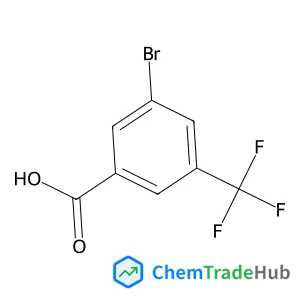
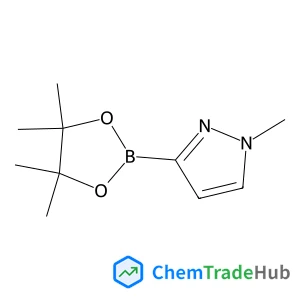
1-Methyl-3-(4,4,5,5-tetramethyl-1,3,2-dioxaborolan-2-yl)-1H-pyrazole
CAS号:
1020174-04-2
分子式:
C10H17BN2O2
推荐供应商




免责声明
本页面提供的学术期刊信息仅供参考和研究使用。我们与任何期刊出版商均无关联,也不处理投稿事宜。如有投稿相关咨询,请直接联系相关期刊出版商。
如发现页面信息有误,请发送邮件至 support@chemtradehub.com 联系我们。我们将及时核实并处理您的问题。