





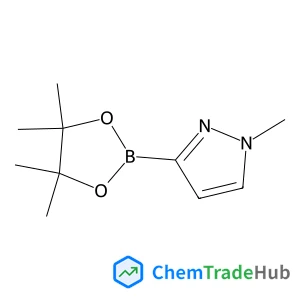
1-Methyl-3-(4,4,5,5-tetramethyl-1,3,2-dioxaborolan-2-yl)-1H-pyrazole
CAS号:
1020174-04-2
分子式:
C10H17BN2O2
Anton Manakhov, David Nečas, Sergey Ershov, Zakhar Popov
The deposition of epoxide groups by plasma polymerization opens new horizons for robust and quick immobilization of biomolecules on any type of substrate. However, as of now there are just very few papers dealing with the deposition of epoxy layers by plasma polymerization, probably due to the high reactivity of this group leading to a low functionalization efficiency. In this work we carried out an extensive experimental and theoretical investigation of plasma synthesis of epoxide groups from a low pressure allyl glycydyl ether (AGE) plasma. The influence of composite parameter W/F and the working pressure on the density of epoxide groups and the layer stability was thoroughly addressed. It was found that by increasing the working pressure it is possible to sufficiently raise the concentration of epoxide groups. The composite parameter W/F was shown to be a crucial parameter in affecting the density of epoxides. An optimal value of W/F of around 2.3 eV per molecule leading to the highest density of epoxides produced in the process at 15 Pa was revealed through FT-IR and XPS findings. This value correlates well with the ab initio calculations suggesting that the lowest bond dissociation energy belongs to the C–O bond of the epoxide ring. Therefore, in order to increase the density of epoxides deposited by plasma polymerization, a precursor molecule containing at least two epoxide rings is strongly advised to be employed.
Madalena C. C. Areias, Kenichi Shimizu, Richard G. Compton
DOI: 10.1039/C6AN00550K
Qi Kang, Dazhong Shen, Yunqing Wang
DOI: 10.1039/C9AN01694E
DOI: 10.1039/C9AN01162E
Timothy P. Cleland, G. Asher Newsome, R. Eric Hollinger
DOI: 10.1039/C9AN01557D
Angela Shore
DOI: 10.1039/C9AN01163C
Chun Mei Li, Lei Zhan, Lin Ling Zheng, Yuan Fang Li
DOI: 10.1039/C6AN00489J
Rajeev Yadav, Rajeev Agarwal, Samuel Kadoury, Dominique Trudel, Marie-Christine Guiot, Kevin Petrecca
DOI: 10.1039/C9AN01144G
Heike Hardelauf‡, Sarah Waide‡, Julia Sisnaiske, Peter Jacob, Vanessa Hausherr, Nicole Schöbel, Dirk Janasek, Christoph van Thriel
DOI: 10.1039/C6AN90037B
Lingfeng Xu, Ling Ni, Lihe Sun, Fang Zeng, Shuizhu Wu
DOI: 10.1039/C9AN01582E
6-氯-2H-1,4-苯并噁嗪-3(4H)-酮主要应用于医药、农药和聚合物等领域。在医药领域,该化合物可用于合成抗菌药物;在农药领域,可用作杀虫剂的中间体;在聚...
活性氧化铝广泛应用于医药、聚合物、传感器、半导体和催化等领域。在医药行业,活性氧化铝用作吸附剂和干燥剂,有助于去除杂质和水分。在聚合物行业,它用作增白剂和抗结块...
硅胶(Silica gel, pptd.,cryst.-free)是一种无定形、多孔的硅酸盐材料,主要成分为二氧化硅(SiO₂)。其结构由硅氧四面体构成,通过酸...
二乙基甲基一氢硅烷主要用于有机合成、表面处理以及作为溶剂。它还被用作合成其他硅烷化合物的原料,以及在涂料、粘合剂和密封剂中的应用。
在合成过程中,可以考虑使用类似结构的化合物作为替代品,例如N-亚油酰基甘氨酸或N-花生二烯酰基甘氨酸。这些替代品在结构上有类似的双键位置,但可能具有不同的物理化...
在合成过程中,可以考虑使用类似结构的化合物作为替代品,例如1-(3-甲氧基苯基)丙烷-1,2-二酮或1-(4-羟基苯基)丙烷-1,2-二酮。这些替代品具有相似的...
该化合物通常通过一系列复杂的有机合成步骤获得。首先,通过芳香族化合物的羟基化反应获得羟基化产物,然后通过酰化反应形成酰胺中间体,最后通过环化反应得到目标产物。常...
该化合物作为生物活性化合物,尤其是在药物化学领域表现出色。近年来,随着对新型抗炎、抗病毒和抗癌药物的研究增加,其市场和研究趋势持续增长。此外,其在神经科学领域的...
核黄素磷酸钠在常规使用条件下安全,但高剂量可能引起刺激性反应。操作时需佩戴防护手套和护目镜,避免吸入粉尘。若接触皮肤或眼睛,应立即用大量清水冲洗。急救时需根据接...
盐酸丙胺卡因杂质A(EP) 标准品可通过重氮化反应和随后的酰胺化反应合成。首先,利用氯化反应将苯环上的氢原子转化为氯原子,然后通过芳香族重氮化反应引入氨基,最后...

Physical Chemistry Chemical Physics (PCCP) is an international journal co-owned by 19 physical chemistry and physics societies from around the world. This journal publishes original, cutting-edge research in physical chemistry, chemical physics and biophysical chemistry. To be suitable for publication in PCCP, articles must include significant innovation and/or insight into physical chemistry; this is the most important criterion that reviewers and Editors will judge against when evaluating submissions. The journal has a broad scope and welcomes contributions spanning experiment, theory, computation and data science. Topical coverage includes spectroscopy, dynamics, kinetics, statistical mechanics, thermodynamics, electrochemistry, catalysis, surface science, quantum mechanics, quantum computing and machine learning. Interdisciplinary research areas such as polymers and soft matter, materials, nanoscience, energy, surfaces/interfaces, and biophysical chemistry are welcomed if they demonstrate significant innovation and/or insight into physical chemistry. Joined experimental/theoretical studies are particularly appreciated when complementary and based on up-to-date approaches.