



Structural characterization of nucleotide 5′-triphosphates by infrared ion spectroscopy and theoretical studies
文献信息
发布日期
2018-10-25
DOI
10.1039/C8CP03314E
影响因子
3.676
作者
Rianne E. van Outersterp, Jonathan Martens, Giel Berden, Jeffrey D. Steill, Anouk M. Rijs
查看原文
摘要
The molecular family of nucleotide triphosphates (NTPs), with adenosine 5′-triphosphate (ATP) as its best-known member, is of high biochemical importance as their phosphodiester bonds form Nature's main means to store and transport energy. Here, gas-phase IR spectroscopic studies and supporting theoretical studies have been performed on adenosine 5′-triphosphate, cytosine 5′-triphosphate and guanosine 5′-triphosphate to elucidate the intrinsic structural properties of NTPs, focusing on the influence of the nucleobase and the extent of deprotonation. Mass spectrometric studies involving collision induced dissociation showed similar fragmentation channels for the three studied NTPs within a selected charge state. The doubly charged anions exhibit fragmentation similar to the energy-releasing hydrolysis reaction in nature, while the singly charged anions show different dominant fragmentation channels, suggesting that the charge state plays a significant role in the favorability of the hydrolysis reaction. A combination of infrared ion spectroscopy and quantum-chemical computations indicates that the singly charged anions of all NTPs are preferentially deprotonated at their β-phosphates, while the doubly-charged anions are dominantly αβ-deprotonated. The assigned three-dimensional structure differs for ATP and CTP on the one hand and GTP on the other, in the sense that ATP and CTP show no interaction between nucleobase and phosphate tail, while in GTP they are hydrogen bonded. This can be rationalized by considering the structure and geometry of the NTPs where the final three dimensional structure depends on a subtle balance between hydrogen bond strength, flexibility and steric hindrance.
相关文献
Outstanding Reviewers for Reaction Chemistry & Engineering in 2018
2019-04-02
Editorial
DOI: 10.1039/C9RE90020A
Inter-particle migration of Cu ions in physically mixed Cu-SSZ-13 and H-SSZ-13 treated by hydrothermal aging
Hwangho Lee, Inhak Song, Se Won Jeon, Do Heui Kim
2019-02-05
Paper
DOI: 10.1039/C8RE00281A
A continuous flow protocol to generate, regenerate, load, and recycle chlorotrityl functionalised resins
Lawson K. Spare, Maria Menti
2019-05-20
Paper
DOI: 10.1039/C8RE00318A
Continuous flow synthesis of amine oxides by oxidation of tertiary amines
Tobias Baumeister, Stefan Zikeli, Hannes Kitzler, Paul Aigner, Piotr P. Wieczorek, Thorsten Röder
2019-04-25
Paper
DOI: 10.1039/C9RE00127A
Green and catalyst-free synthesis of deoxyarbutin in continuous-flow
Xiaoxuan Xie, Shitian Xie, Hongmiao Yao, Xin Ye, Zhiqun Yu
2019-02-28
Paper
DOI: 10.1039/C9RE00084D
Design and 3D printing of a stainless steel reactor for continuous difluoromethylations using fluoroform
Tania Ciaglia, Eyke Slama, Matej Zadravec, Stefan Pfanner
2017-11-09
Paper
DOI: 10.1039/C7RE00176B
Mercury-free nitrogen-doped activated carbon catalyst: an efficient catalyst for the catalytic coupling reaction of acetylene and ethylene dichloride to synthesize the vinyl chloride monomer
Zhaobing Shen, Hong Zhao, Yue Liu, Zeyuan Kan, Ping Xing, Jinguang Zhong
2018-01-11
Paper
DOI: 10.1039/C7RE00201G
Calcination kinetics of cement raw meals under various CO2 concentrations
Jose Ramon Fernandez, Sandra Turrado, Juan Carlos Abanades
2019-10-18
Paper
DOI: 10.1039/C9RE00361D
Continuous synthesis of Zn2Al–CO3 layered double hydroxides: a comparison of bench, pilot and industrial scale syntheses
R. L. Gomes, C. Crawshaw, L. Neve, R. Lodge, M. Fay, C. Winkler, M. Hull, E. Lester
2019-03-08
Communication
DOI: 10.1039/C8RE00241J
您可能还喜欢
化合物问答
2-(甲基磺酰基)嘧啶-5-胺(CAS号:56621-92-2)适用哪些法规指南?
该化合物适用的法规指南包括GHS(全球化学品统一分类和标签制度)分类为特定目标器官毒性-单次接触类别3;根据欧盟REACH法规,该化合物需要进行注册和评估;在美...
56621-92-22-(Methylsulfonyl)py...
化合物问答
在合成中是否有4-(4-氯苯基)-1H-咪唑(CAS号:35512-29-9)的替代品?
在合成中,可以考虑使用一些类似的化合物作为4-(4-氯苯基)-1H-咪唑的替代品,如4-(4-溴苯基)-1H-咪唑或4-(4-甲氧基苯基)-1H-咪唑。这些化合...
35512-29-94-(4-Chlorophenyl)-1...
化合物问答
什么是N~2~-甲基丙氨酸酰胺(CAS号:32012-16-1)?
N~2~-甲基丙氨酸酰胺是一种有机化合物,其化学名为2-(Methylamino)propanamide。它是一种酰胺类化合物,分子式为C4H10N2O,相对分...
32012-16-12-(Methylamino)propa...
化合物问答
如何处理含有N-苄基-3-氨基氧杂环丁烷草酸盐(CAS号:1956341-96-0)的废料?
处理含有N-苄基-3-氨基氧杂环丁烷草酸盐(CAS号:1956341-96-0)的废料时,应首先确保遵循相关法规要求,如GHS和REACH等。通常,废液应先进行...
1956341-96-0N-Benzyloxetan-3-ami...
化合物问答
4-bromo-2-chloro-6-methylbenzoic acid(CAS号:877149-07-0)的物理化学性质是什么?
4-溴-2-氯-6-甲基苯甲酸是一种固体化合物,具有较高的熔点和较低的沸点。它的分子量为261.03 g/mol。该化合物在水中几乎不溶,在有机溶剂中溶解度适中...
877149-07-04-Bromo-2-chloro-6-m...
化合物问答
2-[(2,5-二氯-4-嘧啶)氨基]-N-甲基苯甲酰胺(CAS号:761440-08-8)通常如何合成?
该化合物通常通过缩合反应合成,典型的方法是将2,5-二氯嘧啶与N-甲基苯甲酰胺在碱性条件下进行偶联反应。常用的碱包括NaH、LDA等强碱。该合成路线具有较高的选...
761440-08-82-[(2,5-dichloropyri...
4752-10-71,4-Dichlorophthalaz...
化合物问答
在合成中是否有3,5-二溴-4-甲基苯胺(CAS号:13194-73-5)的替代品?
3,5-二溴-4-甲基苯胺在某些合成路线中可能没有直接替代品。然而,在某些应用场景下,可以考虑使用其他类似结构的化合物如3,5-二溴-4-硝基苯胺或3,5-二碘...
13194-73-53,5-Dibromo-4-methyl...
化合物问答
2-氯喹啉-4-羧酸甲酯(CAS号:62482-26-2)的主要用途是什么?
2-氯喹啉-4-羧酸甲酯主要用于有机合成和药物合成领域,作为中间体或原料。它在合成某些药物和染料时具有重要作用。此外,该化合物还可能用于某些特定的化学研究中。
62482-26-2Methyl 2-chloro-4-qu...
化合物问答
i>]吡啶(CAS号:474708-88-8)安全吗?
6-溴-8-氯咪唑[1,2-a]吡啶在操作过程中需要谨慎以确保安全。该化合物具有一定的毒性,吸入其蒸气或粉尘可能导致呼吸道刺激。处理时应佩戴适当的防护装备,如手...
474708-88-86-Bromo-8-chloroimid...
来源期刊
Physical Chemistry Chemical Physics

CiteScore:
5.5
自引率:
10.3%
年发文量:
3036
Physical Chemistry Chemical Physics (PCCP) is an international journal co-owned by 19 physical chemistry and physics societies from around the world. This journal publishes original, cutting-edge research in physical chemistry, chemical physics and biophysical chemistry. To be suitable for publication in PCCP, articles must include significant innovation and/or insight into physical chemistry; this is the most important criterion that reviewers and Editors will judge against when evaluating submissions. The journal has a broad scope and welcomes contributions spanning experiment, theory, computation and data science. Topical coverage includes spectroscopy, dynamics, kinetics, statistical mechanics, thermodynamics, electrochemistry, catalysis, surface science, quantum mechanics, quantum computing and machine learning. Interdisciplinary research areas such as polymers and soft matter, materials, nanoscience, energy, surfaces/interfaces, and biophysical chemistry are welcomed if they demonstrate significant innovation and/or insight into physical chemistry. Joined experimental/theoretical studies are particularly appreciated when complementary and based on up-to-date approaches.
推荐化合物
![(1R,3S,5R)-2-{[(2-Methyl-2-propanyl)oxy]carbonyl}-2-azabicyclo[3.1.0]hexane-3-carboxylic acid structure](https://cnstatic.chemtradehub.com/structs/197/197142-34-0-6a44.webp "(1R,3S,5R)-2-{[(2-Methyl-2-propanyl)oxy]carbonyl}-2-azabicyclo[3.1.0]hexane-3-carboxylic acid structure")
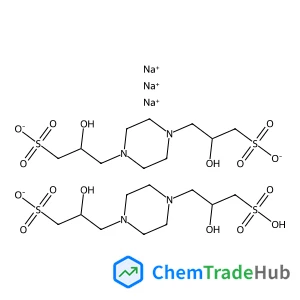
3,3'-(Piperazine-1,4-diyl)bis(2-hydroxypropane-1-sulfonic acid) Sodium Salt
CAS号:
108321-08-0
分子式:
C20H41N4Na3O16S4
![5-(2-Phenylpyrazolo[1,5-a]pyridin-3-yl)-2H-pyrazolo[3,4-c]pyridazin-3-amine structure](https://cnstatic.chemtradehub.com/structs/865/865362-74-9-0091.webp "5-(2-Phenylpyrazolo[1,5-a]pyridin-3-yl)-2H-pyrazolo[3,4-c]pyridazin-3-amine structure")
推荐供应商




免责声明
本页面提供的学术期刊信息仅供参考和研究使用。我们与任何期刊出版商均无关联,也不处理投稿事宜。如有投稿相关咨询,请直接联系相关期刊出版商。
如发现页面信息有误,请发送邮件至 support@chemtradehub.com 联系我们。我们将及时核实并处理您的问题。