




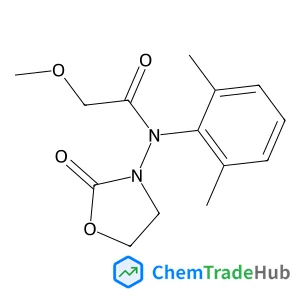
N-(2,6-Dimethylphenyl)-2-methoxy-N-(2-oxo-1,3-oxazolidin-3-yl)acetamide
CAS号:
77732-09-3
分子式:
C14H18N2O4
Isabel Gonzalo, Miguel A. Antón
We analyze theoretically the entanglement between two non-planar and light identical molecules (e.g., pyramidal NH3) that present inversion doubling due to the internal spatial inversion of their nuclear conformations by tunneling. The peculiarity of this system lies in the simplicity of this type of molecular system in which two near levels can be connected by an allowed electric dipole transition with considerable value of the dipole moment transition and negligible spontaneous emission because the transition is in the microwave or far-infrared range. These properties give place to entanglement states oscillating by free evolution with frequency determined by the dipole–dipole interaction and negligible spontaneous decay, which allows consideration of an efficient quantum Zeno effect by frequent measurements of one of the entangled states. If the molecules are initially both in the upper (or lower) eigenstate, the system evolves under an external radiation field, which can induce oscillations of the generated entangled states, with frequency of the order of the Rabi frequency of the field. For a certain detuning, a symmetric entangled state, which is an eigenstate of the collective system, can be populated, and given its negligible spontaneous emission, could be maintained for a time limited only by external decoherence processes, which could be minimized. Although the data used are those of the NH3 molecule, other molecules could present the same advantageous features.
Fei Tong, Mervin P. Hanson, Christopher J. Bardeen
DOI: 10.1039/C6CP04459J
Karin Fink, Valeriu Mereacre, Christopher E. Anson
DOI: 10.1039/C6CP03157A
Simone Conti, Marco Cecchini
DOI: 10.1039/C6CP05249E
Yiteng Zhang, Aaron Wirthwein, Fahhad H. Alharbi, Gregory S. Engel
DOI: 10.1039/C6CP06098F
Peng Liu, Dunyou Wang, Yulong Xu
DOI: 10.1039/C6CP06195H
Ulrich Kuenzer, Jan-Andrè Sorarù, Thomas S. Hofer
DOI: 10.1039/C6CP06698D
Chrystelle Neaime, Maria Amela-Cortes, Yann Molard, Stéphane Cordier, Benjamin Dierre, Michel Mortier, Toshiaki Takei, Kohsei Takahashi, Hajime Haneda, Marc Verelst, Séverine Lechevallier
DOI: 10.1039/C6CP05290H
Yumeng Liu, Xiao Zhang, Junpeng Wang, Ping Yang
DOI: 10.1039/C6CP06371C
Linying Liu, Jianhua Zhang, Xiaowei Zhao, Zheng Mao, Na Liu, Youyu Zhang
DOI: 10.1039/C6CP05998H
十二烷基磺酸钠主要用作表面活性剂,广泛应用于洗涤剂、肥皂、化妆品和工业清洁产品中。它能有效去除油脂和污垢,常用于制造洗发水、沐浴露、洗衣粉和金属清洗剂。此外,它...
5-羟基异喹啉作为化学品,主要适用的法规包括GHS全球化学品统一分类和标签制度,REACH法规等。GHS将5-羟基异喹啉分类为皮肤腐蚀/刺激类别2,严重眼损伤/...
合成中可以考虑使用类似结构的化合物,如4-[(E)-2-(2-氯-6-氟苯基)乙烯基]-N-甲基苯胺的类似物或衍生物作为替代品。这类化合物可能具有相似的生物活性...
该化合物通常通过如下步骤合成:首先,将4-溴-1H-咪唑与对甲苯磺酸在乙酸乙酯中反应,得到中间体5-溴-1H-咪唑-2-甲酸乙酯。然后,该中间体与2-甲基-2-...
处理4-(吡咯烷-1-基)环己酮时,应佩戴手套、护目镜和实验室外套,以防止直接接触或吸入。在通风橱中操作,确保良好的通风条件。一旦发生泄漏,应立即清理并使用适当...
含有异麦芽糖醇的废液应首先进行分类收集,避免与其他化学品混合。对于小规模的废液,可以通过焚烧或加入特定的化学试剂进行无害化处理。对于大规模的废液,建议联系专业的...
7-甲基壬酸主要用于有机合成领域,作为合成其他化合物的原料。此外,它还可能作为一种中间体用于药品制造和香料合成,但具体用途需要根据其具体的化学结构和反应特性来确...
N-甲氧基-N-甲基甲基吡啶羧酰胺在医药领域有一定的应用,作为一种潜在的药物前体或中间体。此外,该化合物也可能应用于聚合物改性剂、传感器材料等。由于其独特的化学...
惕各酸香叶酯是一种化合物,化学名称为(2E)-3,7-二甲基-2,6-辛二烯-1-基(2E)-2-甲基-2-丁烯酸酯。它是一种具有香叶香气的化合物,分子式为C1...
1-环丁基哌嗪在适当的操作条件下是相对安全的,但如遇明火或高热会释放有毒气体。操作时应佩戴防护眼镜和手套,避免吸入或接触皮肤、眼睛。

Physical Chemistry Chemical Physics (PCCP) is an international journal co-owned by 19 physical chemistry and physics societies from around the world. This journal publishes original, cutting-edge research in physical chemistry, chemical physics and biophysical chemistry. To be suitable for publication in PCCP, articles must include significant innovation and/or insight into physical chemistry; this is the most important criterion that reviewers and Editors will judge against when evaluating submissions. The journal has a broad scope and welcomes contributions spanning experiment, theory, computation and data science. Topical coverage includes spectroscopy, dynamics, kinetics, statistical mechanics, thermodynamics, electrochemistry, catalysis, surface science, quantum mechanics, quantum computing and machine learning. Interdisciplinary research areas such as polymers and soft matter, materials, nanoscience, energy, surfaces/interfaces, and biophysical chemistry are welcomed if they demonstrate significant innovation and/or insight into physical chemistry. Joined experimental/theoretical studies are particularly appreciated when complementary and based on up-to-date approaches.