

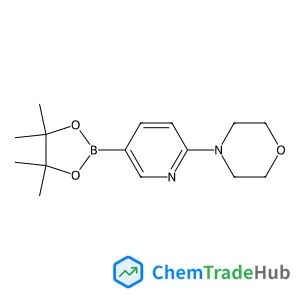
4-(5-(4,4,5,5-tetramethyl-1,3,2-dioxaborolan-2-yl)pyridin-2-yl)morpholine
CAS号:
485799-04-0
分子式:
C15H23BN2O3
Vladyslav Shenderman
Several monocyclic derivatives of 14,14′-difluororipostatin A were prepared using a catalytic Mukaiyama aldol reaction, a ring-closing metathesis reaction and a late stage click reaction as key steps. The biological activity of the produced compounds was assessed in vivo using a panel of pathogenic microorganisms. Moderate antibiotic activity was observed for 11-OMe-ripostatin A and 11-OMe-14,14′-difluororipostatin A.
Ying-Yan Zhang, Qing-Xiang Pei, Hong-Yuan Liu, Ning Wei
DOI: 10.1039/C7CP04982J
DOI: 10.1039/C7CP05536F
Huan Yue, Yixuan Wu, Shubin Su, Hao Li, Zhenhua Ni, Xianfeng Chen
DOI: 10.1039/C7CP03523C
Xianlong Wang
DOI: 10.1039/C7CP05385A
Qi Liang Lu, Qi Quan Luo, Yi De Li, Shou Guo Huang
DOI: 10.1039/C7CP05610A
DOI: 10.1039/C7CP05300B
Bethany A. Wellen, Evan A. Lach, Heather C. Allen
DOI: 10.1039/C7CP04527A
Jamuna K. Vaishnav, Tushar Kanti Mukherjee
DOI: 10.1039/C7CP05225A
Ying-Tao Liu, Yan-Rong Li, Xin Wang
DOI: 10.1039/C7CP05196D
处理含有8-氯咪唑并[1,2-A]吡嗪的废料时,应首先将其收集并进行化学回收或降解。如果无法回收,需采用安全的化学处理方法,如中和、氧化还原或沉淀。处理过程中需...
Calhex 231 hydrochloride 需要遵循《全球化学品统一分类和标签制度》(GHS)的分类和标签要求,以及欧盟的《化学品注册、评估、授权和限制条...
11-Beta,17-alpha,21-三羟基-5-beta-孕烯-3,20-二酮是一种无色结晶性粉末,分子量为372.45 g/mol。该化合物在水中的溶解度...
处理5-异丙基-1,3,4-恶二唑-2-羧酸时应注意以下安全事项:穿戴适当的个人防护装备,包括实验室外套、手套和护目镜;操作应在通风橱中进行,以减少吸入或接触有...
Benzyl 3-bromopropanoate属于有毒物质,吸入、摄入或皮肤接触均可能对人体造成伤害。操作时应佩戴防护眼镜、口罩和手套,避免吸入蒸汽和直接接触...
(R)-N-苄氧羰基-3,4-二氢-1H-异喹啉羧酸是一种含有苄氧羰基和异喹啉环结构的化合物,分子式为C17H15NO3。它是一种有机化合物,具有一定的生物活性...
可以考虑使用1-苄基吡啶-3-羧酸盐作为1-苄基吡啶嗡-3-羧酸盐的替代品。此外,还可以探索其他类似物,如1-苄基吡啶-3-氨基甲酸酯等。具体的替代品选择需根据...
(2,6-二甲基吡啶-3-基)甲醇在使用时需注意安全,应避免吸入其蒸汽,接触皮肤和眼睛。操作应在通风良好的环境中进行,佩戴适当的个人防护装备。
5-溴-2-乙烯基吡啶是一种有机化合物,外观为白色固体,具有良好的结晶性。分子量约为190.03 g/mol。它的溶解性在水中较差,但在有机溶剂如二氯甲烷、甲醇...
2-羟基-3-硝基-5-甲基吡啶主要应用于医药、聚合物和半导体行业。在医药领域,它可以用作合成其他药物的中间体。在聚合物领域,它可以作为功能性单体参与聚合反应,...
Organic & Biomolecular Chemistry (OBC) publishes original and high impact research and reviews in organic chemistry. We welcome research that shows new or significantly improved protocols or methodologies in total synthesis, synthetic methodology or physical and theoretical organic chemistry as well as research that shows a significant advance in the organic chemistry or molecular design aspects of chemical biology, catalysis, supramolecular and macromolecular chemistry, theoretical chemistry, mechanism-oriented physical organic chemistry, medicinal chemistry or natural products. Articles published in the journal should report new work which makes a highly-significant impact in the field. Routine and incremental work is generally not suitable for publication in the journal. More details about key areas of our scope are below. In all cases authors should include in their article clear rationale for why their research has been carried out.