







Logical design and application of prodrug platforms
文献信息
发布日期
2018-11-12
DOI
10.1039/C8PY01160E
影响因子
5.582
作者
Qingye Meng, Hao Hu, Liping Zhou, Yixin Zhang
查看原文
摘要
Accurate design and high drug-loading content are the two key points in designing high-performance cancer nanomedicines. Using common strategies for drug delivery systems (DDS), such as nanoparticle (NP)-mediated DDS, lipid nanocarrier-mediated DDS, and micelle-mediated DDS, it is difficult to meet the requirements for their translation into clinical applications because of the imprecise control of the conjugation sites and density. Using drug molecules to directly construct the delivery platform is a promising approach to precisely control the composition and molecular structure. The polyprodrug platform for disease treatment is an advanced strategy with a precise structure and a high drug-loading rate. This review summarizes the current state of prodrugs, especially the polyprodrug platform, and focuses on the logical design for clinical use and proposes some practical prospects for the future development of the prodrug platform.
相关文献
Molecular dynamics simulation of spin–lattice NMR relaxation in poly-l-lysine dendrimers: manifestation of the semiflexibility effect
Denis A. Markelov, Stanislav G. Falkovich, Maxim Yu. Ilyash, Vladimir V. Matveev, Erkki Lähderanta, Petri Ingman
2014-12-08
Paper
DOI: 10.1039/C4CP04825C
The effect of sugar stereochemistry on protein self-assembly: the case of β-casein micellization in different aldohexose solutions
Ofer Setter
2014-12-16
Paper
DOI: 10.1039/C4CP03686G
Radiolysis of crown ether–ionic liquid systems: identification of radiolytic products and their effect on the removal of Sr2+ from nitric acid
Yinyong Ao, Weijin Yuan, Tianlin Yu, Jing Peng, Jiuqiang Li, Maolin Zhai, Long Zhao
2014-12-11
Paper
DOI: 10.1039/C4CP04294H
Chemistry in one dimension
Pierre-François Loos, Caleb J. Ball, Peter M. W. Gill
2014-12-11
Paper
DOI: 10.1039/C4CP03571B
An equation to calculate internuclear distances of covalent, ionic and metallic lattices
Peter F. Lang, Barry C. Smith
2014-12-16
Paper
DOI: 10.1039/C4CP05135A
Pressure-induced phase transition of BiOF: novel two-dimensional layered structures
Dawei Zhou, Chunying Pu, Chaozheng He, Cheng Lu, Gang Bao
2015-01-06
Paper
DOI: 10.1039/C4CP05142D
Electrochemical oxidation stability of anions for modern battery electrolytes: a CBS and DFT study
Erlendur Jónsson, Patrik Johansson
2015-01-05
Paper
DOI: 10.1039/C4CP04592K
Changes in microstructure and physical properties of skutterudites after severe plastic deformation
Jiri Bursik, Jelena Horky, Ramakrishnan Anbalagan, Ramesh Chandra Mallik, Michael Zehetbauer
2014-12-18
Paper
DOI: 10.1039/C4CP05230G
Cyano-substituted oligo(p-phenylene vinylene) single-crystal with balanced hole and electron injection and transport for ambipolar field-effect transistors
Jian Deng, Jia Tang, Yuanxiang Xu, Liqun Liu, Yan Wang, Zengqi Xie, Yuguang Ma
2014-12-04
Paper
DOI: 10.1039/C4CP04265D
您可能还喜欢
化合物问答
6-氯-2H-1,4-苯并噁嗪-3(4H)-酮(CAS号:7652-29-1)应用于哪些行业?
6-氯-2H-1,4-苯并噁嗪-3(4H)-酮主要应用于医药、农药和聚合物等领域。在医药领域,该化合物可用于合成抗菌药物;在农药领域,可用作杀虫剂的中间体;在聚...
7652-29-16-Chloro-2H-1,4-benz...
化合物问答
活性氧化铝(CAS号:1302-74-5)应用于哪些行业?
活性氧化铝广泛应用于医药、聚合物、传感器、半导体和催化等领域。在医药行业,活性氧化铝用作吸附剂和干燥剂,有助于去除杂质和水分。在聚合物行业,它用作增白剂和抗结块...
1302-74-5aluminum;trihydrate
化合物问答
什么是硅胶(CAS号:112926-00-8)?
硅胶(Silica gel, pptd.,cryst.-free)是一种无定形、多孔的硅酸盐材料,主要成分为二氧化硅(SiO₂)。其结构由硅氧四面体构成,通过酸...
112926-00-8Silica gel, pptd.,cr...
化合物问答
二乙基甲基一氢硅烷(CAS号:760-32-7)的主要用途是什么?
二乙基甲基一氢硅烷主要用于有机合成、表面处理以及作为溶剂。它还被用作合成其他硅烷化合物的原料,以及在涂料、粘合剂和密封剂中的应用。
760-32-7Diethyl(methyl)silan...
化合物问答
在合成中是否有N-花生四烯酰基甘氨酸(CAS号:179113-91-8)的替代品?
在合成过程中,可以考虑使用类似结构的化合物作为替代品,例如N-亚油酰基甘氨酸或N-花生二烯酰基甘氨酸。这些替代品在结构上有类似的双键位置,但可能具有不同的物理化...
179113-91-8Glycine, N-[(5Z,8Z,1...
化合物问答
在合成中是否有1-(4-甲氧基苯基)丙烷-1,2-二酮(CAS号:10557-27-4)的替代品?
在合成过程中,可以考虑使用类似结构的化合物作为替代品,例如1-(3-甲氧基苯基)丙烷-1,2-二酮或1-(4-羟基苯基)丙烷-1,2-二酮。这些替代品具有相似的...
10557-27-41-(4-Methoxyphenyl)p...
化合物问答
N-(4-氨基-1-苄基-3-羟基-5-苯基戊基)-3-甲基-2-(2-氧代四氢嘧啶-1-基)-丁酰胺 5-氧代吡咯烷-2-甲酸(CAS号:192726-06-0)通常如何合成?
该化合物通常通过一系列复杂的有机合成步骤获得。首先,通过芳香族化合物的羟基化反应获得羟基化产物,然后通过酰化反应形成酰胺中间体,最后通过环化反应得到目标产物。常...
192726-06-05-Oxo-L-proline - (2...
化合物问答
(S)-2-氨基-3-喹啉-2-丙酸(CAS号:161513-46-8)的市场或研究趋势如何?
该化合物作为生物活性化合物,尤其是在药物化学领域表现出色。近年来,随着对新型抗炎、抗病毒和抗癌药物的研究增加,其市场和研究趋势持续增长。此外,其在神经科学领域的...
161513-46-8(S)-2-Amino-3-quinol...
化合物问答
核黄素磷酸钠(CAS号:130-40-5)安全吗?
核黄素磷酸钠在常规使用条件下安全,但高剂量可能引起刺激性反应。操作时需佩戴防护手套和护目镜,避免吸入粉尘。若接触皮肤或眼睛,应立即用大量清水冲洗。急救时需根据接...
130-40-5Sodium 1-deoxy-1-(7,...
化合物问答
盐酸丙胺卡因杂质A(EP) 标准品(CAS号:19281-31-3)通常如何合成?
盐酸丙胺卡因杂质A(EP) 标准品可通过重氮化反应和随后的酰胺化反应合成。首先,利用氯化反应将苯环上的氢原子转化为氯原子,然后通过芳香族重氮化反应引入氨基,最后...
19281-31-32-Chloro-N-(2-methyl...
来源期刊
Polymer Chemistry

CiteScore:
8.6
自引率:
7.3%
年发文量:
457
Polymer Chemistry welcomes submissions in all areas of polymer science that have a strong focus on macromolecular chemistry. Manuscripts may cover a broad range of fields, yet no direct application focus is required.
推荐化合物
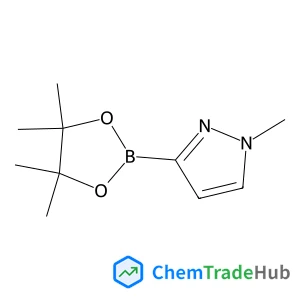
1-Methyl-3-(4,4,5,5-tetramethyl-1,3,2-dioxaborolan-2-yl)-1H-pyrazole
CAS号:
1020174-04-2
分子式:
C10H17BN2O2
推荐供应商



免责声明
本页面提供的学术期刊信息仅供参考和研究使用。我们与任何期刊出版商均无关联,也不处理投稿事宜。如有投稿相关咨询,请直接联系相关期刊出版商。
如发现页面信息有误,请发送邮件至 support@chemtradehub.com 联系我们。我们将及时核实并处理您的问题。