




![2-[(5Z,8Z,11Z,14Z)-5,8,11,14-Icosatetraen-1-yloxy]-1,3-propanediol structure](https://cnstatic.chemtradehub.com/structs/222/222723-55-9-0348.webp "2-[(5Z,8Z,11Z,14Z)-5,8,11,14-Icosatetraen-1-yloxy]-1,3-propanediol structure")
A hybridization chain reaction coupled with gold nanoparticles for allergen gene detection in peanut, soybean and sesame DNAs
文献信息
发布日期
2019-04-30
DOI
10.1039/C9AN00394K
影响因子
4.616
作者
Dan Yuan, Yongxin Liu, Jilie Kong, Qin Chen
查看原文
摘要
Food allergy is an abnormal immune response of the immune system to some foods, which has caused great harm to people's health. Therefore, it is particularly important to detect allergens in food. In this article, a hybridization chain reaction (HCR) was coupled with gold nanoparticles (AuNPs) to detect the allergen genes of peanut, soybean and sesame DNAs. Two hairpin probes (H1 and H2) were designed for the allergen target genes of peanut, soybean and sesame DNAs. In the presence of target DNA, the hybridization chain reaction was triggered by it producing long double-stranded DNA (dsDNA) products. In the gold nanoparticle system, long dsDNA couldn't be adsorbed on the surface of AuNPs. When the concentration of salt ions in the solution increased, gold nanoparticles accumulated and led to a decrease of ultraviolet absorption. In the absence of target DNA, no hybridization chain reaction occurred. The hairpin probes could be adsorbed on the surface of AuNPs and no accumulation happened for gold nanoparticles even if the concentration of salt ions in the solution was increased. This method required no enzymes and had a strong specificity, so it was very easy to distinguish target DNA from non-target DNA. The detection limit of three allergens detected by this method was as low as 0.5 nM. The feasibility of this method for the detection of commercial commodities had been demonstrated by the successful detection of the DNAs extracted from commercial commodities, which were treated with extreme thermostable single-stranded binding protein (ET SSB).
相关文献
Improving the performance of the MM/PBSA and MM/GBSA methods in recognizing the native structure of the Bcl-2 family using the interaction entropy method
Susu Zhong, Kaifang Huang, Song Luo, Shuheng Dong, Lili Duan
2020-02-04
Paper
DOI: 10.1039/C9CP06459A
Water plays a dynamical role in a hydrogen-bonded, hexameric supramolecular assembly
Ankita Katiyar, Julia C. Freire Sovierzoski, Paul B. Calio, Anthony A. Vartia, Ward H. Thompson
2020-02-24
Paper
DOI: 10.1039/C9CP06874K
Computational approaches to studying methylated H4K20 recognition by DNA repair factor 53BP1
Zhendong Li, Jingxiao Bao
2020-02-06
Paper
DOI: 10.1039/C9CP05635A
Structural relationships for the design of responsive azobenzene-based lyotropic liquid crystals
Luke W. Giles, Joshua B. Marlow, Calum S. G. Butler, Geosmin A. Turpin, Liliana de Campo, Stephen T. Mudie, Charl F. J. Faul, Rico F. Tabor
2020-01-30
Paper
DOI: 10.1039/C9CP05463D
Do defects in PAHs promote catalytic activity in space? Stone–Wales pyrene as a test case
Dario Campisi
2020-02-28
Paper
DOI: 10.1039/C9CP06523G
Theoretical study on the stability and aromaticity in silapentafulvenes towards triplet ground state species
Jiashun Wu, Alvi Muhammad Rouf, Yuanyuan Huang, Danling Zhuang, Jun Zhu
2020-02-03
Paper
DOI: 10.1039/C9CP06506G
Interaction of hydantoin with solar wind minority ions: O6+ and He2+
Julie Renoud, Suvasthika Indrajith, Alicja Domaracka, Patrick Rousseau, Patrick Moretto-Capelle, Bernd A. Huber, Jean-Philippe Champeaux
2020-01-28
Paper
DOI: 10.1039/C9CP06230K
Modelling the bulk properties of ambient pressure polymorphs of zirconia
2020-02-25
Paper
DOI: 10.1039/D0CP00032A
您可能还喜欢
化合物问答
(5-氨基吡唑-3-基)乙酸(CAS号:174891-10-2)的物理化学性质是什么?
(5-氨基吡唑-3-基)乙酸是一种无色至白色固体,分子量为174.15 g/mol。它在水中具有较好的溶解性,在有机溶剂中的溶解度较低。该化合物具有较好的反应活...
174891-10-2(3-Amino-1H-pyrazol-...
化合物问答
3-氟-4,5-二氯苯胺(CAS号:35754-38-2)适用哪些法规指南?
3-氟-4,5-二氯苯胺受到多项法规指南的约束,包括但不限于GHS(全球化学品统一分类和标签制度)的危险分类标准、欧盟的REACH法规(注册、评估、授权和限制)...
35754-38-23,4-Dichloro-5-fluor...
化合物问答
什么是(R)-(+)-2,2',6,6'-四甲氧基-4,4'-联(二(3,5-二甲苯基基)膦基)-3,3'-二联吡啶(CAS号:442905-33-1)?
这是一种有机化合物,化学名为(R)-(+)-2,2',6,6'-四甲氧基-4,4'-联(二(3,5-二甲苯基基)膦基)-3,3'-二联吡啶,CAS号为44290...
442905-33-14,4'-Bis[bis(3,5-dim...
化合物问答
1-氨基-2-氰基萘(CAS号:3100-67-2)应用于哪些行业?
1-氨基-2-氰基萘在医药、聚合物、传感器和半导体等行业中有应用。在医药领域,它可用作中间体合成某些药物。在聚合物行业,它可以用于制备具有特定性能的聚合物。此外...
3100-67-21-Amino-2-naphthonit...
化合物问答
如何处理含有1-溴-4-(异丙氧基甲基)苯(CAS号:98446-84-5)的废料?
处理含1-溴-4-(异丙氧基甲基)苯的废料时,首先应确保废液收集在防渗漏的容器中,避免泄露。然后,可以考虑采用化学降解法或物理吸附法进行处理。在特定条件下,可通...
98446-84-51-Bromo-4-(isopropox...
化合物问答
6-Chloro-8-(trifluoromethyl)chroman-4-one(CAS号:1344889-75-3)的主要用途是什么?
6-氯-8-三氟甲基-2,3-二氢-4H-色喃-4-酮主要用于有机合成中的中间体,也可作为研究试剂使用。
1344889-75-36-Chloro-8-(trifluor...
化合物问答
7-乙氧基-2-萘酚(CAS号:57944-44-2)通常如何合成?
7-乙氧基-2-萘酚通常通过N-乙氧基化反应合成,首先将2-萘酚与乙醇钠在乙醇中反应生成7-乙氧基-2-萘酚钠盐,再通过酸化进一步得到7-乙氧基-2-萘酚。该合...
57944-44-27-Ethoxy-2-naphthol
化合物问答
4-(1,1-二氧硫代吗啉)丁醇(CAS号:59801-41-1)适用哪些法规指南?
该化合物需遵循一系列的法规指南,包括但不限于GHS全球统一分类和标签制度,其分类可能包括易燃液体和可能危害水生环境。在欧洲,还需遵循REACH法规,确保物质和混...
59801-41-14-(4-Hydroxybutyl)th...
化合物问答
4-甲氧基苄基叠氮甲酸酯(CAS号:25474-85-5)的物理化学性质是什么?
4-甲氧基苄基叠氮甲酸酯是一种无色液体,具有一定的挥发性。其分子量为198.16,熔点为-69°C,沸点为105°C。该化合物在水中溶解度较低,在有机溶剂如乙醇...
25474-85-54-Methoxybenzyl carb...
化合物问答
如何处理含有4-氯-2-氟嘧啶(CAS号:51422-00-5)的废料?
含有4-氯-2-氟嘧啶的废料应按照危险废物处理。首先,应收集并分类这些废料,避免与其他废物混合。然后,可以采用焚烧处理或者交由专业机构进行处置。在处理过程中,需...
51422-00-54-Chloro-2-fluoropyr...
来源期刊
Analyst

CiteScore:
7.8
自引率:
5.6%
年发文量:
653
Analyst publishes analytical and bioanalytical research that reports premier fundamental discoveries and inventions, and the applications of those discoveries, unconfined by traditional discipline barriers.
推荐化合物
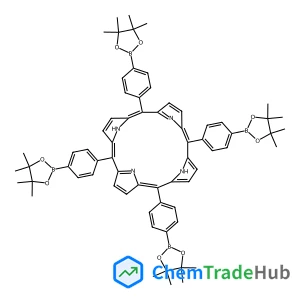
5,10,15,20-tetrakis(4-boronic acid pinacol ester phenyl) porphyrin
CAS号:
1332748-00-1
分子式:
C68H74B4N4O8
推荐供应商


免责声明
本页面提供的学术期刊信息仅供参考和研究使用。我们与任何期刊出版商均无关联,也不处理投稿事宜。如有投稿相关咨询,请直接联系相关期刊出版商。
如发现页面信息有误,请发送邮件至 support@chemtradehub.com 联系我们。我们将及时核实并处理您的问题。