









Enhanced selectivity of target gas molecules through a minimal array of gas sensors based on nanoparticle-decorated SWCNTs
文献信息
发布日期
2019-05-30
DOI
10.1039/C9AN00551J
影响因子
4.616
作者
Sonia Freddi, Giovanni Drera, Stefania Pagliara, Andrea Goldoni, Luigi Sangaletti
查看原文
摘要
An array of five sensors, based on carbon nanotubes (CNT) functionalized with nanoparticles of Au, TiO2, ITO, and Si has been fabricated and exposed to a selected series of target gas molecules (NH3, NO2, H2S, H2O, benzene, ethanol, acetone, 2-propanol, sodium hypochlorite, and several combinations of two gases). The results of principal component analysis (PCA) of the experimental data show that this array of sensors is able to detect different target gas and to discriminate each molecule in the 2D PCA parameters space. In particular, the possibility to include in the array a humidity sensor significantly increases the capability to discriminate the response to volatile organic compounds (VOCs), even though VOCs usually react with CNTs less than NO2 or NH3. This leads to an improvement in selectivity that could meet the requirements for gas detection applications in the field of environmental monitoring and breathomics, where sensors are exposed to a variety of different molecules and where the humidity can severely affect the overall response of the sensor. Finally, we demonstrate that the ability to test multiple sensors simultaneously can reveal a specific sensor sensitivity, addressing the best functionalization choice to improve the response of new sensors based on decorated CNT layers. In particular, our study shows the better capability of the ITO-decorated sensor to detect H2S and benzene.
相关文献
Impact of intrinsic framework flexibility for selective adsorption of sarin in non-aqueous solvents using metal–organic frameworks
Jongwoo Park, Mayank Agrawal, Dorina F. Sava Gallis, Jacob A. Harvey, Jeffery A. Greathouse, David S. Sholl
2020-02-28
Paper
DOI: 10.1039/C9CP06788D
A molecular device providing a remarkable spin filtering effect due to the central molecular stretch caused by lateral zigzag graphene nanoribbon electrodes
Xiaoyue Liu, Jueming Yang, Xingwu Zhai, Hongxia Yan, Yanwen Zhang, Long Zhou
2020-02-28
Paper
DOI: 10.1039/D0CP00238K
Theoretical study on the stability and aromaticity in silapentafulvenes towards triplet ground state species
Jiashun Wu, Alvi Muhammad Rouf, Yuanyuan Huang, Danling Zhuang, Jun Zhu
2020-02-03
Paper
DOI: 10.1039/C9CP06506G
Phase transition and mechanical properties of cesium bismuth silver halide double perovskites (Cs2AgBiX6, X = Cl, Br, I): a DFT approach
Javad Beheshtian
2020-02-05
Paper
DOI: 10.1039/C9CP05342E
Explaining doping in material research (Hf substitution in ZnO films) by directly quantifying the van der Waals force
Chia-Yun Lai, Sergio Santos, Boulos Alfakes, Nitul Rajput, Tobias Boström
2020-02-04
Paper
DOI: 10.1039/C9CP06441A
Formation of N2 bubbles along grain boundaries in (ZnO)1−x(GaN)x: nanoscale STEM-EELS studies
Calliope Bazioti, Vegard S. Olsen, Andrej Y. Kuznetsov, Lasse Vines, Øystein Prytz
2020-01-31
Communication
DOI: 10.1039/C9CP06025A
Interfacial structure in the liquid–liquid extraction of rare earth elements by phosphoric acid ligands: a molecular dynamics study
Balarama Sridhar Dwadasi, Sriram Goverapet Srinivasan, Beena Rai
2020-02-05
Paper
DOI: 10.1039/C9CP05719F
Excited state hydrogen transfer dynamics in phenol–(NH3)2 studied by picosecond UV-near IR-UV time-resolved spectroscopy
Shun-ichi Ishiuchi, Junko Kamizori, Norihiro Tsuji, Makoto Sakai, Mitsuhiko Miyazaki, Claude Dedonder
2020-02-10
Paper
DOI: 10.1039/C9CP06369B
Steady semiconducting properties of monolayer PtSe2 with non-metal atom and transition metal atom doping
Ranzhuo Huang, Tianxing Wang, Xianqi Dai, Shuyi Wei, Yaqiang Ma
2020-02-13
Paper
DOI: 10.1039/C9CP06249A
您可能还喜欢
化合物问答
(5-氨基吡唑-3-基)乙酸(CAS号:174891-10-2)的物理化学性质是什么?
(5-氨基吡唑-3-基)乙酸是一种无色至白色固体,分子量为174.15 g/mol。它在水中具有较好的溶解性,在有机溶剂中的溶解度较低。该化合物具有较好的反应活...
174891-10-2(3-Amino-1H-pyrazol-...
化合物问答
3-氟-4,5-二氯苯胺(CAS号:35754-38-2)适用哪些法规指南?
3-氟-4,5-二氯苯胺受到多项法规指南的约束,包括但不限于GHS(全球化学品统一分类和标签制度)的危险分类标准、欧盟的REACH法规(注册、评估、授权和限制)...
35754-38-23,4-Dichloro-5-fluor...
化合物问答
什么是(R)-(+)-2,2',6,6'-四甲氧基-4,4'-联(二(3,5-二甲苯基基)膦基)-3,3'-二联吡啶(CAS号:442905-33-1)?
这是一种有机化合物,化学名为(R)-(+)-2,2',6,6'-四甲氧基-4,4'-联(二(3,5-二甲苯基基)膦基)-3,3'-二联吡啶,CAS号为44290...
442905-33-14,4'-Bis[bis(3,5-dim...
化合物问答
1-氨基-2-氰基萘(CAS号:3100-67-2)应用于哪些行业?
1-氨基-2-氰基萘在医药、聚合物、传感器和半导体等行业中有应用。在医药领域,它可用作中间体合成某些药物。在聚合物行业,它可以用于制备具有特定性能的聚合物。此外...
3100-67-21-Amino-2-naphthonit...
化合物问答
如何处理含有1-溴-4-(异丙氧基甲基)苯(CAS号:98446-84-5)的废料?
处理含1-溴-4-(异丙氧基甲基)苯的废料时,首先应确保废液收集在防渗漏的容器中,避免泄露。然后,可以考虑采用化学降解法或物理吸附法进行处理。在特定条件下,可通...
98446-84-51-Bromo-4-(isopropox...
化合物问答
6-Chloro-8-(trifluoromethyl)chroman-4-one(CAS号:1344889-75-3)的主要用途是什么?
6-氯-8-三氟甲基-2,3-二氢-4H-色喃-4-酮主要用于有机合成中的中间体,也可作为研究试剂使用。
1344889-75-36-Chloro-8-(trifluor...
化合物问答
7-乙氧基-2-萘酚(CAS号:57944-44-2)通常如何合成?
7-乙氧基-2-萘酚通常通过N-乙氧基化反应合成,首先将2-萘酚与乙醇钠在乙醇中反应生成7-乙氧基-2-萘酚钠盐,再通过酸化进一步得到7-乙氧基-2-萘酚。该合...
57944-44-27-Ethoxy-2-naphthol
化合物问答
4-(1,1-二氧硫代吗啉)丁醇(CAS号:59801-41-1)适用哪些法规指南?
该化合物需遵循一系列的法规指南,包括但不限于GHS全球统一分类和标签制度,其分类可能包括易燃液体和可能危害水生环境。在欧洲,还需遵循REACH法规,确保物质和混...
59801-41-14-(4-Hydroxybutyl)th...
化合物问答
4-甲氧基苄基叠氮甲酸酯(CAS号:25474-85-5)的物理化学性质是什么?
4-甲氧基苄基叠氮甲酸酯是一种无色液体,具有一定的挥发性。其分子量为198.16,熔点为-69°C,沸点为105°C。该化合物在水中溶解度较低,在有机溶剂如乙醇...
25474-85-54-Methoxybenzyl carb...
化合物问答
如何处理含有4-氯-2-氟嘧啶(CAS号:51422-00-5)的废料?
含有4-氯-2-氟嘧啶的废料应按照危险废物处理。首先,应收集并分类这些废料,避免与其他废物混合。然后,可以采用焚烧处理或者交由专业机构进行处置。在处理过程中,需...
51422-00-54-Chloro-2-fluoropyr...
来源期刊
Analyst

CiteScore:
7.8
自引率:
5.6%
年发文量:
653
Analyst publishes analytical and bioanalytical research that reports premier fundamental discoveries and inventions, and the applications of those discoveries, unconfined by traditional discipline barriers.
推荐化合物
![6-Bromo-3-ethyl-3H-imidazo[4,5-b]pyridine structure](https://cnstatic.chemtradehub.com/structs/103/1033202-59-3-2a8f.webp "6-Bromo-3-ethyl-3H-imidazo[4,5-b]pyridine structure")
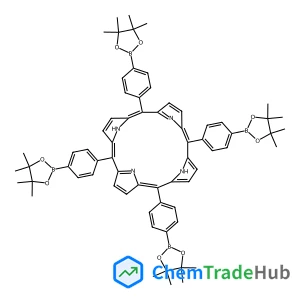
5,10,15,20-tetrakis(4-boronic acid pinacol ester phenyl) porphyrin
CAS号:
1332748-00-1
分子式:
C68H74B4N4O8
![N-{3-[Benzyl(methyl)amino]propyl}-9-chloro-5,6,7,8-tetrahydro-2-acridinecarboxamide structure](https://cnstatic.chemtradehub.com/structs/142/1426944-49-1-1e4c.webp "N-{3-[Benzyl(methyl)amino]propyl}-9-chloro-5,6,7,8-tetrahydro-2-acridinecarboxamide structure")
推荐供应商






免责声明
本页面提供的学术期刊信息仅供参考和研究使用。我们与任何期刊出版商均无关联,也不处理投稿事宜。如有投稿相关咨询,请直接联系相关期刊出版商。
如发现页面信息有误,请发送邮件至 support@chemtradehub.com 联系我们。我们将及时核实并处理您的问题。