




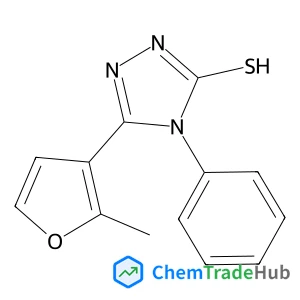
5-(2-Methyl-3-furyl)-4-phenyl-2,4-dihydro-3H-1,2,4-triazole-3-thione
CAS号:
346464-59-3
分子式:
C13H11N3OS
Balarama Sridhar Dwadasi, Sriram Goverapet Srinivasan, Beena Rai
Solvent extraction (SX), wherein two immiscible liquids, one containing the extractant molecules and the other containing the solute to be extracted are brought in contact to effect the phase transfer of the solute, underpins metal extraction and recovery processes. The interfacial region is of utmost importance in the SX process, since besides thermodynamics, the physical and chemical heterogeneity at the interface governs the kinetics of the process. Yet, a fundamental understanding of this heterogeneity and its implications for the extraction mechanism are currently lacking. We use molecular dynamics (MD) simulations to study the liquid–liquid interface under conditions relevant to the SX of Rare Earth Elements (REEs) by a phosphoric acid ligand. Simulations revealed that the extractant molecules and varying amounts of acid and metal ions partitioned to the interface. The presence of these species had a significant effect on the interfacial thickness, hydrogen bond life times and orientations of the water molecules at the interface. Deprotonation of the ligands was essential for the adsorption of the metal ions at the interface, with these ions forming a number of different complexes at the interface involving one to three extractant molecules and four to eight water molecules. Although the interface itself was rough, no obvious ‘finger-like’ water protrusions penetrating the organic phase were seen in our simulations. While the results of our work help us gain fundamental insights into the sequence of events leading to the formation of a variety of interfacial complexes, they also emphasize the need to carry out a more detailed atomic level study to understand the full mechanism of extraction of REEs from the aqueous to organic phases by phosphoric acid ligands.
Basit Yameen, Mubarak Ali, Marta Álvarez, Reinhard Neumann, Wolfgang Ensinger, Wolfgang Knoll, Omar Azzaroni
DOI: 10.1039/B9PY00201D
Remi Beucher, Vasile Hulea, Claudia Cammarano
DOI: 10.1039/D1RE00258A
Zifei Yan, Chencan Du, Guangsheng Luo, Jian Deng
DOI: 10.1039/D1RE00277E
Ségolène Brusseau, Joël Belleney, Stéphanie Magnet, Laurence Couvreur
DOI: 10.1039/B9PY00371A
Gijs J. M. Habraken, Maloes Peeters, Carin H. J. T. Dietz, Cor E. Koning
DOI: 10.1039/B9PY00337A
Hamish R. Stephen, Sarah Boyall, Christiane Schotten, Richard A. Bourne, Nikil Kapur, Charlotte E. Willans
DOI: 10.1039/D1RE00530H
Dominique M. Roberge, Paul Hanselmann, Petteri Elsner
DOI: 10.1039/D1RE00264C
Pedro S. F. Mendes, Sébastien Siradze, Laura Pirro, Joris W. Thybaut
DOI: 10.1039/D1RE00215E
Wenqiao Du, Zaiqian Yu, Xin Wang, Jingdong Wu, Long Zhang
DOI: 10.1039/D1RE00289A
2,6-二溴-4,8-双[(2-乙基己基)氧基]苯并[1,2-b:4,5-b']二噻吩是一种有机化合物,分子式为C23H32Br2O2S2。该化合物具有芳香性和...
木聚硫钠通常为无色或白色结晶性粉末,具有吸湿性。其分子量约为121.11 g/mol。木聚硫钠易溶于水,不溶于醇类和其他非极性溶剂。在酸性或碱性溶液中,木聚硫钠...
该化合物在合成、储存和运输过程中需遵循《全球化学品统一分类和标签制度》(GHS)的健康、环境和物理危险分类。在欧洲还需符合《化学品注册、评估、授权和限制》(RE...
1,4-二氮杂双环[2.2.2]辛烷-1,4-二硫酸二酯主要用于有机合成中的保护基团,特别是在保护胺基和硫醇基方面具有广泛应用。此外,它还用于一些特殊化学反应的...
含有4-(Bromomethyl)-2-fluorobenzenesulphonamide的废液应首先进行中和处理,以降低pH值,避免对环境造成腐蚀性影响。随后...
Loureiriol是一种天然化合物,其分子式为C15H22O4。Loureiriol为无色结晶性粉末,具有较高的熔点和良好的热稳定性。其相对分子质量为262....
在合成过程中,可以考虑使用类似结构的化合物作为3-氨基苯甲酰苯胺的替代品,例如N-苯基-3-氰基苯胺或N-苯基-3-硝基苯胺等,这些化合物具有相似的化学性质,可...
4-异氰酰苯基硼酸频哪醇酯主要应用于有机合成、药物化学和材料科学领域。随着绿色化学的发展,该化合物因其高效的官能团转化能力和环境友好性而受到越来越多的关注。近年...
3β-乙酰氧基-7,25-甘遂二烯-24(R)-醇应储存在阴凉、干燥、通风良好的地方,避免直接光照。储存容器应密封,防止空气中的水分和氧气影响化合物的稳定性。建...
应将4-氟-2-甲基-1H-吲哚存放在阴凉、干燥、通风良好的地方,避免直接暴露在光照下。容器应密封,避免与空气中的水蒸气接触。建议在避光、温度不超过25℃的环境...

Physical Chemistry Chemical Physics (PCCP) is an international journal co-owned by 19 physical chemistry and physics societies from around the world. This journal publishes original, cutting-edge research in physical chemistry, chemical physics and biophysical chemistry. To be suitable for publication in PCCP, articles must include significant innovation and/or insight into physical chemistry; this is the most important criterion that reviewers and Editors will judge against when evaluating submissions. The journal has a broad scope and welcomes contributions spanning experiment, theory, computation and data science. Topical coverage includes spectroscopy, dynamics, kinetics, statistical mechanics, thermodynamics, electrochemistry, catalysis, surface science, quantum mechanics, quantum computing and machine learning. Interdisciplinary research areas such as polymers and soft matter, materials, nanoscience, energy, surfaces/interfaces, and biophysical chemistry are welcomed if they demonstrate significant innovation and/or insight into physical chemistry. Joined experimental/theoretical studies are particularly appreciated when complementary and based on up-to-date approaches.
![6-(Benzyloxy)-8-(2-bromoacetyl)-2H-benzo[b][1,4]oxazin-3(4H)-one structure](https://cnstatic.chemtradehub.com/structs/926/926319-53-1-2287.webp "6-(Benzyloxy)-8-(2-bromoacetyl)-2H-benzo[b][1,4]oxazin-3(4H)-one structure")
![[(2R)-6,6-Dimethyl-2-morpholinyl]methanol hydrochloride (1:1) structure](https://cnstatic.chemtradehub.com/structs/141/1416444-88-6-e06a.webp "[(2R)-6,6-Dimethyl-2-morpholinyl]methanol hydrochloride (1:1) structure")