





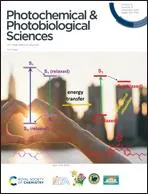


Responsive methylene blue release from lanthanide coordination polymer for label-free, immobilization-free and sensitive electrochemical alkaline phosphatase activity assay
文献信息
发布日期
2019-08-19
DOI
10.1039/C9AN01325C
影响因子
4.616
作者
Zhiqiang Chen, Shuang Liu, Xiaoxiao Yu, Lijie Hao, Li Wang, Shufeng Liu
查看原文
摘要
Alkaline phosphatase (ALP) is an important enzyme related to many clinical diseases and also widely used as a labeling enzyme for immunoassay. Herein, a new electrochemical sensing strategy for ALP activity was proposed, which was based on the ALP-triggered methylene blue (MB) release from a lanthanide coordination polymer and successive penetration through a self-assembled dodecanethiol monolayer for electrochemical response. The supramolecular lanthanide coordination polymer was constructed by using guanine monophosphate (GMP) and Tb3+ as the ligand and the metal ion, respectively, and the encapsulated MB as the signal molecule. ALP catalyzed the cleavage of the phosphate group from the GMP ligand and disrupted the coordination polymer network to release abundant MB molecules for electrochemical responses related to ALP activity. The obtained lanthanide coordination polymers were well characterized by various techniques. The fabricated electrochemical sensor for ALP activity assay shows distinct advantages such as being one-step, label-free, immobilization-free and highly sensitive. The detection limit toward ALP activity was down to 0.5 U L−1. With the aid of a MB enrichment process on the modified electrode before measurement, the detection limit could be further improved to 0.1 U L−1. Moreover, the assay method could be applied for ALP detection in complex matrixes such as human serum and also for efficient inhibitor evaluation. Thus, the current study provides a new pathway to the fabrication of a coordination polymer-based electrochemical sensing platform for applications in disease diagnosis and drug discovery.
期刊推荐
相关文献
Molecular and dissociative O2 adsorption on the Cu2O(111) surface
Xiaohu Yu, Caibin Zhao, Tianlei Zhang, Zhong Liu
2018-05-23
Paper
DOI: 10.1039/C8CP03035A
Band alignment in quantum wells from automatically tuned DFT+U
Chungwei Lin, Andrew Knyazev, Keisuke Kojima, Joseph Katz, Koichi Akiyama, Eiji Nakai, Hiroyuki Kawahara
2019-02-22
Paper
DOI: 10.1039/C9CP00122K
Reaction pathways for HCN on transition metal surfaces
Mohammed Abdel-Rahman, Xu Feng, Mark Muir, Kushal Ghale, Ye Xu, Michael Trenary
2019-02-18
Paper
DOI: 10.1039/C8CP07548D
Extending the scope of the carbonyl facilitated triplet excited state towards visible light excitation
Shinaj K. Rajagopal, Nagaraj K., Somadrita Deb, Vinayak Bhat, Devika Sasikumar, Ebin Sebastian, Mahesh Hariharan
2018-06-18
Paper
DOI: 10.1039/C8CP01023D
Analysis of the interfacial characteristics of BiVO4/metal oxide heterostructures and its implication on their junction properties
Sebastián Murcia-López, Andreas Klein, Roel van de Krol, Teresa Andreu, Joan Ramón Morante, Thierry Toupance, Wolfram Jaegermann
2019-01-29
Paper
DOI: 10.1039/C8CP07483F
Excitation of singlet–triplet coherences in pairs of nearly-equivalent spins
Christian Bengs, Joseph T. Hill-Cousins, Lynda J. Brown, Richard C. D. Brown, Giuseppe Pileio, Malcolm H. Levitt
2019-02-18
Paper
DOI: 10.1039/C9CP00451C
Properties of perhalogenated {closo-B10} and {closo-B11} multiply charged anions and a critical comparison with {closo-B12} in the gas and the condensed phase
Jonas Warneke, Szymon Z. Konieczka, Gao-Lei Hou, Edoardo Aprà, Christoph Kerpen, Fabian Keppner, Thomas C. Schäfer, Michael Deckert, Zheng Yang, Eric J. Bylaska, Grant E. Johnson, Julia Laskin, Xue-Bin Wang, Maik Finze
2018-11-07
Paper
DOI: 10.1039/C8CP05313H
Rotational (de)-excitation of linear C3O by collision with He
Fehmi Khadri, Kamel Hammami
2019-01-29
Paper
DOI: 10.1039/C8CP07409G
Vertical vs. adiabatic ionization energies in solution and gas-phase: probing ionization-induced reorganization in conformationally-mobile bichromophoric actuators using photoelectron spectroscopy, electrochemistry and theory
Maxim V. Ivanov, Denan Wang, Depeng Zhang, Rajendra Rathore, Scott A. Reid
2018-09-24
Paper
DOI: 10.1039/C8CP02936A
Geometry and energetics of CO adsorption on hydroxylated UiO-66
Darren M. Driscoll, Diego Troya, Pavel M. Usov, Andrew J. Maynes, Amanda J. Morris, John R. Morris
2019-02-05
Paper
DOI: 10.1039/C8CP07778A
您可能还喜欢
化合物问答
6-氯-2H-1,4-苯并噁嗪-3(4H)-酮(CAS号:7652-29-1)应用于哪些行业?
6-氯-2H-1,4-苯并噁嗪-3(4H)-酮主要应用于医药、农药和聚合物等领域。在医药领域,该化合物可用于合成抗菌药物;在农药领域,可用作杀虫剂的中间体;在聚...
7652-29-16-Chloro-2H-1,4-benz...
化合物问答
活性氧化铝(CAS号:1302-74-5)应用于哪些行业?
活性氧化铝广泛应用于医药、聚合物、传感器、半导体和催化等领域。在医药行业,活性氧化铝用作吸附剂和干燥剂,有助于去除杂质和水分。在聚合物行业,它用作增白剂和抗结块...
1302-74-5aluminum;trihydrate
化合物问答
什么是硅胶(CAS号:112926-00-8)?
硅胶(Silica gel, pptd.,cryst.-free)是一种无定形、多孔的硅酸盐材料,主要成分为二氧化硅(SiO₂)。其结构由硅氧四面体构成,通过酸...
112926-00-8Silica gel, pptd.,cr...
化合物问答
二乙基甲基一氢硅烷(CAS号:760-32-7)的主要用途是什么?
二乙基甲基一氢硅烷主要用于有机合成、表面处理以及作为溶剂。它还被用作合成其他硅烷化合物的原料,以及在涂料、粘合剂和密封剂中的应用。
760-32-7Diethyl(methyl)silan...
化合物问答
在合成中是否有N-花生四烯酰基甘氨酸(CAS号:179113-91-8)的替代品?
在合成过程中,可以考虑使用类似结构的化合物作为替代品,例如N-亚油酰基甘氨酸或N-花生二烯酰基甘氨酸。这些替代品在结构上有类似的双键位置,但可能具有不同的物理化...
179113-91-8Glycine, N-[(5Z,8Z,1...
化合物问答
在合成中是否有1-(4-甲氧基苯基)丙烷-1,2-二酮(CAS号:10557-27-4)的替代品?
在合成过程中,可以考虑使用类似结构的化合物作为替代品,例如1-(3-甲氧基苯基)丙烷-1,2-二酮或1-(4-羟基苯基)丙烷-1,2-二酮。这些替代品具有相似的...
10557-27-41-(4-Methoxyphenyl)p...
化合物问答
N-(4-氨基-1-苄基-3-羟基-5-苯基戊基)-3-甲基-2-(2-氧代四氢嘧啶-1-基)-丁酰胺 5-氧代吡咯烷-2-甲酸(CAS号:192726-06-0)通常如何合成?
该化合物通常通过一系列复杂的有机合成步骤获得。首先,通过芳香族化合物的羟基化反应获得羟基化产物,然后通过酰化反应形成酰胺中间体,最后通过环化反应得到目标产物。常...
192726-06-05-Oxo-L-proline - (2...
化合物问答
(S)-2-氨基-3-喹啉-2-丙酸(CAS号:161513-46-8)的市场或研究趋势如何?
该化合物作为生物活性化合物,尤其是在药物化学领域表现出色。近年来,随着对新型抗炎、抗病毒和抗癌药物的研究增加,其市场和研究趋势持续增长。此外,其在神经科学领域的...
161513-46-8(S)-2-Amino-3-quinol...
化合物问答
核黄素磷酸钠(CAS号:130-40-5)安全吗?
核黄素磷酸钠在常规使用条件下安全,但高剂量可能引起刺激性反应。操作时需佩戴防护手套和护目镜,避免吸入粉尘。若接触皮肤或眼睛,应立即用大量清水冲洗。急救时需根据接...
130-40-5Sodium 1-deoxy-1-(7,...
化合物问答
盐酸丙胺卡因杂质A(EP) 标准品(CAS号:19281-31-3)通常如何合成?
盐酸丙胺卡因杂质A(EP) 标准品可通过重氮化反应和随后的酰胺化反应合成。首先,利用氯化反应将苯环上的氢原子转化为氯原子,然后通过芳香族重氮化反应引入氨基,最后...
19281-31-32-Chloro-N-(2-methyl...
来源期刊
Analyst

CiteScore:
7.8
自引率:
5.6%
年发文量:
653
Analyst publishes analytical and bioanalytical research that reports premier fundamental discoveries and inventions, and the applications of those discoveries, unconfined by traditional discipline barriers.
推荐化合物
![5-Methyl-4,5,6,7-tetrahydropyrazolo[1,5-a]pyrazin-2-amine structure](https://cnstatic.chemtradehub.com/structs/122/1227210-33-4-8d64.webp "5-Methyl-4,5,6,7-tetrahydropyrazolo[1,5-a]pyrazin-2-amine structure")
![tert-Butyl N-[(2-chloropyridin-4-yl)methyl]carbamate structure](https://cnstatic.chemtradehub.com/structs/916/916210-27-0-9f95.webp "tert-Butyl N-[(2-chloropyridin-4-yl)methyl]carbamate structure")
推荐供应商





免责声明
本页面提供的学术期刊信息仅供参考和研究使用。我们与任何期刊出版商均无关联,也不处理投稿事宜。如有投稿相关咨询,请直接联系相关期刊出版商。
如发现页面信息有误,请发送邮件至 support@chemtradehub.com 联系我们。我们将及时核实并处理您的问题。