






![5-Methyl-4,5,6,7-tetrahydropyrazolo[1,5-a]pyrazin-2-amine structure](https://cnstatic.chemtradehub.com/structs/122/1227210-33-4-8d64.webp "5-Methyl-4,5,6,7-tetrahydropyrazolo[1,5-a]pyrazin-2-amine structure")
Discriminative potential of ion mobility spectrometry for the detection of fentanyl and fentanyl analogues relative to confounding environmental interferents‡
文献信息
发布日期
2019-09-27
DOI
10.1039/C9AN01771B
影响因子
4.616
作者
Thomas P. Forbes, Jeffrey Lawrence, Jennifer R. Verkouteren, R. Michael Verkouteren
查看原文
摘要
The opioid crisis and emergence of fentanyl, fentanyl analogues, and other synthetic opioids has highlighted the need for sensitive and robust detection for interdiction at screening points, notably vehicles at border crossings and packages at postal facilities. This work investigates the discriminative potential, sensitivity and specificity, of ion mobility spectrometry (IMS) for the detection of fentanyl and fifteen (15) fentanyl-related compounds (analogues, other opioids, and metabolites) relative to confounding environmental interferents. The environmental background interferent levels, frequency and intensity, were derived from over 10 000 screening samples collected from delivery vehicles entering a federal site. A receiver operating characteristic (ROC) curve methodology was employed to quantify the relationship between sensitivity and specificity for these target compounds on two instruments/configurations. These instrument configurations differed in desorption and drift tube temperatures, reactant ion dopant chemistry, and analysis time. This work identified reduced mobility areas of high interference that resulted in increased false positive rates (FPR), effectively reducing sensitivity (true positive rate: TPR) in those regions. Except for a few target compounds on either of the instruments that exhibited elevated FPRs, detection of fentanyl and fentanyl-related species was achieved at single to tens of nanograms with ≥90% TPR and ≤2% FPR. This work established the importance of systematic environmental background characterization at each specific screening setting in evaluating a platform's true performance.
相关文献
Thermally activated delayed fluorescence in a deep red dinuclear iridium(iii) complex: a hidden mechanism for short luminescence lifetimes
Andrey V. Zaytsev, Amit Sil, Glib V. Baryshnikov, J. A. Gareth Williams, Fernando B. Dias, Valery N. Kozhevnikov
2023-11-14
Edge Article
DOI: 10.1039/D3SC04450E
A universal orthogonal imaging platform for living-cell RNA detection using fluorogenic RNA aptamers
Peng Yin, Mingmin Ge, Shiyi Xie, Li Zhang, Shi Kuang, Zhou Nie
2023-12-02
Edge Article
DOI: 10.1039/D3SC04957D
1,2-Disubstituted bicyclo[2.1.1]hexanes as saturated bioisosteres of ortho-substituted benzene
Aleksandr Denisenko, Pavel Garbuz, Yelyzaveta Makovetska, Dmytro Lesyk, Rodion Korzh, Iryna V. Sadkova, Pavel K. Mykhailiuk
2023-10-27
Edge Article
DOI: 10.1039/D3SC05121H
Atomically accurate site-specific ligand tailoring of highly acid- and alkali-resistant Ti(iv)-based metallamacrocycle for enhanced CO2 photoreduction
Yi-Qi Tian, Lin-Fang Dai, Wen-Lei Mu, Wei-Dong Yu, Jun Yan, Chao Liu
2023-11-30
Edge Article
DOI: 10.1039/D3SC06046B
Manipulating the crystal plane angle within the primary particle arrangement for the radial ordered structure in a Ni-rich cathode
Ting Chen, Chuyao Wen, Chen Wu, Lang Qiu, Zhenguo Wu, Jiayang Li, Yanfang Zhu, Haoyu Li, Qingquan Kong, Yang Song, Fang Wan, Mingzhe Chen, Ismael Saadoune, Benhe Zhong, Shixue Dou, Yao Xiao
2023-11-27
Edge Article
DOI: 10.1039/D3SC05461F
Engineering TADF, mechanochromism, and second harmonic up-conversion properties in regioisomeric substitution space
Abhijit Chatterjee, Joy Chatterjee, Subrahmanyam Sappati, Riteeka Tanwar, Madan D. Ambhore, Habibul Arfin, Rintu M. Umesh, Mayurika Lahiri, Pankaj Mandal, Partha Hazra
2023-11-08
Edge Article
DOI: 10.1039/D3SC04280D
Computationally guided bioengineering of the active site, substrate access pathway, and water channels of thermostable cytochrome P450, CYP175A1, for catalyzing the alkane hydroxylation reaction
Mohd Taher, Kshatresh Dutta Dubey, Shyamalava Mazumdar
2023-12-04
Edge Article
DOI: 10.1039/D3SC02857G
Using waste to treat waste: facile synthesis of hollow carbon nanospheres from lignin for water decontamination
Xiang Liu, Zixuan Hao, Chen Fang, Kun Pang, Jiaying Yan, Yingping Huang, Di Huang
2023-11-27
Edge Article
DOI: 10.1039/D3SC05275C
Matrix stiffness-dependent microglia activation in response to inflammatory cues: in situ investigation by scanning electrochemical microscopy
Jian Zhuang, Hua Zhang
2023-11-28
Edge Article
DOI: 10.1039/D3SC03504B
A library of vinyl phosphonate anions dimerize with cyanostars, form supramolecular polymers and undergo statistical sorting
Yusheng Chen, Anastasia Kuvayskaya, Maren Pink, Amar H. Flood
2023-11-29
Edge Article
DOI: 10.1039/D3SC03685E
您可能还喜欢
化合物问答
6-氯-2H-1,4-苯并噁嗪-3(4H)-酮(CAS号:7652-29-1)应用于哪些行业?
6-氯-2H-1,4-苯并噁嗪-3(4H)-酮主要应用于医药、农药和聚合物等领域。在医药领域,该化合物可用于合成抗菌药物;在农药领域,可用作杀虫剂的中间体;在聚...
7652-29-16-Chloro-2H-1,4-benz...
化合物问答
活性氧化铝(CAS号:1302-74-5)应用于哪些行业?
活性氧化铝广泛应用于医药、聚合物、传感器、半导体和催化等领域。在医药行业,活性氧化铝用作吸附剂和干燥剂,有助于去除杂质和水分。在聚合物行业,它用作增白剂和抗结块...
1302-74-5aluminum;trihydrate
化合物问答
什么是硅胶(CAS号:112926-00-8)?
硅胶(Silica gel, pptd.,cryst.-free)是一种无定形、多孔的硅酸盐材料,主要成分为二氧化硅(SiO₂)。其结构由硅氧四面体构成,通过酸...
112926-00-8Silica gel, pptd.,cr...
化合物问答
二乙基甲基一氢硅烷(CAS号:760-32-7)的主要用途是什么?
二乙基甲基一氢硅烷主要用于有机合成、表面处理以及作为溶剂。它还被用作合成其他硅烷化合物的原料,以及在涂料、粘合剂和密封剂中的应用。
760-32-7Diethyl(methyl)silan...
化合物问答
在合成中是否有N-花生四烯酰基甘氨酸(CAS号:179113-91-8)的替代品?
在合成过程中,可以考虑使用类似结构的化合物作为替代品,例如N-亚油酰基甘氨酸或N-花生二烯酰基甘氨酸。这些替代品在结构上有类似的双键位置,但可能具有不同的物理化...
179113-91-8Glycine, N-[(5Z,8Z,1...
化合物问答
在合成中是否有1-(4-甲氧基苯基)丙烷-1,2-二酮(CAS号:10557-27-4)的替代品?
在合成过程中,可以考虑使用类似结构的化合物作为替代品,例如1-(3-甲氧基苯基)丙烷-1,2-二酮或1-(4-羟基苯基)丙烷-1,2-二酮。这些替代品具有相似的...
10557-27-41-(4-Methoxyphenyl)p...
化合物问答
N-(4-氨基-1-苄基-3-羟基-5-苯基戊基)-3-甲基-2-(2-氧代四氢嘧啶-1-基)-丁酰胺 5-氧代吡咯烷-2-甲酸(CAS号:192726-06-0)通常如何合成?
该化合物通常通过一系列复杂的有机合成步骤获得。首先,通过芳香族化合物的羟基化反应获得羟基化产物,然后通过酰化反应形成酰胺中间体,最后通过环化反应得到目标产物。常...
192726-06-05-Oxo-L-proline - (2...
化合物问答
(S)-2-氨基-3-喹啉-2-丙酸(CAS号:161513-46-8)的市场或研究趋势如何?
该化合物作为生物活性化合物,尤其是在药物化学领域表现出色。近年来,随着对新型抗炎、抗病毒和抗癌药物的研究增加,其市场和研究趋势持续增长。此外,其在神经科学领域的...
161513-46-8(S)-2-Amino-3-quinol...
化合物问答
核黄素磷酸钠(CAS号:130-40-5)安全吗?
核黄素磷酸钠在常规使用条件下安全,但高剂量可能引起刺激性反应。操作时需佩戴防护手套和护目镜,避免吸入粉尘。若接触皮肤或眼睛,应立即用大量清水冲洗。急救时需根据接...
130-40-5Sodium 1-deoxy-1-(7,...
化合物问答
盐酸丙胺卡因杂质A(EP) 标准品(CAS号:19281-31-3)通常如何合成?
盐酸丙胺卡因杂质A(EP) 标准品可通过重氮化反应和随后的酰胺化反应合成。首先,利用氯化反应将苯环上的氢原子转化为氯原子,然后通过芳香族重氮化反应引入氨基,最后...
19281-31-32-Chloro-N-(2-methyl...
来源期刊
Analyst

CiteScore:
7.8
自引率:
5.6%
年发文量:
653
Analyst publishes analytical and bioanalytical research that reports premier fundamental discoveries and inventions, and the applications of those discoveries, unconfined by traditional discipline barriers.
推荐化合物
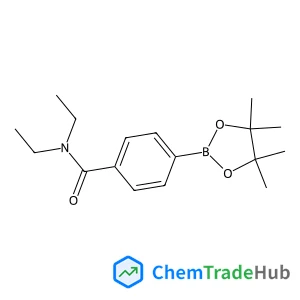
N,N-Diethyl-4-(4,4,5,5-tetramethyl-1,3,2-dioxaborolan-2-yl)benzamide
CAS号:
325142-99-2
分子式:
C17H26BNO3
推荐供应商




免责声明
本页面提供的学术期刊信息仅供参考和研究使用。我们与任何期刊出版商均无关联,也不处理投稿事宜。如有投稿相关咨询,请直接联系相关期刊出版商。
如发现页面信息有误,请发送邮件至 support@chemtradehub.com 联系我们。我们将及时核实并处理您的问题。