


Novel inorganic aromatic mixed-valent superalkali electride CaN3Ca: an alkaline-earth-based high-sensitivity multi-state nonlinear optical molecular switch
文献信息
发布日期
2020-02-19
DOI
10.1039/C9CP06848A
影响因子
3.676
作者
Yin-Feng Wang, Tian Qin, Jia-Min Tang, Yan-Jiao Liu, Miao Xie, Jia Li, Jiangen Huang, Zhi-Ru Li
查看原文
摘要
Focusing on innovative high-performance single-pole double-throw nonlinear optical (NLO) molecular switches, two C3v configurations (1 and 3) and one D3h configuration (2) of bipyramidal CaN3Ca have been obtained by using quantum mechanical methods. Not only are 1, 2, and 3 alkaline-earth-based aromatic superalkalis, but they are also interesting electrides. The salt-like electronic structures of e−⋯Ca2+N33−Ca2+ (1) and Ca2+N33−Ca2+⋯e− (3) with localized redox centres are rare inorganic Robin–Day class II-type structures, and e0.5−⋯Ca2+N33−Ca2+⋯e0.5− (2) with a delocalized structure is a class III-type mixed-valent superalkali electride. Under a small external electric field of ±0.0110 a.u. (0.565 V Å−1), the short-distance hopping of Ca atoms in CaN3Ca from the D3h configuration with in-plane aromaticity to each C3v configuration with out-of-plane aromaticity brings about the long-range transfer of half an electron from one Ca atom to another. And, subsequently, a large dipole moment (μ0) and remarkable static first hyperpolarizability (β0) occur. μz and βzzz range from 0 (D3h, off form) to −12.1 or 12.1 D (C3v, on forms) and from 0 (D3h, off form) to −19 428 or 19 428 a.u. (C3v, on forms), respectively. These extremely large differences in μz and βzzz values between the D3h and each of the C3v configurations confirm the potential of these inorganic aromatic Robin–Day-type superalkali electrides for applications in high-sensitivity multi-state nonlinear optical switches.
期刊推荐
Drug Discovery Today
Journal of Saudi Chemical Society
Russian Journal of General Chemistry
Russian Journal of Organic Chemistry
Current Opinion in Colloid & Interface Science
Russian Chemical Bulletin
Journal of Natural Medicines
Crystallography Reports
Nature Medicine
Current Opinion in Solid State & Materials Science
相关文献
Solvent-shared pairs of densely charged ions induce intense but short-range supra-additive slowdown of water rotation
Ana Vila Verde, Mark Santer, Reinhard Lipowsky
2015-11-25
Paper
DOI: 10.1039/C5CP05726D
Pressure-dependent formation of i-motif and G-quadruplex DNA structures
S. Takahashi
2015-09-03
Paper
DOI: 10.1039/C5CP04727G
Transient low-barrier hydrogen bond in the photoactive state of green fluorescent protein
Marc Nadal-Ferret, Ricard Gelabert, Miquel Moreno
2015-04-24
Paper
DOI: 10.1039/C5CP01067E
Probing electrode/electrolyte interfaces in situ by X-ray spectroscopies: old methods, new tricks
Robert S. Weatherup
2015-09-21
Perspective
DOI: 10.1039/C5CP04058B
Photoinduced charge separation in an oligophenylenevinylene-based Hamilton-type receptor supramolecularly associating two C60-barbiturate guests
G. Pagona, A. Stergiou, H. B. Gobeze, G. Rotas, F. D'Souza, N. Tagmatarchis
2015-11-17
Paper
DOI: 10.1039/C5CP05657H
Self-assembly of block copolymers on lithographically patterned template with ordered posts
Dan Xu, Yao-Hong Xue, Yan-Bo Sun
2015-11-03
Paper
DOI: 10.1039/C5CP05449D
Spectroscopic evidence of ‘jumping and pecking’ of cholinium and H-bond enhanced cation–cation interaction in ionic liquids
Anne Knorr, Koichi Fumino, Anne-Marie Bonsa
2015-08-11
Communication
DOI: 10.1039/C5CP03412D
A fast but accurate excitonic simulation of the electronic circular dichroism of nucleic acids: how can it be achieved?
Daniele Loco, Sandro Jurinovich, Lorenzo Di Bari, Benedetta Mennucci
2015-11-23
Paper
DOI: 10.1039/C5CP06341H
Cryogenic abnormal thermal expansion properties of carbon-doped La(Fe,Si)13 compounds
Rongjin Huang, Wei Wang, Laifeng Li
2015-10-26
Communication
DOI: 10.1039/C5CP03948G
The role of copper in the thermal conductivity of thermoelectric oxychalcogenides: do lone pairs matter?
P. Vaqueiro, R. A. R. Al Orabi, G. Guélou, A. V. Powell, R. I. Smith, J.-P. Song, D. Wee, M. Fornari
2015-11-06
Paper
DOI: 10.1039/C5CP06192J
您可能还喜欢
化合物问答
(3-氨苯基)环丙基甲酮(CAS号:162174-75-6)的主要用途是什么?
(3-氨苯基)环丙基甲酮主要用于合成化学中间体,特别是在药物化学领域作为原料。它还可以用于有机合成反应中,作为催化剂或反应物。
162174-75-6(3-Aminophenyl)(cycl...
化合物问答
如何储存亚胺菌(CAS号:136470-79-6)?
亚胺菌应储存在干燥、阴凉处,避免直接暴露于光线下。建议使用密封容器储存,防止吸潮和污染。具体的储存条件应参考产品的安全数据表(MSDS)或药品说明书。
136470-79-6Abacavir EP Impurity...
化合物问答
2-氯-2,2-二氟乙酰胺(CAS号:354-28-9)应用于哪些行业?
2-氯-2,2-二氟乙酰胺在医药、聚合物、传感器、半导体等领域有广泛应用。在医药领域,它作为中间体用于合成其他药物;在聚合物领域,用作聚合引发剂或稳定剂;在传感...
354-28-92-Chloro-2,2-difluor...
化合物问答
处理4-甲基-3-硝基-1,1-联苯(CAS号:53812-68-3)时应注意哪些实验室安全事项?
在处理4-甲基-3-硝基-1,1-联苯时,应佩戴手套、护目镜和实验室外套等个人防护装备(PPE),确保在通风橱中操作以减少吸入风险。若发生泄露,应立即使用沙子或...
53812-68-34'-Methyl-3-nitro-1,...
化合物问答
(2S)-羟基(苯基)乙酸 (2R)-N-苄基-1-(4-甲氧基苯基)丙-2-胺盐(CAS号:188690-84-8)应用于哪些行业?
该化合物广泛应用于医药、聚合物和半导体行业。在医药领域,它是某些药物中间体的重要组成部分;在聚合物领域,可用作增塑剂;在半导体行业,可用于制造光刻胶。
188690-84-8Benzeneacetic acid, ...
化合物问答
在合成中是否有芬苯哒唑砜-D3标准品(CAS号:1228182-49-7)的替代品?
芬苯哒唑砜-D3标准品的替代品可能包括类似的苯并咪唑类化合物,如芬苯哒唑本身或其非同位素标记版本。这些替代品在结构上与芬苯哒唑砜-D3相似,但在具体应用中需进行...
1228182-49-7(~2~H_3_)Methyl [5-(...
化合物问答
2-氟-4-硝基苯乙酸(CAS号:315228-19-4)通常如何合成?
2-氟-4-硝基苯乙酸可以通过一系列化学反应合成,通常是从4-氟苯胺开始,首先进行硝化反应生成4-氟-2-硝基苯胺,然后进行乙酰化反应得到目标产物。具体的合成步...
315228-19-42-(2-fluoro-4-nitrop...
化合物问答
2-氟-4-甲氧基苯乙酸(CAS号:883531-28-0)通常如何合成?
2-氟-4-甲氧基苯乙酸通常通过将4-甲氧基苯乙酸与氟化试剂(如氟化氰)反应来合成。反应通常在无水条件下进行,使用催化剂如六氟磷酸锂或四氟硼酸锂以提高选择性和产...
883531-28-02-Fluoro-4-methoxyph...
化合物问答
什么是4SC 202;4SC202(CAS号:1186222-89-8)?
4SC 202;4SC202是一种化学化合物,其化学名称为(2E)-N-(2-氨基苯基)-3-(1-{[4-(1-甲基-1H-吡唑-4-基)苯基]磺酰基}-1H...
1186222-89-8(2E)-N-(2-Aminopheny...
132980-99-53,5-Difluorobenzamid...
来源期刊
Physical Chemistry Chemical Physics

CiteScore:
5.5
自引率:
10.3%
年发文量:
3036
Physical Chemistry Chemical Physics (PCCP) is an international journal co-owned by 19 physical chemistry and physics societies from around the world. This journal publishes original, cutting-edge research in physical chemistry, chemical physics and biophysical chemistry. To be suitable for publication in PCCP, articles must include significant innovation and/or insight into physical chemistry; this is the most important criterion that reviewers and Editors will judge against when evaluating submissions. The journal has a broad scope and welcomes contributions spanning experiment, theory, computation and data science. Topical coverage includes spectroscopy, dynamics, kinetics, statistical mechanics, thermodynamics, electrochemistry, catalysis, surface science, quantum mechanics, quantum computing and machine learning. Interdisciplinary research areas such as polymers and soft matter, materials, nanoscience, energy, surfaces/interfaces, and biophysical chemistry are welcomed if they demonstrate significant innovation and/or insight into physical chemistry. Joined experimental/theoretical studies are particularly appreciated when complementary and based on up-to-date approaches.
推荐化合物
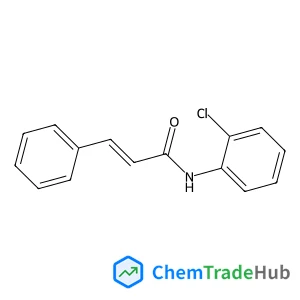
![(2E)-4-[(1R,2S,8R,19S,21R)-14-Hydroxy-11-isopropenyl-8,23,23-trimethyl-5-(3-methyl-2-buten-1-yl)-16,20-dioxo-3,7,22-trioxaheptacyclo[17.4.1.1~8,12~.0~2,17~.0~2,21~.0~4,15~.0~6,13~]pentacosa-4(15),5,13
,17-tetraen-21-yl]-2-methyl-2-butenoic acid structure](https://cnstatic.chemtradehub.com/structs/173/173867-04-4-d2d3.webp "(2E)-4-[(1R,2S,8R,19S,21R)-14-Hydroxy-11-isopropenyl-8,23,23-trimethyl-5-(3-methyl-2-buten-1-yl)-16,20-dioxo-3,7,22-trioxaheptacyclo[17.4.1.1~8,12~.0~2,17~.0~2,21~.0~4,15~.0~6,13~]pentacosa-4(15),5,13
,17-tetraen-21-yl]-2-methyl-2-butenoic acid structure")
推荐供应商



免责声明
本页面提供的学术期刊信息仅供参考和研究使用。我们与任何期刊出版商均无关联,也不处理投稿事宜。如有投稿相关咨询,请直接联系相关期刊出版商。
如发现页面信息有误,请发送邮件至 support@chemtradehub.com 联系我们。我们将及时核实并处理您的问题。