

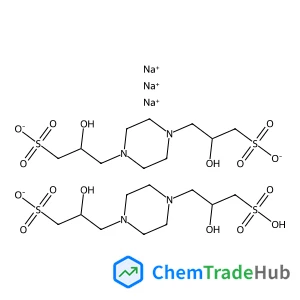
3,3'-(Piperazine-1,4-diyl)bis(2-hydroxypropane-1-sulfonic acid) Sodium Salt
CAS号:
108321-08-0
分子式:
C20H41N4Na3O16S4
Weijian Xue, Peter Y. Zavalij, Lyle Isaacs
We report the synthesis of three new triazole functionalized acyclic CB[n]-type receptors (2–4) by click chemistry. The compounds have good solubility in water (≥8 mM) and do not undergo strong self-association (Ks ≤ 903 M−1). We measured the binding constants of 2–4 toward guests 9–24 and compared the results to those obtained for the prototypical acyclic CB[n]-type receptor 1. The X-ray crystal structure of 4 is also described.
Congdi Shang, Li Wang, Yanqin An, Ping Chen, Xingmao Chang, Yanyu Qi, Rui Kang, Yu Fang
DOI: 10.1039/C7CP04235C
DOI: 10.1039/C7CP04068G
Mihirsinh Chauhan, Vishal Bharti, Manoj Kumar, Suresh Chand, Brijesh Tripathi, J. P. Tiwari
DOI: 10.1039/C7CP05235A
D. V. Andreeva, A. Kollath, D. V. Sviridov, B. J. Cafferty, H. Möhwald
DOI: 10.1039/C7CP02618H
Mireia Via-Nadal
DOI: 10.1039/C7CP03349D
Hasyiya Karimah Adli, Takashi Harada, Shuji Nakanishi, Shigeru Ikeda
DOI: 10.1039/C7CP04132B
Qingyu Liu, Fang Zuo, Zhigang Zhao, Junxian Chen, Dingguo Xu
DOI: 10.1039/C7CP02292A
Georg Ehlers, Joerg C. Neuefeind, Souleymane O. Diallo, Christopher B. Stanley, Luke Daemen
DOI: 10.1039/C7CP04013J
该化合物适用的法规指南包括GHS(全球化学品统一分类和标签制度)分类为特定目标器官毒性-单次接触类别3;根据欧盟REACH法规,该化合物需要进行注册和评估;在美...
在合成中,可以考虑使用一些类似的化合物作为4-(4-氯苯基)-1H-咪唑的替代品,如4-(4-溴苯基)-1H-咪唑或4-(4-甲氧基苯基)-1H-咪唑。这些化合...
N~2~-甲基丙氨酸酰胺是一种有机化合物,其化学名为2-(Methylamino)propanamide。它是一种酰胺类化合物,分子式为C4H10N2O,相对分...
处理含有N-苄基-3-氨基氧杂环丁烷草酸盐(CAS号:1956341-96-0)的废料时,应首先确保遵循相关法规要求,如GHS和REACH等。通常,废液应先进行...
4-溴-2-氯-6-甲基苯甲酸是一种固体化合物,具有较高的熔点和较低的沸点。它的分子量为261.03 g/mol。该化合物在水中几乎不溶,在有机溶剂中溶解度适中...
该化合物通常通过缩合反应合成,典型的方法是将2,5-二氯嘧啶与N-甲基苯甲酰胺在碱性条件下进行偶联反应。常用的碱包括NaH、LDA等强碱。该合成路线具有较高的选...
3,5-二溴-4-甲基苯胺在某些合成路线中可能没有直接替代品。然而,在某些应用场景下,可以考虑使用其他类似结构的化合物如3,5-二溴-4-硝基苯胺或3,5-二碘...
2-氯喹啉-4-羧酸甲酯主要用于有机合成和药物合成领域,作为中间体或原料。它在合成某些药物和染料时具有重要作用。此外,该化合物还可能用于某些特定的化学研究中。
6-溴-8-氯咪唑[1,2-a]吡啶在操作过程中需要谨慎以确保安全。该化合物具有一定的毒性,吸入其蒸气或粉尘可能导致呼吸道刺激。处理时应佩戴适当的防护装备,如手...

Organic & Biomolecular Chemistry (OBC) publishes original and high impact research and reviews in organic chemistry. We welcome research that shows new or significantly improved protocols or methodologies in total synthesis, synthetic methodology or physical and theoretical organic chemistry as well as research that shows a significant advance in the organic chemistry or molecular design aspects of chemical biology, catalysis, supramolecular and macromolecular chemistry, theoretical chemistry, mechanism-oriented physical organic chemistry, medicinal chemistry or natural products. Articles published in the journal should report new work which makes a highly-significant impact in the field. Routine and incremental work is generally not suitable for publication in the journal. More details about key areas of our scope are below. In all cases authors should include in their article clear rationale for why their research has been carried out.
![5-Methoxy-1H-pyrrolo[3,2-b]pyridine structure](https://cnstatic.chemtradehub.com/structs/172/17288-40-3-a8d1.webp "5-Methoxy-1H-pyrrolo[3,2-b]pyridine structure")