












Secondary structure drives self-assembly in weakly segregated globular protein–rod block copolymers
文献信息
发布日期
2020-04-07
DOI
10.1039/C9PY01680E
影响因子
5.582
作者
Helen Yao, Kai Sheng, Jialing Sun, Shupeng Yan, Yingqin Hou, Hua Lu, Bradley D. Olsen
查看原文
摘要
Protein–polymer bioconjugates represent a class of materials that integrate protein functionality with polymer material properties and block copolymer self-assembly. To investigate the effect of polymer block secondary structure and chirality on self-assembly of globular protein–helix diblock copolymers, four types of bioconjugates consisting of a poly(amino acid) and enhanced green fluorescent protein (eGFP) were synthesized and compared: two homochiral, α-helix-forming bioconjugates incorporating either L- or D-type poly(amino acids), a 1 : 1 blend of the L- and D-type bioconjugates, and a bioconjugate incorporating structureless, achiral poly(amino acids). Poly(amino acids) (PAAs) were synthesized via N-carboxy anhydride (NCA) polymerization, and PAAs were conjugated to eGFP via native chemical ligation. All bioconjugates with a helical block self-assembled into lamellae at all concentrations measured (20 to 60 wt%). In contrast, the random copolymer of L- and D-type monomers did not self-assemble at any concentration or temperature. This was shown to be an effect of a non-repulsive interaction between the flexible PAA and the eGFP blocks, which is strong enough to affect the protonation state of the eGFP chromophore in water. Therefore, secondary structure of the polymer block can modulate the effective segregation strength between blocks and drive self-assembly even in systems with non-repulsive blocks.
相关文献
Pharmacokinetics and pharmacodynamics in the treatment of cutaneous leishmaniasis – challenges and opportunities
Katrien Van Bocxlaer, Simon L. Croft
2021-01-07
Review Article
DOI: 10.1039/D0MD00343C
Amino alcohol acrylonitriles as broad spectrum and tumour selective cytotoxic agents
Jennifer R. Baker, Cecilia C. Russell, Jayne Gilbert, Adam McCluskey, Jennette A. Sakoff
2021-03-09
Research Article
DOI: 10.1039/D1MD00021G
Human carboxylesterases and fluorescent probes to image their activity in live cells
Anchal Singh, Mingze Gao, Michael W. Beck
2021-05-18
Review Article
DOI: 10.1039/D1MD00073J
The medicinal chemistry of mitochondrial dysfunction: a critical overview of efforts to modulate mitochondrial health
Maximillian Taro William Lee, William Mahy, Mark David Rackham
2021-06-04
Review Article
DOI: 10.1039/D1MD00113B
Cyclisation strategies for stabilising peptides with irregular conformations
Quynh Ngoc Vu, Reginald Young, Haritha Krishna Sudhakar, Tianyi Gao, Tiancheng Huang, Yaw Sing Tan, Yu Heng Lau
2021-04-28
Review Article
DOI: 10.1039/D1MD00098E
Drugging the undruggable: a computational chemist's view of KRASG12C
Michael S. Bodnarchuk, Doyle J. Cassar, Jason G. Kettle, Graeme Robb, Richard A. Ward
2021-03-29
Research Article
DOI: 10.1039/D1MD00055A
Macrocyclization strategies for cyclic peptides and peptidomimetics
Clément Bechtler, Christina Lamers
2021-06-29
Review Article
DOI: 10.1039/D1MD00083G
Studies on the affinity of 6-[(n-(cyclo)aminoalkyl)oxy]-4H-chromen-4-ones for sigma 1/2 receptors
Winnie Deuther-Conrad, Daniel Diez-Iriepa, Isabel Iriepa, Francisco López-Muñoz, María Angeles Martínez-Grau, Michael Gütschow, José Marco-Contelles
2021-05-20
Research Article
DOI: 10.1039/D1MD00105A
Expanding the repertoire of methanocarba nucleosides from purinergic signaling to diverse targets
Kenneth A. Jacobson, Veronica Salmaso, R. Rama Suresh, Dilip K. Tosh
2021-07-13
Review Article
DOI: 10.1039/D1MD00167A
The right tools for the job: the central role for next generation chemical probes and chemistry-based target deconvolution methods in phenotypic drug discovery
2021-03-24
Review Article
DOI: 10.1039/D1MD00022E
您可能还喜欢
化合物问答
什么是2-氨基戊烷(CAS号:63493-28-7)?
2-氨基戊烷,又名pentan-2-amine,是一种有机化合物,分子式为C5H11NH2。它是一种无色透明液体,有氨味。该化合物在工业和研究中有一定的应用。
63493-28-7pentan-2-amine
化合物问答
反式-4-[4-[[[5-[(3,4-二氟苯基)氨基]-1,3,4-恶二唑-2-基]羰基]氨基]苯基]环己烷乙酸(CAS号:892489-52-0)的物理化学性质是什么?
该化合物为白色固体,分子量为552.31 g/mol。它在水中溶解度较低,在有机溶剂如乙腈、乙酸乙酯中有较好的溶解性。该化合物具有较高的化学稳定性,对酸和碱具有...
892489-52-0Trans-4-[4-[[[5-[(3,...
化合物问答
如何处理含有Pyrotinib dimaleate(CAS号:1397922-61-0)的废料?
处理含有Pyrotinib dimaleate 的废料时,应遵循当地的法规要求。首先,收集废料并进行分类,确保没有与其他化学品混合。然后,采取适当的物理和化学处...
1397922-61-0(2E)-N-(4-{[3-Chloro...
化合物问答
在合成中是否有4-(5-5-乙基-1,2,4-噁二唑-3-基)苯甲酸乙酯(CAS号:1166756-79-1)的替代品?
在合成过程中,可以考虑使用其他结构类似的化合物作为替代品,例如苯甲酸酯类化合物,如2-乙基-5-甲基噁二唑基苯甲酸乙酯等。这些替代品可能具有相似的化学性质,但在...
1166756-79-1Ethyl 4-(5-ethyl-1,2...
化合物问答
如何处理含有1-((叔丁氧基羰基)氨基)环丁烷甲酸甲酯(CAS号:880166-10-9)的废料?
处理含有该化合物的废液时,应先确保其完全反应并转化为无害物质。对于未反应的化合物,建议采用中和处理后进行蒸馏回收,剩余物可使用化学氧化法或焚烧法进行无害化处理。...
880166-10-9Methyl 1-({[(2-methy...
化合物问答
2-({[3,5-二(三氟甲基)苯基]磺酰基}氨基)-4-(甲基硫代)丁酸甲酯(CAS号:175202-21-8)的市场或研究趋势如何?
目前该化合物主要应用于药物合成领域,尤其在开发新型抗癌药物方面具有潜在应用。随着制药行业的持续发展,对于高效、低毒的合成中间体需求增加,预计该化合物的研究和应用...
175202-21-8Methyl N-{[3,5-bis(t...
化合物问答
N,N-乙烯双(碘乙酰胺)(CAS号:7250-43-3)的物理化学性质是什么?
N,N-乙烯双(碘乙酰胺)是一种白色或类白色固体,易溶于乙醇、丙酮等有机溶剂,但在水中溶解度较低。该化合物具有较高的反应活性,可以与其他含有活性氢的化合物发生酰...
7250-43-3N,N'-1,2-Ethanediylb...
化合物问答
7-Fluoro-1H-spiro[furo[3,4-c]pyridine-3,4'-piperidine](CAS号:1283090-73-2)通常如何合成?
该化合物可以通过环合反应合成,首先合成吡啶和哌啶的衍生物,然后在合适的条件下进行环合反应得到目标化合物。常用的催化剂包括某些金属盐类,产率一般在70%-90%之...
1283090-73-27-Fluoro-1H-spiro[fu...
化合物问答
处理3-乙酰滇乌碱(CAS号:80787-51-5)时应注意哪些实验室安全事项?
在处理3-乙酰滇乌碱时,应穿戴适当的个人防护装备(PPE),如实验服、手套(丁腈手套或PVC手套)、护目镜和口罩。实验应在通风橱中进行,以减少吸入或皮肤接触的风...
80787-51-54-Methylaconitane-1,...
化合物问答
如何储存2-溴-5-硝基-4-羧酸(CAS号:1053655-82-5)?
2-溴-5-硝基-4-羧酸应存放在阴凉、干燥、通风良好的地方,远离火源和热源。避免与还原剂、碱性物质接触。储存容器应密封,防止吸湿。
1053655-82-52-Bromo-5-nitropyrid...
来源期刊
Polymer Chemistry

CiteScore:
8.6
自引率:
7.3%
年发文量:
457
Polymer Chemistry welcomes submissions in all areas of polymer science that have a strong focus on macromolecular chemistry. Manuscripts may cover a broad range of fields, yet no direct application focus is required.
推荐化合物
![4-{[4-(Trifluoromethoxy)benzyl]oxy}benzonitrile structure](https://cnstatic.chemtradehub.com/structs/103/1036629-63-6-2172.webp "4-{[4-(Trifluoromethoxy)benzyl]oxy}benzonitrile structure")
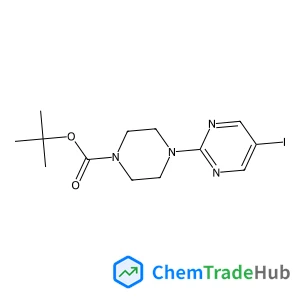
2-Methyl-2-propanyl 4-(5-iodo-2-pyrimidinyl)-1-piperazinecarboxylate
CAS号:
1027616-32-5
分子式:
C13H19IN4O2
![2-morpholino-2-[2-(trifluoromethyl)pyrimidin-5-yl]ethanamine structure](https://cnstatic.chemtradehub.com/structs/119/1192570-20-9-2810.webp "2-morpholino-2-[2-(trifluoromethyl)pyrimidin-5-yl]ethanamine structure")
推荐供应商






免责声明
本页面提供的学术期刊信息仅供参考和研究使用。我们与任何期刊出版商均无关联,也不处理投稿事宜。如有投稿相关咨询,请直接联系相关期刊出版商。
如发现页面信息有误,请发送邮件至 support@chemtradehub.com 联系我们。我们将及时核实并处理您的问题。