







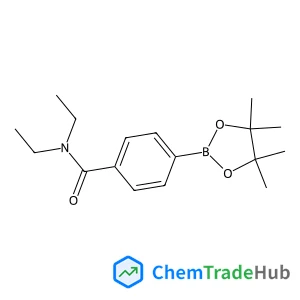
N,N-Diethyl-4-(4,4,5,5-tetramethyl-1,3,2-dioxaborolan-2-yl)benzamide
CAS号:
325142-99-2
分子式:
C17H26BNO3
Vinicius Bonatto, Pedro Henrique Jatai Batista, Lorenzo Cianni, Daniela De Vita, Daniel G. Silva, Rodrigo Cedron, Sérgio de Albuquerque, Carolina Borsoi Moraes, Caio Haddad Franco, Andrei Leitão, Carlos A. Montanari
The cysteine protease cruzipain is considered to be a validated target for therapeutic intervention in the treatment of Chagas disease. Hence, peptidomimetic cruzipain inhibitors having a reactive group (known as warhead) are subject to continuous studies to discover novel antichagasic compounds. Here, we evaluated how different warheads for a set of structurally similar related compounds could inhibit the activity of cruzipain and, ultimately, their trypanocidal effect. We first investigated in silico the intrinsic reactivity of these compounds by applying the Fukui index to correlate it with the enzymatic affinity. Then, we evaluated their potency against T. cruzi (Y and Tulahuen strains), which revealed the reversible cruzain inhibitor Neq0656 as a better trypanocidal agent (ECY.strain50 = 0.1 μM; SI = 58.4) than the current drug benznidazole (ECY.strain50 = 5.1 μM; SI > 19.6). We also measured the half-life time by HPLC analysis of three lead compounds in the presence of glutathione and cysteine to experimentally assess their intrinsic reactivity. Results clearly illustrated the reactivity trend for the warheads (azanitrile > aldehyde > nitrile), where the aldehyde displayed an intermediate intrinsic reactivity. Therefore, the aldehyde bearing peptidomimetic compounds should be subject for in-depth evaluation in the drug discovery process.
Sangbaek Park, Chan Woo Lee, Sanghyeon Kim, Hae Jin Kim, Ji Eon Kwon, Soo Young Park, Kug Sun Hong, Ki Tae Nam
DOI: 10.1039/C4CP01267D
N. Gao, J. C. Li, Q. Jiang
DOI: 10.1039/C4CP00089G
Harry Ramanantoanina, Fanica Cimpoesu, Claude Daul
DOI: 10.1039/C4CP01193G
Reza Omidyan, Hajar Rezaei
DOI: 10.1039/C4CP00679H
DOI: 10.1039/C4CP03939D
Kaushik L. Joshi, George Psofogiannakis, Adri C. T. van Duin, Sumathy Raman
DOI: 10.1039/C4CP02612H
Khaoula Boukari, Eric Duverger, Louise Stauffer, Philippe Sonnet
DOI: 10.1039/C4CP00839A
Bogdan I. Costescu, Ilona B. Baldus
DOI: 10.1039/C3CP55340J
DOI: 10.1039/C4CP04107K
Kamilla Norregaard, Liselotte Jauffred, Kirstine Berg-Sørensen, Lene B. Oddershede
DOI: 10.1039/C4CP00208C
3 - (二氟甲基)-1 -氟苯需遵循联合国全球化学品统一分类和标签制度(GHS),包括急性毒性、皮肤腐蚀/刺激、严重眼损伤/眼刺激等分类。同时,该化合物还需符...
3,5-二甲基苯胺通常通过乙苯的氨解反应合成。反应中使用硫酸作为催化剂,反应温度为120-130°C。乙苯在硫酸存在下与氨反应,生成3,5-二甲基苯胺和苯胺副产...
3-甲基异噻唑-5-胺在适当使用和储存条件下是相对安全的,但在操作时应注意防护措施。应避免吸入粉尘,避免与皮肤和眼睛直接接触。在操作过程中,应穿戴适当的防护装备...
3-(1,3-噻唑-2-基)-1H-吲哚通常通过多步合成方法制备。首先,由噻唑-2-基溴化物和吲哚进行偶联反应,得到中间体。然后,通过还原反应将中间体转化为所需...
4-溴-2-氟苯甲基氯主要用于有机合成中间体,特别是在医药、农药和染料等领域。作为一种具有特定结构的化合物,它在合成复杂有机分子时扮演重要角色。
处理Fmoc-β-(3-噻吩基)-D-Ala-OH时,应佩戴防护手套、护目镜和实验服。操作应在通风橱内进行。如发生泄露,应立即用大量水冲洗,并通知实验室管理人员...
氮化硅通常通过氮化硅的直接反应合成,即在高温下将四氯化硅与氨气反应。具体步骤是将四氯化硅和氨气混合并加热至1300-1700℃,在该条件下,四氯化硅与氨气反应生...
Cetirizine EP Impurity B DiHCl通常通过一锅法合成,首先将4-氯苯基-苯甲基氯甲酸酯与1-哌嗪乙酸反应,生成相应的酸,然后与盐酸反应...
1-哌啶-4-基丁-1-酮应储存在阴凉、干燥的地方,避免阳光直射。存储容器应密封,并确保通风良好。建议储存温度不超过25℃,湿度保持在相对较低的水平。
含有VORUCICLIB的废料应进行专业的收集和处理,包括使用适当的容器进行隔离,避免与其他化学品接触。处理方法通常包括化学中和、沉淀反应或吸附过程,随后进行焚...
![4-Chloro-3-(trifluoromethyl)-1H-pyrrolo[2,3-b]pyridine structure](https://cnstatic.chemtradehub.com/structs/869/869335-75-1-a9d0.webp "4-Chloro-3-(trifluoromethyl)-1H-pyrrolo[2,3-b]pyridine structure")
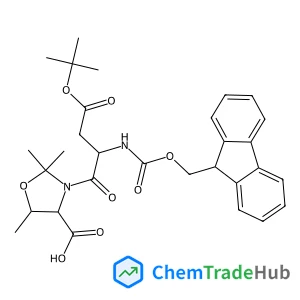
![2,6-Di(thiophen-2-yl)dithieno[3,2-b:2',3'-d]thiophene structure](https://cnstatic.chemtradehub.com/structs/910/910788-24-8-5b70.webp "2,6-Di(thiophen-2-yl)dithieno[3,2-b:2',3'-d]thiophene structure")
![2,6-Bis({(2R)-2-[hydroxy(diphenyl)methyl]-1-pyrrolidinyl}methyl)-4-methylphenol structure](https://cnstatic.chemtradehub.com/structs/877/877395-58-9-70bf.webp "2,6-Bis({(2R)-2-[hydroxy(diphenyl)methyl]-1-pyrrolidinyl}methyl)-4-methylphenol structure")



