




Shifting the paradigm in treating multi-factorial diseases: polypharmacological co-inhibitors of HDAC6
文献信息
发布日期
2020-12-11
DOI
10.1039/D0MD00286K
影响因子
0
作者
Alexandria M. Chan
查看原文
摘要
Multi-factorial diseases are illnesses that exploit multiple cellular processes, or stages within one process, and thus highly targeted therapies often succumb to the disease, losing efficacy as resistance sets in. Combination therapies have become a mainstay to battle these diseases, however these regimens are plagued with caveats. An emerging avenue to treat multi-factorial diseases is polypharmacology, wherein a single drug is rationally designed to bind multiple targets, and is widely touted to be superior to combination therapy by inherently addressing the latter's shortcomings, which include poor patient compliance, narrow therapeutic windows and spiraling healthcare costs. Through its roles in intracellular trafficking, cell motility, mitosis, protein folding and as a back-up to the proteasome pathway, HDAC6 has rapidly become an exciting new target for therapeutics, particularly in the discovery of new drugs to treat Alzheimer's disease and cancer. Herein, we describe recent efforts to marry together HDAC pharmacophores, with a particular emphasis on HDAC6 selectivity, with those of other targets towards the discovery of potent therapeutics to treat these evasive diseases. Such polypharmacological agents may supercede combination therapies through inherent synergism, permitting reduced dosing, wider therapeutic windows and improved compliance.
期刊推荐
相关文献
Fluorescence imaging of antibiotic clofazimine encapsulated within mesoporous silica particle carriers: relevance to drug delivery and the effect on its release kinetics
Lorenzo Angiolini, Boiko Cohen, Abderrazzak Douhal
2018-03-26
Paper
DOI: 10.1039/C7CP08328A
An Sn-induced resonant level in β-As2Te3
Bartlomiej Wiendlocha, Jean-Baptiste Vaney, Christophe Candolfi, Anne Dauscher, Bertrand Lenoir, Janusz Tobola
2018-04-27
Paper
DOI: 10.1039/C8CP00431E
Plasmonic sphere-on-plane systems with semiconducting polymer spacer layers
Binxing Yu, Jill I. Tracey, Zhongkai Cheng, Martin Vacha
2018-03-26
Paper
DOI: 10.1039/C8CP01314D
A catalytic role of surface silanol groups in CO2 capture on the amine-anchored silica support
Moses Cho, Joonho Park, Cafer T. Yavuz, Yousung Jung
2018-04-06
Paper
DOI: 10.1039/C7CP07973G
The influence of the size and symmetry of cations and anions on the physicochemical behavior of organic ionic plastic crystal electrolytes mixed with sodium salts
F. Makhlooghiazad, J. Guazzagaloppa, L. A. O’Dell, R. Yunis, A. Basile, P. C. Howlett, M. Forsyth
2018-01-25
Paper
DOI: 10.1039/C7CP06971E
Kinetics in the real world: linking molecules, processes, and systems
Katharina Kohse-Höinghaus, Jürgen Troe, Jens-Uwe Grabow, Matthias Olzmann, Gernot Friedrichs, Klaus-Dieter Hungenberg
2018-04-04
Editorial
DOI: 10.1039/C8CP90054J
Dependence of hot electron transfer on surface coverage and adsorbate species at semiconductor–molecule interfaces
Lesheng Li, Yosuke Kanai
2018-04-12
Paper
DOI: 10.1039/C7CP07247C
Effect of GCAA stabilizing loops on three- and four-way intramolecular junctions
Carolyn E. Carr, Luis A. Marky
2018-01-25
Paper
DOI: 10.1039/C7CP08329G
Comparing ammonia diffusion in NH3-SCR zeolite catalysts: a quasielastic neutron scattering and molecular dynamics simulation study
M. Sarwar, J. Armstrong, A. P. E. York, I. Hitchcock
2018-03-29
Paper
DOI: 10.1039/C8CP01022F
您可能还喜欢
化合物问答
3 - (二氟甲基)-1 -氟苯(CAS号:26029-52-7)适用哪些法规指南?
3 - (二氟甲基)-1 -氟苯需遵循联合国全球化学品统一分类和标签制度(GHS),包括急性毒性、皮肤腐蚀/刺激、严重眼损伤/眼刺激等分类。同时,该化合物还需符...
26029-52-71-(Difluoromethyl)-3...
化合物问答
3,5-二甲基苯胺(CAS号:108-69-0)通常如何合成?
3,5-二甲基苯胺通常通过乙苯的氨解反应合成。反应中使用硫酸作为催化剂,反应温度为120-130°C。乙苯在硫酸存在下与氨反应,生成3,5-二甲基苯胺和苯胺副产...
108-69-03,5-Dimethylaniline
化合物问答
3-甲基异噻唑-5-胺(CAS号:24340-76-9)安全吗?
3-甲基异噻唑-5-胺在适当使用和储存条件下是相对安全的,但在操作时应注意防护措施。应避免吸入粉尘,避免与皮肤和眼睛直接接触。在操作过程中,应穿戴适当的防护装备...
24340-76-93-Methyl-1,2-thiazol...
化合物问答
3-(1,3-Thiazol-2-yl)-1H-indole(CAS号:135531-86-1)通常如何合成?
3-(1,3-噻唑-2-基)-1H-吲哚通常通过多步合成方法制备。首先,由噻唑-2-基溴化物和吲哚进行偶联反应,得到中间体。然后,通过还原反应将中间体转化为所需...
135531-86-13-(1,3-Thiazol-2-yl)...
化合物问答
4-溴-2-氟苯甲基氯(CAS号:85510-82-3)的主要用途是什么?
4-溴-2-氟苯甲基氯主要用于有机合成中间体,特别是在医药、农药和染料等领域。作为一种具有特定结构的化合物,它在合成复杂有机分子时扮演重要角色。
85510-82-34-Bromo-1-(chloromet...
化合物问答
处理Fmoc-β-(3-噻吩基)-D-Ala-OH(CAS号:220497-90-5)时应注意哪些实验室安全事项?
处理Fmoc-β-(3-噻吩基)-D-Ala-OH时,应佩戴防护手套、护目镜和实验服。操作应在通风橱内进行。如发生泄露,应立即用大量水冲洗,并通知实验室管理人员...
220497-90-5N-[(9H-Fluoren-9-ylm...
化合物问答
氮化硅(CAS号:12033-89-5)通常如何合成?
氮化硅通常通过氮化硅的直接反应合成,即在高温下将四氯化硅与氨气反应。具体步骤是将四氯化硅和氨气混合并加热至1300-1700℃,在该条件下,四氯化硅与氨气反应生...
12033-89-5Trisilicon tetranitr...
化合物问答
Cetirizine EP Impurity B DiHCl(CAS号:1000690-91-4)通常如何合成?
Cetirizine EP Impurity B DiHCl通常通过一锅法合成,首先将4-氯苯基-苯甲基氯甲酸酯与1-哌嗪乙酸反应,生成相应的酸,然后与盐酸反应...
1000690-91-4{4-[(4-Chlorophenyl)...
化合物问答
如何储存1-哌啶-4-基丁-1-酮(CAS号:3509-15-7)?
1-哌啶-4-基丁-1-酮应储存在阴凉、干燥的地方,避免阳光直射。存储容器应密封,并确保通风良好。建议储存温度不超过25℃,湿度保持在相对较低的水平。
3509-15-71-Piperidin-4-ylbuta...
化合物问答
如何处理含有VORUCICLIB(CAS号:1000023-04-0)的废料?
含有VORUCICLIB的废料应进行专业的收集和处理,包括使用适当的容器进行隔离,避免与其他化学品接触。处理方法通常包括化学中和、沉淀反应或吸附过程,随后进行焚...
1000023-04-02-[2-Chloro-4-(trifl...
来源期刊
推荐化合物
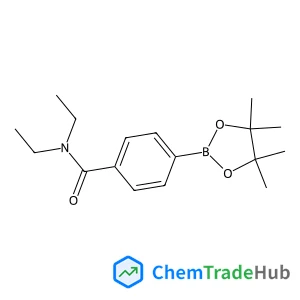
N,N-Diethyl-4-(4,4,5,5-tetramethyl-1,3,2-dioxaborolan-2-yl)benzamide
CAS号:
325142-99-2
分子式:
C17H26BNO3
推荐供应商




免责声明
本页面提供的学术期刊信息仅供参考和研究使用。我们与任何期刊出版商均无关联,也不处理投稿事宜。如有投稿相关咨询,请直接联系相关期刊出版商。
如发现页面信息有误,请发送邮件至 support@chemtradehub.com 联系我们。我们将及时核实并处理您的问题。