







![[2',6'-bis(propan-2-yloxy)-[1,1'-biphenyl]-3-yl]dicyclohexylphosphane structure](https://cnstatic.chemtradehub.com/structs/787/787618-22-8-dda2.webp "[2',6'-bis(propan-2-yloxy)-[1,1'-biphenyl]-3-yl]dicyclohexylphosphane structure")
[2',6'-bis(propan-2-yloxy)-[1,1'-biphenyl]-3-yl]dicyclohexylphosphane
CAS号:
787618-22-8
分子式:
C30H43O2P
Keiji Konagaya, Ken Abamba Omwange, Francisco Rovira-Más, Hiroki Nagasato, Kazunori Ninomiya, Naoshi Kondo
We investigated the association of blue fluorescence (excitation at 365 nm) with the traits of the fruit, pericarp, and epidermis in green peppers. The fruits were manually classified into two groups based on fluorescence brightness. The dark fluorescence group showed the accumulation of blue-absorbing pigments and a thicker cuticular structure, suggesting epidermal development.
Akira Aiba, Satoshi Kaneko, Shintaro Fujii, Tomoaki Nishino, Manabu Kiguchi
DOI: 10.1039/C6CP03437C
Rafał Szabla, Robert W. Góra, A. Marco Saitta, Fabio Pietrucci, Franz Saija, Ernesto Di Mauro, Raffaele Saladino, Martin Ferus, Svatopluk Civiš
DOI: 10.1039/C6CP00670A
Gustavo A. Pino, Géraldine Feraud, Claude Dedonder, Christophe Jouvet
DOI: 10.1039/C6CP01345G
B. Carlotti, E. Benassi, A. Cesaretti, C. G. Fortuna, A. Spalletti, V. Barone, F. Elisei
DOI: 10.1039/C5CP03207E
Arvin Akoopie, Ulrich F. Müller
DOI: 10.1039/C6CP00672H
Jérôme Lasne, Alexander Rosu-Finsen, Andrew Cassidy, Martin R. S. McCoustra, David Field
DOI: 10.1039/C5CP03174E
Dong-Kwan Kim, Yoon Jo Hwang, Cheolho Yoon, Hye-On Yoon, Ki Soo Chang, Gi-Ra Yi
DOI: 10.1039/C5CP02968F
Liyang Luo, Ram B. Ambre, Sandeep B. Mane, Eric Wei-Guang Diau, Chen-Hsiung Hung
DOI: 10.1039/C5CP02367J
Dang Xuan Long, Yong Xu, Huai-xin Wei, Yong-Young Noh
DOI: 10.1039/C5CP03369A
4-[4-三氟甲基苯基]恶唑通常通过将4-三氟甲基苯酚与异硫氰酸苯酯在有机溶剂中进行酯化反应合成。该反应可在无水条件下,使用适当的催化剂,如四丁基氢氧化铵,以提...
RockPhos Pd G3 通常通过钯催化偶联反应合成,使用配体 (2'-Amino-2-biphenylyl)(methanesulfonato-kappa...
1-哌啶甲酰胺作为有机合成中的重要中间体,其市场需求主要受医药、农药、染料等行业推动。近年来,随着新药开发和绿色化学的发展,该化合物的研究趋势集中在开发更高效、...
2-(二苯基膦基)乙胺适用于多种法规指南,包括但不限于《全球化学品统一分类和标签制度》(GHS),欧盟《化学品注册、评估、授权和限制》法规(REACH),以及美...
间苯二甲酸二烯丙酯应储存在阴凉、干燥、通风良好的地方,远离火源和热源。储存容器应密封,避免光照和高温。储存温度应控制在25℃以下,相对湿度应低于80%。避免与其...
间甲苯异硫代异氰酸酯是一种有机化合物,分子式为C7H7NO2S,具有刺激性气味。它是一种重要的有机合成中间体,在合成其他化合物时广泛应用。
在合成中,可以考虑使用N-Cbz-D-苯丙氨醇或N-Fmoc-D-苯丙氨醇作为替代品。这些化合物同样具有保护氨基的功能,且在合成过程中表现出良好的反应性能。
3-羟甲基-2-氧异丙基吡啶主要用于有机合成领域,可以作为合成其他药物、农药或精细化学品的中间体。此外,它还可能在实验室研究中作为特定反应的前体或溶剂。
6-氨基-9-甲基嘌呤目前主要应用于医药行业,作为某些药物的中间体。此外,它还可能用于聚合物、传感器和半导体的某些领域,作为功能性单体或掺杂剂。
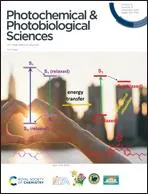
Photochemical & Photobiological Sciences (PPS) is a monthly journal for the publication of original research papers (Full papers), Reviews, Perspectives, Communications and Technical notes of current interest in the areas of photochemistry and photobiology. The journal also contains a Forum section. PPS is published by Springer and is the official journal of the European Society for Photobiology (ESP) and the European Photochemistry Association (EPA). The journal publishes articles on the interaction of light with molecules, supramolecular systems or biological matter. Topics include, but are not limited to the following. Applied photochemistry Atmospheric photochemistry Bioluminescence Chronobiology DNA repair Energy transfer Environmental photobiology Environmental photochemistry Excited state properties Laser photochemistry Luminescence Mechanistic photochemistry Organic and inorganic photochemistry Photocarcinogenesis Photochemical kinetics Photochemistry of biomolecules Photochemotherapy Photochromism Photodegradation Photodermatology Photoelectrochemistry Photoimaging Photoimmunology Photomedicine Photomorphogenesis Photomovement Photoprotection Photoreception Photosensitisation Photosynthesis Phototechnology Phototherapy Phototoxicity Solar energy utilisation Spectroscopy Spectroscopy of biological systems Supramolecular photochemistry Synthetic photochemistry Theoretical photochemistry UV and visible radiation effects and vision