


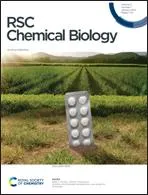
A bicyclic S-adenosylmethionine regeneration system applicable with different nucleosides or nucleotides as cofactor building blocks
文献信息
发布日期
2021-03-22
DOI
10.1039/D1CB00033K
影响因子
0
作者
Désirée Popadić, Dipali Mhaindarkar, Mike H. N. Dang Thai, Helen C. Hailes, Silja Mordhorst, Jennifer N. Andexer
查看原文
摘要
The ubiquitous cofactor S-adenosyl-L-methionine (SAM) is part of numerous biochemical reactions in metabolism, epigenetics, and cancer development. As methylation usually improves physiochemical properties of compounds relevant for pharmaceutical use, the sustainable use of SAM as a methyl donor in biotechnological applications is an important goal. SAM-dependent methyltransferases are consequently an emerging biocatalytic tool for environmentally friendly and selective alkylations. However, SAM shows undesirable characteristics such as degradation under mild conditions and its stoichiometric use is economically not reasonable. Here, we report an optimised biomimetic system for the regeneration of SAM and SAM analogues consisting of effective nucleoside triphosphate formation and an additional L-methionine regeneration cycle without by-product accumulation. The bicyclic system uses seven enzymes, S-methylmethionine as methyl donor and a surplus of inorganic polyphosphate, along with catalytic amounts of L-methionine and cofactor building block reaching conversions of up to 99% (up to 200 turnovers). We also show that the cycle can be run with cofactor building blocks containing different purine and pyrimidine nucleobases, which can be fed in at the nucleoside or nucleotide stage. These alternative cofactors are in turn converted to the corresponding SAM analogues, which are considered to be a key for the development of bioorthogonal systems. In addition to purified enzymes, the bicyclic system can also be used with crude lysates highlighting its broad biocatalytic applicability.
期刊推荐

Science Progress

Fibre Chemistry

Pure and Applied Chemistry
Journal of Medicinal Chemistry

Helvetica Chimica Acta

Journal of Physics and Chemistry of Solids

Proceedings of the National Academy of Sciences of the United States of America

Journal of Organometallic Chemistry

Pharmacological Reviews
Russian Chemical Reviews
相关文献
Dendritic carbon architectures formed by nanotube core-directed diffusion-limited aggregation of nanoparticles
Zhenyu Liu
2010-07-06
Paper
DOI: 10.1039/C000363H
Zinc-doping in TiO2 films to enhance electron transport in dye-sensitized solar cells under low-intensity illumination
Kai-Ping Wang, Hsisheng Teng
2009-08-18
Paper
DOI: 10.1039/B912672D
Physical chemistry of self-organization and self-healing in metals
Michael Nosonovsky, Ryoichi Amano, Jose M. Lucci, Pradeep K. Rohatgi
2009-08-21
Paper
DOI: 10.1039/B912433K
Aleuritic (9,10,16-trihydroxypalmitic) acid self-assembly on mica
José Alejandro Heredia-Guerrero, Miguel Angel San-Miguel, Mark S. P. Sansom, Antonio Heredia, José Jesús Benítez
2010-07-06
Paper
DOI: 10.1039/C0CP00163E
Determination of the charge profile in the KcsA selectivity filter using ab initio calculations and molecular dynamics simulations
Sebastian Kraszewski, Céline Boiteux, Christophe Ramseyer, Claude Girardet
2009-07-24
Paper
DOI: 10.1039/B905991A
Diffusion of water into SU-8 microcantilevers
Ying Liu, Daniela Fell, Stephan Keller, Anja Boisen, Hans-Jürgen Butt, Günter K. Auernhammer
2010-07-07
Paper
DOI: 10.1039/C002478C
Tuning the surface potential of gold substrates arbitrarily with self-assembled monolayers with mixed functional groups
Wei-Chun Lin, Szu-Hsian Lee, Ying-Yu Chen, Yu-Chin Lin, Che-Hung Kuo
2009-05-13
Paper
DOI: 10.1039/B902044F
Mixed solutions of silver cation and chloride anion in acetonitrile: Voltammetric and EQCM study
Magdalena Skompska, Aleksandra Rajchowska, Oleg V. Levin
2010-07-07
Paper
DOI: 10.1039/C003332D
您可能还喜欢
化合物问答
4-[[6-(3-苯基苯基)-7H-嘌呤-2-基]氨基]苯磺酰胺(CAS号:2079895-42-2)适用哪些法规指南?
该化合物需遵循REACH法规以确保其安全使用和管理。同时,根据其潜在的生物降解性和毒性,也需要符合GHS分类中的相应要求。此外,若用于医药或食品相关领域,则还需...
2079895-42-24-{[6-(3-Biphenylyl)...
化合物问答
反式-度骨化醇(CAS号:74007-20-8)的物理化学性质是什么?
反式-度骨化醇是一种脂溶性维生素D3的衍生物,呈无色或白色结晶性粉末,不溶于水,溶于乙醇、丙酮、氯仿等有机溶剂。其分子式为C28H44O,分子量为404.65。...
74007-20-8trans-Doxercalcifero...
化合物问答
莲花掌苷(CAS号:59282-56-3)的市场或研究趋势如何?
莲花掌苷作为一种天然产物,近年来在抗炎、抗癌等生物活性研究方面显示出一定的潜力,因此市场需求逐渐增长。市场动态方面,随着天然产物开发的深入,预计该化合物的研究会...
59282-56-3Lindleyin
化合物问答
2-溴-6-(吡咯烷-1-基)吡啶-4-硼酸频那醇酯(CAS号:1150271-64-9)应用于哪些行业?
2-溴-6-(吡咯烷-1-基)吡啶-4-硼酸频那醇酯在医药领域有着广泛的应用,它可以用作药物合成中的中间体。此外,它还可以用于有机合成,特别是在构建复杂杂环化合...
1150271-64-92-Bromo-6-(1-pyrroli...
化合物问答
什么是methyl 2-(4-bromophenyl)-3-methylbutanoate(CAS号:1061284-70-5)?
methyl 2-(4-溴苯基)-3-甲基丁酸甲酯是一种化学物质,分子式为C12H13BrO2。它是一种有机化合物,具有一定的挥发性和易燃性。
1061284-70-52-(4-Bromo-phenyl)-3...
化合物问答
CJC1-295(CAS号:863288-34-0)的物理化学性质是什么?
CJC1-295是一种具有复杂肽链结构的化合物,其分子量约为1875 Da。该化合物在水中具有一定的溶解性,但在有机溶剂中的溶解性不佳。它是一种反应活性化合物,...
863288-34-0L-tyrosyl-D-alanyl-L...
化合物问答
三正丁基锍碘(CAS号:18146-62-8)的市场或研究趋势如何?
三正丁基锍碘作为一种重要的有机硫化合物,主要用于有机合成中作为亲电试剂。近年来,由于其在合成中的广泛应用,市场对其需求持续增长。此外,随着绿色化学的发展,对其替...
18146-62-8Tributylsulfonium io...
化合物问答
雌二醇-[13C3]同位素内标(CAS号:1261254-48-1)通常如何合成?
雌二醇-[13C3]同位素内标通常通过在雌二醇分子中引入[13C3]同位素来合成。常见的方法是通过化学标记反应,如与[13C3]标记的甲基溴化物进行亲核取代反应...
1261254-48-117beta-Estradiol-2,3...
化合物问答
N1-(2-吡啶甲基)-N2-(2-甲基-1-萘基)草酰胺(CAS号:2611225-93-3)的物理化学性质是什么?
N1-(2-吡啶甲基)-N2-(2-甲基-1-萘基)草酰胺为固体化合物,具有良好的结晶形态,分子量为340.34 g/mol。该化合物在水中的溶解度较低,但在有...
2611225-93-3N-(2-Methyl-1-naphth...
化合物问答
如何处理含有十五碳烯酸甲酯(顺-10)(C15:1)标准品(CAS号:90176-52-6)的废料?
含有十五碳烯酸甲酯(顺-10)(C15:1)标准品的废料应首先进行适当收集和储存,避免与其他化学品混合。然后,可采用焚烧或交由专业废物处理公司进行处理。处理过程...
90176-52-6(Z)-10-Pentadecenoic...
来源期刊
推荐化合物
![1,2-Diphenyl-4-[2-(phenylsulfinyl)ethyl]-3,5-pyrazolidinedione structure](https://cnstatic.chemtradehub.com/structs/57-/57-96-5-efcc.webp "1,2-Diphenyl-4-[2-(phenylsulfinyl)ethyl]-3,5-pyrazolidinedione structure")
![4-{2-[4-(2-Methyl-2-propanyl)phenyl]ethoxy}quinazoline structure](https://cnstatic.chemtradehub.com/structs/120/120928-09-8-d3db.webp "4-{2-[4-(2-Methyl-2-propanyl)phenyl]ethoxy}quinazoline structure")
推荐供应商





免责声明
本页面提供的学术期刊信息仅供参考和研究使用。我们与任何期刊出版商均无关联,也不处理投稿事宜。如有投稿相关咨询,请直接联系相关期刊出版商。
如发现页面信息有误,请发送邮件至 support@chemtradehub.com 联系我们。我们将及时核实并处理您的问题。