




How many methanol molecules effectively solvate an excess proton in the gas phase? Infrared spectroscopy of H+(methanol)n–benzene clusters
文献信息
发布日期
2021-11-26
DOI
10.1039/D1CP04689F
影响因子
3.676
作者
Takeru Kato, Asuka Fujii
查看原文
摘要
An excess proton in a hydrogen-bonded system enhances the strength of hydrogen bonds of the surrounding molecules. The extent of this influence can be a measure of the number of molecules effectively solvating the excess proton. Such extent in methanol has been discussed by the observation of the π-hydrogen-bonded OH stretch bands of the terminal sites of protonated methanol clusters, H+(methanol)n, in benzene solutions, and it has been concluded that ∼8 molecules effectively solvate the excess proton (Stoyanov et al., Chem. Eur. J. 2008, 14, 3596–3604). In the present study, we performed infrared spectroscopy of H+(methanol)n–benzene clusters in the gas phase. The cluster size and hydrogen-bonded network structure are identified by the tandem mass spectrometric technique and the comparison of the observed infrared spectra with density functional theory calculations. Though changes of the preferred hydrogen bond network type occur with the increase of cluster size in the gas phase clusters, the observed size dependence of the π-hydrogen bonded OH frequency agrees well with that in the benzene solutions. This means that the observations in both the gas and condensed phases catch the same physical essence of the excess proton solvation by methanol.
相关文献
Impact of vibrational excitation on the kinetics of a nascent ketene
Thomas Schmierer, Wolfgang J. Schreier, Florian O. Koller, Tobias E. Schrader
2009-11-05
Paper
DOI: 10.1039/B915451E
Dynamics of multi-channel dissociation of tetrahydrofuran photoexcited at 193 nm: distributions of kinetic energy, angular anisotropies and branching ratios
2010-01-27
Paper
DOI: 10.1039/B921219A
Low-coverage adsorption properties of the metal–organic framework MIL-47 studied by pulse chromatography and Monte Carlo simulations
Vincent Finsy, Sofia Calero, Elena García-Pérez, Patrick J. Merkling, Gill Vedts, Dirk E. De Vos, Gino V. Baron, Joeri F. M. Denayer
2009-03-02
Paper
DOI: 10.1039/B822247A
Editorial Highlight: Molecules in confined spaces
Bert M. Weckhuysen
2009-03-24
Paper
DOI: 10.1039/B905015A
Poly(p-phenylene sulfone)s with high ion exchange capacity: ionomers with unique microstructural and transport features
C. C. de Araujo, M. Schuster, G. Portale, H. Mendil-Jakani, G. Gebel, J. Maier
2009-03-03
Paper
DOI: 10.1039/B822069G
Anomalous length and voltage dependence of single molecule conductance
Wolfgang Haiss, Santiago Martin, Lisa E. Scullion, Laurent Bouffier, Simon J. Higgins, Richard J. Nichols
2009-10-02
Paper
DOI: 10.1039/B910194B
Photoinduced multi-electron transfer in the Dn–A system consisting of multi-phthalocyanines linked to one carbon nanotube
Xiaofeng Cui, Qiang Liu, Fushi Zhang
2009-03-13
Paper
DOI: 10.1039/B819521H
Glancing-angle Raman spectroscopic probe for reaction kinetics at water surfaces
Sumi N. Wren, D. J. Donaldson
2010-01-27
Paper
DOI: 10.1039/B922254E
Reactivity of crotonaldehyde and propene over Au/Pd(111) surfaces
James Naughton, Adam F. Lee, Sarah Thompson, C. P. Vinod, Karen Wilson
2010-01-27
Paper
DOI: 10.1039/B921669C
您可能还喜欢
化合物问答
十二烷基磺酸钠(CAS号:2386-53-0)的主要用途是什么?
十二烷基磺酸钠主要用作表面活性剂,广泛应用于洗涤剂、肥皂、化妆品和工业清洁产品中。它能有效去除油脂和污垢,常用于制造洗发水、沐浴露、洗衣粉和金属清洗剂。此外,它...
2386-53-01-Dodecanesulfonic a...
化合物问答
5-羟基异喹啉(CAS号:2439-04-5)适用哪些法规指南?
5-羟基异喹啉作为化学品,主要适用的法规包括GHS全球化学品统一分类和标签制度,REACH法规等。GHS将5-羟基异喹啉分类为皮肤腐蚀/刺激类别2,严重眼损伤/...
2439-04-55-Isoquinolinol
化合物问答
在合成中是否有FIDAS-5 | Wnt(CAS号:1391934-98-7)的替代品?
合成中可以考虑使用类似结构的化合物,如4-[(E)-2-(2-氯-6-氟苯基)乙烯基]-N-甲基苯胺的类似物或衍生物作为替代品。这类化合物可能具有相似的生物活性...
1391934-98-74-[(E)-2-(2-Chloro-6...
化合物问答
(R)-tert-Butyl 2-(5-bromo-1H-imidazol-2-yl)pyrrolidine-1-carboxylate(CAS号:1370600-56-8)通常如何合成?
该化合物通常通过如下步骤合成:首先,将4-溴-1H-咪唑与对甲苯磺酸在乙酸乙酯中反应,得到中间体5-溴-1H-咪唑-2-甲酸乙酯。然后,该中间体与2-甲基-2-...
1370600-56-82-Methyl-2-propanyl ...
化合物问答
处理4-(吡咯烷-1-基)环己酮(CAS号:10421-18-8)时应注意哪些实验室安全事项?
处理4-(吡咯烷-1-基)环己酮时,应佩戴手套、护目镜和实验室外套,以防止直接接触或吸入。在通风橱中操作,确保良好的通风条件。一旦发生泄漏,应立即清理并使用适当...
10421-18-84-(Pyrrolidin-1-yl)c...
化合物问答
如何处理含有异麦芽糖醇(CAS号:534-73-6)的废料?
含有异麦芽糖醇的废液应首先进行分类收集,避免与其他化学品混合。对于小规模的废液,可以通过焚烧或加入特定的化学试剂进行无害化处理。对于大规模的废液,建议联系专业的...
534-73-66-O-alpha-D-Glucopyr...
化合物问答
7-甲基壬酸(CAS号:41653-89-8)的主要用途是什么?
7-甲基壬酸主要用于有机合成领域,作为合成其他化合物的原料。此外,它还可能作为一种中间体用于药品制造和香料合成,但具体用途需要根据其具体的化学结构和反应特性来确...
41653-89-87-Methylnonanoic aci...
化合物问答
N-甲氧基-N-甲基甲基吡啶羧酰胺(CAS号:148493-07-6)应用于哪些行业?
N-甲氧基-N-甲基甲基吡啶羧酰胺在医药领域有一定的应用,作为一种潜在的药物前体或中间体。此外,该化合物也可能应用于聚合物改性剂、传感器材料等。由于其独特的化学...
148493-07-6N-Methoxy-N-methylpi...
化合物问答
什么是惕各酸香叶酯(CAS号:7785-33-3)?
惕各酸香叶酯是一种化合物,化学名称为(2E)-3,7-二甲基-2,6-辛二烯-1-基(2E)-2-甲基-2-丁烯酸酯。它是一种具有香叶香气的化合物,分子式为C1...
7785-33-3(2E)-3,7-Dimethyl-2,...
化合物问答
1-环丁基哌嗪(CAS号:132800-13-6)安全吗?
1-环丁基哌嗪在适当的操作条件下是相对安全的,但如遇明火或高热会释放有毒气体。操作时应佩戴防护眼镜和手套,避免吸入或接触皮肤、眼睛。
132800-13-61-Cyclobutylpiperazi...
来源期刊
Physical Chemistry Chemical Physics

CiteScore:
5.5
自引率:
10.3%
年发文量:
3036
Physical Chemistry Chemical Physics (PCCP) is an international journal co-owned by 19 physical chemistry and physics societies from around the world. This journal publishes original, cutting-edge research in physical chemistry, chemical physics and biophysical chemistry. To be suitable for publication in PCCP, articles must include significant innovation and/or insight into physical chemistry; this is the most important criterion that reviewers and Editors will judge against when evaluating submissions. The journal has a broad scope and welcomes contributions spanning experiment, theory, computation and data science. Topical coverage includes spectroscopy, dynamics, kinetics, statistical mechanics, thermodynamics, electrochemistry, catalysis, surface science, quantum mechanics, quantum computing and machine learning. Interdisciplinary research areas such as polymers and soft matter, materials, nanoscience, energy, surfaces/interfaces, and biophysical chemistry are welcomed if they demonstrate significant innovation and/or insight into physical chemistry. Joined experimental/theoretical studies are particularly appreciated when complementary and based on up-to-date approaches.
推荐化合物
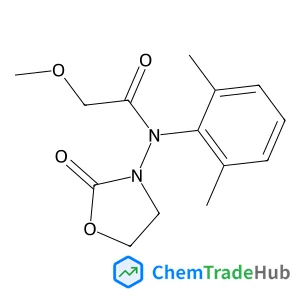
N-(2,6-Dimethylphenyl)-2-methoxy-N-(2-oxo-1,3-oxazolidin-3-yl)acetamide
CAS号:
77732-09-3
分子式:
C14H18N2O4
![(1R)-3-Bromo-1,7,7-trimethylbicyclo[2.2.1]heptan-2-one structure](https://cnstatic.chemtradehub.com/structs/102/10293-06-8-dd8a.webp "(1R)-3-Bromo-1,7,7-trimethylbicyclo[2.2.1]heptan-2-one structure")
推荐供应商



免责声明
本页面提供的学术期刊信息仅供参考和研究使用。我们与任何期刊出版商均无关联,也不处理投稿事宜。如有投稿相关咨询,请直接联系相关期刊出版商。
如发现页面信息有误,请发送邮件至 support@chemtradehub.com 联系我们。我们将及时核实并处理您的问题。