







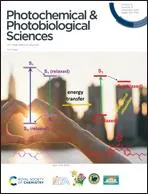
Multi-responsive, injectable, and self-healing hydrogels based on benzoxaborole–tannic acid complexation
文献信息
发布日期
2021-08-31
DOI
10.1039/D1PY00692D
影响因子
5.582
作者
Yi-Yang Peng, Qiuli Cheng, Wenda Wang, Meng Wu, Diana Diaz-Dussan, Piyush Kumar, Ravin Narain
查看原文
摘要
The plant-derived polyphenol tannic acid (TA) was used to crosslink linear statistical polymers containing benzoxaborole [poly(MPC-st-MAABO)] to form a bio-inspired, multi-responsive, injectable, and self-healing hydrogel in the physiological environment via benzoxaborole–tannic acid complexation. The mechanical properties of the hydrogel were easily tuned by adjusting the molar ratio between tannic acid and benzoxaborole groups. Fast degradation of the hydrogel was observed in the presence of fructose, adenosine 5′-triphosphate (ATP), and dopamine (catechol), and reversible sol–gel formation was induced by changing the pH of the hydrogel. As the hydrogel was crosslinked by dynamic boronic ester bonds, the self-healing property and injectability were expected and confirmed. 3D cell encapsulation within the hydrogel scaffold was successfully achieved. This technique offered a promising method for preparing bio-inspired, multi-responsive, injectable, and self-healing hydrogels to fulfill current demands in biomedical applications.
相关文献
Protein crystals make it big at electrode surfaces
Barry R. Silver, Patrick R. Unwin
2008-09-10
Communication
DOI: 10.1039/B810226K
Formation of an ink-bottle-like pore structure in SBA-15 by MOCVD
Ying Zhang, Frank Leung-Yuk Lam, Xijun Hu, Zifeng Yan
2008-10-21
Communication
DOI: 10.1039/B809290G
Tristriazolotriazines: a core for luminescent discotic liquid crystals
Rodrigo Cristiano, Hugo Gallardo, Adailton J. Bortoluzzi, Ivan H. Bechtold, Carlos E. M. Campos, Ricardo L. Longo
2008-09-03
Communication
DOI: 10.1039/B810680K
Confined proteinadsorption into nanopore arrays fabricated by colloidal-assisted polymer patterning
Grazia M. L. Messina, Cristina Satriano, Giovanni Marletta
2008-09-05
Communication
DOI: 10.1039/B809664C
Direct growth of novel alloyed PtAu nanodendrites
Dan F. Thomas, Aicheng Chen
2008-09-01
Communication
DOI: 10.1039/B807660J
Photopolymerization of metal nanoparticles on multiwall carbon nanotubes
Xichen Cai, Kelechi C. Anyaogu, Douglas C. Neckers
2008-09-01
Communication
DOI: 10.1039/B807407K
Quantitative formation of a tetraporphyrin [2]catenaneviacopper and zinc coordination
Maryline Beyler, Valérie Heitz, Jean-Pierre Sauvage
2008-09-17
Communication
DOI: 10.1039/B811013A
One-step fabrication of well-defined hollow CdS nanoboxes
Mee Rahn Kim, Du-Jeon Jang
2008-09-12
Communication
DOI: 10.1039/B809807G
Fabrication of mechanically improved hydrogels using a movable cross-linker based on vinyl modified polyrotaxane
Abu Bin Imran, Takahiro Seki, Toshiyuki Kataoka, Masatoshi Kidowaki, Kohzo Ito, Yukikazu Takeoka
2008-09-12
Communication
DOI: 10.1039/B810290B
An efficient heteropolyacid catalyzed acylation of pyruvate esters to α-acyloxyacrylate esters as potential candidate monomers for bio-based polymers
Masahiro Sadakane, Shinji Matsuoka, Hiroki Nakamura, Hiroyuki Naitou, Wataru Ueda
2008-09-12
Communication
DOI: 10.1039/B809940E
您可能还喜欢
化合物问答
3 - (二氟甲基)-1 -氟苯(CAS号:26029-52-7)适用哪些法规指南?
3 - (二氟甲基)-1 -氟苯需遵循联合国全球化学品统一分类和标签制度(GHS),包括急性毒性、皮肤腐蚀/刺激、严重眼损伤/眼刺激等分类。同时,该化合物还需符...
26029-52-71-(Difluoromethyl)-3...
化合物问答
3,5-二甲基苯胺(CAS号:108-69-0)通常如何合成?
3,5-二甲基苯胺通常通过乙苯的氨解反应合成。反应中使用硫酸作为催化剂,反应温度为120-130°C。乙苯在硫酸存在下与氨反应,生成3,5-二甲基苯胺和苯胺副产...
108-69-03,5-Dimethylaniline
化合物问答
3-甲基异噻唑-5-胺(CAS号:24340-76-9)安全吗?
3-甲基异噻唑-5-胺在适当使用和储存条件下是相对安全的,但在操作时应注意防护措施。应避免吸入粉尘,避免与皮肤和眼睛直接接触。在操作过程中,应穿戴适当的防护装备...
24340-76-93-Methyl-1,2-thiazol...
化合物问答
3-(1,3-Thiazol-2-yl)-1H-indole(CAS号:135531-86-1)通常如何合成?
3-(1,3-噻唑-2-基)-1H-吲哚通常通过多步合成方法制备。首先,由噻唑-2-基溴化物和吲哚进行偶联反应,得到中间体。然后,通过还原反应将中间体转化为所需...
135531-86-13-(1,3-Thiazol-2-yl)...
化合物问答
4-溴-2-氟苯甲基氯(CAS号:85510-82-3)的主要用途是什么?
4-溴-2-氟苯甲基氯主要用于有机合成中间体,特别是在医药、农药和染料等领域。作为一种具有特定结构的化合物,它在合成复杂有机分子时扮演重要角色。
85510-82-34-Bromo-1-(chloromet...
化合物问答
处理Fmoc-β-(3-噻吩基)-D-Ala-OH(CAS号:220497-90-5)时应注意哪些实验室安全事项?
处理Fmoc-β-(3-噻吩基)-D-Ala-OH时,应佩戴防护手套、护目镜和实验服。操作应在通风橱内进行。如发生泄露,应立即用大量水冲洗,并通知实验室管理人员...
220497-90-5N-[(9H-Fluoren-9-ylm...
化合物问答
氮化硅(CAS号:12033-89-5)通常如何合成?
氮化硅通常通过氮化硅的直接反应合成,即在高温下将四氯化硅与氨气反应。具体步骤是将四氯化硅和氨气混合并加热至1300-1700℃,在该条件下,四氯化硅与氨气反应生...
12033-89-5Trisilicon tetranitr...
化合物问答
Cetirizine EP Impurity B DiHCl(CAS号:1000690-91-4)通常如何合成?
Cetirizine EP Impurity B DiHCl通常通过一锅法合成,首先将4-氯苯基-苯甲基氯甲酸酯与1-哌嗪乙酸反应,生成相应的酸,然后与盐酸反应...
1000690-91-4{4-[(4-Chlorophenyl)...
化合物问答
如何储存1-哌啶-4-基丁-1-酮(CAS号:3509-15-7)?
1-哌啶-4-基丁-1-酮应储存在阴凉、干燥的地方,避免阳光直射。存储容器应密封,并确保通风良好。建议储存温度不超过25℃,湿度保持在相对较低的水平。
3509-15-71-Piperidin-4-ylbuta...
化合物问答
如何处理含有VORUCICLIB(CAS号:1000023-04-0)的废料?
含有VORUCICLIB的废料应进行专业的收集和处理,包括使用适当的容器进行隔离,避免与其他化学品接触。处理方法通常包括化学中和、沉淀反应或吸附过程,随后进行焚...
1000023-04-02-[2-Chloro-4-(trifl...
来源期刊
Polymer Chemistry

CiteScore:
8.6
自引率:
7.3%
年发文量:
457
Polymer Chemistry welcomes submissions in all areas of polymer science that have a strong focus on macromolecular chemistry. Manuscripts may cover a broad range of fields, yet no direct application focus is required.
推荐化合物
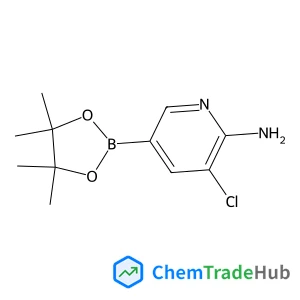
3-Chloro-5-(4,4,5,5-tetramethyl-1,3,2-dioxaborolan-2-yl)-2-pyridinamine
CAS号:
1032758-99-8
分子式:
C11H16BClN2O2
![1-[3-(4-Morpholinylsulfonyl)phenyl]methanamine structure](https://cnstatic.chemtradehub.com/structs/933/933989-32-3-51af.webp "1-[3-(4-Morpholinylsulfonyl)phenyl]methanamine structure")
推荐供应商





免责声明
本页面提供的学术期刊信息仅供参考和研究使用。我们与任何期刊出版商均无关联,也不处理投稿事宜。如有投稿相关咨询,请直接联系相关期刊出版商。
如发现页面信息有误,请发送邮件至 support@chemtradehub.com 联系我们。我们将及时核实并处理您的问题。