




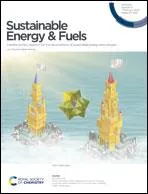
Harnessing the potential of lead-free Sn–Ge based perovskite solar cells by unlocking the recombination channels
文献信息
发布日期
2021-07-26
DOI
10.1039/D1SE00687H
影响因子
6.367
作者
Yulia Galagan, Hamid Ez-Zahraouy
查看原文
摘要
Perovskite solar cells (PSCs) have celebrated a decade of investigation as a promising photovoltaic technology. However, they contain lead, so inorganic lead-free PSCs can be designed as green and clean energy sources. To overcome the current obstacles in lead-free PSCs, the stability and performance gap should be minimized. The drift-diffusion simulation model is a conducive way to understand the working mechanism in a thin-film solar cell. Here we adopted a computational approach to design and investigate the performance of CsSn0.5Ge0.5I3 as a light harvester. We optimize the thickness of the perovskite, for its use in an inverted planar structure (FTO/PCBM/CsSn0.5Ge0.5I3/Spiro-OMeTAD/Au). Furthermore, cerium oxide (CeOx) and PTAA are used as alternative electron and hole transport layers, respectively. We studied the effect of trap density in the bulk CsSn0.5Ge0.5I3 and its impact on performance, recombination rate, and diffusion length. The open-circuit voltage (Voc) showed a significant improvement and the correlation with the trap density at the interface layers is established. We noted that the defect density at the perovskite/hole selective layer interface has a profound impact on the performance of lead-free PSCs as compared to the electron selective layer/perovskite interface. After optimizing defect parameters, the lead-free PSC can deliver a PCE of 24.20%, with Voc = 1170 mV, Jsc = 25.80 mA cm−2, and FF = 80.33%. Our findings provide access guidelines and pave the way for lead-free PSCs based on the Sn–Ge combination to approach their limit.
相关文献
Switchable asymmetric transmission with broadband polarization conversion in vanadium dioxide-assisted terahertz metamaterials
Zhichao Liu, Tianle Zhou, Gui Jin, Jiangbin Su, Bin Tang
2023-12-04
Paper
DOI: 10.1039/D3CP05095E
Predicting nearest neighbor free energies of modified RNA with LIE: results for pseudouridine and N1-methylpseudouridine within RNA duplexes
Nivedita Dutta, Joanna Sarzynska, Indrajit Deb, Ansuman Lahiri
2023-11-24
Paper
DOI: 10.1039/D3CP02442C
Multiscale simulation of fluids: coupling molecular and continuum
Edward R. Smith, Panagiotis E. Theodorakis
2023-11-29
Perspective
DOI: 10.1039/D3CP03579D
A nanoscale surface engineered magneto-mechano-triboelectric nanogenerator enabled by reliable pattern replication for self-powered IoT devices
Srinivas Pattipaka, Tae Wan Park, Young Min Bae, Yujin Na, Kyeongwoon Chung, Kwi-Il Park, Jungho Ryu, Woon Ik Park, Geon-Tae Hwang
2024-01-04
Paper
DOI: 10.1039/D3SE01206A
HER catalytic activity and regulation of a transition metal atom-anchored BC3 monolayer: a first-principles study
Liying Pan, Xuxin Kang
2023-11-25
Paper
DOI: 10.1039/D3CP04660E
Insights into the multi-functional lithium difluoro(oxalate)borate additive in boosting the Li-ion reaction kinetics for Li3VO4 anodes
Miaomiao Zhang, Cunyuan Pei, Qiqi Xiang, Lintao Liu, Zhongxu Dai, Huijuan Ma, Shibing Ni
2023-12-06
Paper
DOI: 10.1039/D3CP04952C
Predicting the pair correlation functions of silicate and borosilicate glasses using machine learning
Kumar Ayush, Pooja Sahu, Sk. Musharaf Ali, Tarak K. Patra
2023-12-04
Paper
DOI: 10.1039/D3CP05136F
Band inversion and switchable magnetic properties of two-dimensional RuClF/WSe2 van der Waals heterostructures
Ziyu Liu, Baozeng Zhou, Xiaocha Wang, Wenbo Mi
2023-12-05
Paper
DOI: 10.1039/D3CP05545K
Probing the conformational dynamics of an Ago–RNA complex in water/methanol solution
Alessandro Grottesi
2023-12-15
Paper
DOI: 10.1039/D3CP05530B
Delayed photodissociation of the tin cluster Sn22−
Alexander Jankowski, Paul Fischer, Klavs Hansen, Lutz Schweikhard
2023-12-15
Paper
DOI: 10.1039/D3CP04476A
您可能还喜欢
化合物问答
4-[[6-(3-苯基苯基)-7H-嘌呤-2-基]氨基]苯磺酰胺(CAS号:2079895-42-2)适用哪些法规指南?
该化合物需遵循REACH法规以确保其安全使用和管理。同时,根据其潜在的生物降解性和毒性,也需要符合GHS分类中的相应要求。此外,若用于医药或食品相关领域,则还需...
2079895-42-24-{[6-(3-Biphenylyl)...
化合物问答
反式-度骨化醇(CAS号:74007-20-8)的物理化学性质是什么?
反式-度骨化醇是一种脂溶性维生素D3的衍生物,呈无色或白色结晶性粉末,不溶于水,溶于乙醇、丙酮、氯仿等有机溶剂。其分子式为C28H44O,分子量为404.65。...
74007-20-8trans-Doxercalcifero...
化合物问答
莲花掌苷(CAS号:59282-56-3)的市场或研究趋势如何?
莲花掌苷作为一种天然产物,近年来在抗炎、抗癌等生物活性研究方面显示出一定的潜力,因此市场需求逐渐增长。市场动态方面,随着天然产物开发的深入,预计该化合物的研究会...
59282-56-3Lindleyin
化合物问答
2-溴-6-(吡咯烷-1-基)吡啶-4-硼酸频那醇酯(CAS号:1150271-64-9)应用于哪些行业?
2-溴-6-(吡咯烷-1-基)吡啶-4-硼酸频那醇酯在医药领域有着广泛的应用,它可以用作药物合成中的中间体。此外,它还可以用于有机合成,特别是在构建复杂杂环化合...
1150271-64-92-Bromo-6-(1-pyrroli...
化合物问答
什么是methyl 2-(4-bromophenyl)-3-methylbutanoate(CAS号:1061284-70-5)?
methyl 2-(4-溴苯基)-3-甲基丁酸甲酯是一种化学物质,分子式为C12H13BrO2。它是一种有机化合物,具有一定的挥发性和易燃性。
1061284-70-52-(4-Bromo-phenyl)-3...
化合物问答
CJC1-295(CAS号:863288-34-0)的物理化学性质是什么?
CJC1-295是一种具有复杂肽链结构的化合物,其分子量约为1875 Da。该化合物在水中具有一定的溶解性,但在有机溶剂中的溶解性不佳。它是一种反应活性化合物,...
863288-34-0L-tyrosyl-D-alanyl-L...
化合物问答
三正丁基锍碘(CAS号:18146-62-8)的市场或研究趋势如何?
三正丁基锍碘作为一种重要的有机硫化合物,主要用于有机合成中作为亲电试剂。近年来,由于其在合成中的广泛应用,市场对其需求持续增长。此外,随着绿色化学的发展,对其替...
18146-62-8Tributylsulfonium io...
化合物问答
雌二醇-[13C3]同位素内标(CAS号:1261254-48-1)通常如何合成?
雌二醇-[13C3]同位素内标通常通过在雌二醇分子中引入[13C3]同位素来合成。常见的方法是通过化学标记反应,如与[13C3]标记的甲基溴化物进行亲核取代反应...
1261254-48-117beta-Estradiol-2,3...
化合物问答
N1-(2-吡啶甲基)-N2-(2-甲基-1-萘基)草酰胺(CAS号:2611225-93-3)的物理化学性质是什么?
N1-(2-吡啶甲基)-N2-(2-甲基-1-萘基)草酰胺为固体化合物,具有良好的结晶形态,分子量为340.34 g/mol。该化合物在水中的溶解度较低,但在有...
2611225-93-3N-(2-Methyl-1-naphth...
化合物问答
如何处理含有十五碳烯酸甲酯(顺-10)(C15:1)标准品(CAS号:90176-52-6)的废料?
含有十五碳烯酸甲酯(顺-10)(C15:1)标准品的废料应首先进行适当收集和储存,避免与其他化学品混合。然后,可采用焚烧或交由专业废物处理公司进行处理。处理过程...
90176-52-6(Z)-10-Pentadecenoic...
来源期刊
推荐化合物
![2-Methylbenzo[h]quinoline structure](https://cnstatic.chemtradehub.com/structs/605/605-88-9-ac43.webp "2-Methylbenzo[h]quinoline structure")
推荐供应商




免责声明
本页面提供的学术期刊信息仅供参考和研究使用。我们与任何期刊出版商均无关联,也不处理投稿事宜。如有投稿相关咨询,请直接联系相关期刊出版商。
如发现页面信息有误,请发送邮件至 support@chemtradehub.com 联系我们。我们将及时核实并处理您的问题。