



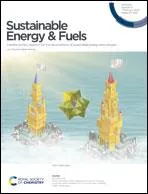
Self-assembled polypyrrole nanotubes/MoS2 quantum dots for high performance solid state flexible symmetric supercapacitors
文献信息
发布日期
2021-11-17
DOI
10.1039/D1SE01391B
影响因子
6.367
作者
Vijeth Hebri, Rabah Boukherroub, Ashokkumar Shankar Pawar, Vandana Molahalli, Devendrappa Hundekal
查看原文
摘要
A new kind of chitosan–polypyrrole nanotube/molybdenum disulphide (CS–PNT/MoS2) nanocomposite is fabricated for the first time via a facile two-step in situ chemical polymerization and hydrothermal method, and successfully applied in flexible charge storage supercapacitor (SC) devices. The CS–PNT/MoS2 nanocomposite represents a good SC electrode material by inheriting the properties of good electrical conductivity of MoS2 and enhanced pseudocapacitive activity of polypyrrole nanotubes (PNTs). The incorporation of chitosan (CS) increases the cycling stability of the CS–PNT/MoS2 nanocomposite by reducing the aggregation of MoS2 quantum dots and enhancing the surface area and porous structure of the nanocomposite, which facilitates the diffusion of the solvent and faradaic process. The CS–PNT/MoS2 nanocomposite exhibits a highest specific capacity (Csp) of 759 C g−1 and a solid state flexible symmetric supercapacitor (SSC) was assembled using CS–PNTs/MoS2, which achieved a high-power density of 7680 W kg−1 at an energy density of 32.12 W h kg−1 and also good cycling stability with a capacity retention of 91.2% after 10 000 cycles at 10 A g−1. Remarkably, the SSC device showed enhanced flexibility and stability and can retain up to 97% of its initial capacity under various bending positions, clearly suggesting that the fabricated solid-state SSC device is exceptionally flexible and can be deformed without compromising its structural integrity and energy storage ability. These findings suggest that CS–PNTs/MoS2 represents a promising electrode material for flexible supercapacitors.
相关文献
Hydroxyapatite as a key biomaterial: quantum-mechanical simulation of its surfaces in interaction with biomolecules
Marta Corno, Albert Rimola, Vera Bolis, Piero Ugliengo
2010-05-18
Perspective
DOI: 10.1039/C002146F
Existence of dual species composed of Cu+ in CuMFI being bridged by C2H2
Atsushi Itadani, Takashi Yumura, Takahiro Ohkubo, Hisayoshi Kobayashi, Yasushige Kuroda
2010-05-07
Paper
DOI: 10.1039/C000967A
On the proton conductivity in pure and gadolinium doped nanocrystalline cerium oxide
Mona Shirpour, Giuliano Gregori, Rotraut Merkle, Joachim Maier
2010-11-25
Communication
DOI: 10.1039/C0CP01702G
Titania supported gold nanoparticles as photocatalyst
2010-11-17
Perspective
DOI: 10.1039/C0CP00917B
Single dibenzoterrylene molecules in naphthalene and 2,3-dimethylnaphthalene crystals: vibronic spectra
Irena Deperasińska, Elena Karpiuk, Marzena Banasiewicz, Artur Makarewicz, Bolesław Kozankiewicz
2011-01-07
Paper
DOI: 10.1039/C0CP01730B
The effect of cationic gemini surfactants upon lipidmembranes. An experimental and molecular dynamics simulation study
Eduardo F. Marques, Amália S. Jurado, Alberto A. C. C. Pais
2010-10-04
Paper
DOI: 10.1039/C0CP00950D
Label-free RNA aptamer-based capacitive biosensor for the detection of C-reactive protein
Anjum Qureshi, Yasar Gurbuz, Saravan Kallempudi, Javed H. Niazi
2010-07-20
Paper
DOI: 10.1039/C004133E
Quantifying heterogeneity and conformational dynamics from single molecule FRET of diffusing molecules: recurrence analysis of single particles (RASP)
Armin Hoffmann, Daniel Nettels, Sheena E. Radford, Jane Clarke, Benjamin Schuler
2011-01-07
Paper
DOI: 10.1039/C0CP01911A
Confinement effects for ionic carriers in SrTiO3 ultrathin films: first-principles calculations of oxygen vacancies
R. A. Evarestov, J. Maier
2010-11-29
Communication
DOI: 10.1039/C0CP01060J
您可能还喜欢
化合物问答
4-[[6-(3-苯基苯基)-7H-嘌呤-2-基]氨基]苯磺酰胺(CAS号:2079895-42-2)适用哪些法规指南?
该化合物需遵循REACH法规以确保其安全使用和管理。同时,根据其潜在的生物降解性和毒性,也需要符合GHS分类中的相应要求。此外,若用于医药或食品相关领域,则还需...
2079895-42-24-{[6-(3-Biphenylyl)...
化合物问答
反式-度骨化醇(CAS号:74007-20-8)的物理化学性质是什么?
反式-度骨化醇是一种脂溶性维生素D3的衍生物,呈无色或白色结晶性粉末,不溶于水,溶于乙醇、丙酮、氯仿等有机溶剂。其分子式为C28H44O,分子量为404.65。...
74007-20-8trans-Doxercalcifero...
化合物问答
莲花掌苷(CAS号:59282-56-3)的市场或研究趋势如何?
莲花掌苷作为一种天然产物,近年来在抗炎、抗癌等生物活性研究方面显示出一定的潜力,因此市场需求逐渐增长。市场动态方面,随着天然产物开发的深入,预计该化合物的研究会...
59282-56-3Lindleyin
化合物问答
2-溴-6-(吡咯烷-1-基)吡啶-4-硼酸频那醇酯(CAS号:1150271-64-9)应用于哪些行业?
2-溴-6-(吡咯烷-1-基)吡啶-4-硼酸频那醇酯在医药领域有着广泛的应用,它可以用作药物合成中的中间体。此外,它还可以用于有机合成,特别是在构建复杂杂环化合...
1150271-64-92-Bromo-6-(1-pyrroli...
化合物问答
什么是methyl 2-(4-bromophenyl)-3-methylbutanoate(CAS号:1061284-70-5)?
methyl 2-(4-溴苯基)-3-甲基丁酸甲酯是一种化学物质,分子式为C12H13BrO2。它是一种有机化合物,具有一定的挥发性和易燃性。
1061284-70-52-(4-Bromo-phenyl)-3...
化合物问答
CJC1-295(CAS号:863288-34-0)的物理化学性质是什么?
CJC1-295是一种具有复杂肽链结构的化合物,其分子量约为1875 Da。该化合物在水中具有一定的溶解性,但在有机溶剂中的溶解性不佳。它是一种反应活性化合物,...
863288-34-0L-tyrosyl-D-alanyl-L...
化合物问答
三正丁基锍碘(CAS号:18146-62-8)的市场或研究趋势如何?
三正丁基锍碘作为一种重要的有机硫化合物,主要用于有机合成中作为亲电试剂。近年来,由于其在合成中的广泛应用,市场对其需求持续增长。此外,随着绿色化学的发展,对其替...
18146-62-8Tributylsulfonium io...
化合物问答
雌二醇-[13C3]同位素内标(CAS号:1261254-48-1)通常如何合成?
雌二醇-[13C3]同位素内标通常通过在雌二醇分子中引入[13C3]同位素来合成。常见的方法是通过化学标记反应,如与[13C3]标记的甲基溴化物进行亲核取代反应...
1261254-48-117beta-Estradiol-2,3...
化合物问答
N1-(2-吡啶甲基)-N2-(2-甲基-1-萘基)草酰胺(CAS号:2611225-93-3)的物理化学性质是什么?
N1-(2-吡啶甲基)-N2-(2-甲基-1-萘基)草酰胺为固体化合物,具有良好的结晶形态,分子量为340.34 g/mol。该化合物在水中的溶解度较低,但在有...
2611225-93-3N-(2-Methyl-1-naphth...
化合物问答
如何处理含有十五碳烯酸甲酯(顺-10)(C15:1)标准品(CAS号:90176-52-6)的废料?
含有十五碳烯酸甲酯(顺-10)(C15:1)标准品的废料应首先进行适当收集和储存,避免与其他化学品混合。然后,可采用焚烧或交由专业废物处理公司进行处理。处理过程...
90176-52-6(Z)-10-Pentadecenoic...
来源期刊
推荐化合物
![[(5-Methyl-1,3,4-thiadiazol-2-yl)sulfanyl]acetic acid structure](https://cnstatic.chemtradehub.com/structs/509/50918-26-8-4ce8.webp "[(5-Methyl-1,3,4-thiadiazol-2-yl)sulfanyl]acetic acid structure")
推荐供应商



免责声明
本页面提供的学术期刊信息仅供参考和研究使用。我们与任何期刊出版商均无关联,也不处理投稿事宜。如有投稿相关咨询,请直接联系相关期刊出版商。
如发现页面信息有误,请发送邮件至 support@chemtradehub.com 联系我们。我们将及时核实并处理您的问题。