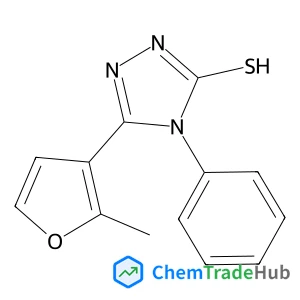
5-(2-Methyl-3-furyl)-4-phenyl-2,4-dihydro-3H-1,2,4-triazole-3-thione
CAS号:
346464-59-3
分子式:
C13H11N3OS
Madhvi Garg, Dhiraj Sud
A water-soluble azo functionalized oligomeric chitosan reagent (β-NAC) has been developed for the visual detection and quantification of KMnO4 at micromolar concentrations. The β-NAC sensor was also explored as a detection probe for the spectrophotometric and spectrofluorometric detection of several metal ions and anions. The synthesized reagent was characterized by TGA-DTA-DTG analysis, DLS studies, BET analysis, and spectral analysis. The β-NAC reagent produces conspicuous colours with different concentrations and different pH values of KMnO4 solution. This provides evidence for high selectivity in the visual detection of KMnO4 up to the micromolar level because of its interactions in the case of KMnO4 only. The colour of the β-NAC reagent after interacting with KMnO4 (10−3 M) changes from brown to blood red. Furthermore, the β-NAC sensor was employed for the spectrophotometric detection of KMnO4. The absorption spectrum of β-NAC shows a peak at 327 nm and on interacting with KMnO4, it shows a bathochromic shift to 331 nm. The intensity of the peak at 331 nm increases as the concentration of KMnO4 was increased from 1 μM to 0.01 M. The detection and quantification limits in the spectrophotometric detection of KMnO4 were found to be 4.55 μM and 15.17 μM, respectively. The results of pH studies show that there is a pH effect of the KMnO4 solution on KMnO4 detection. The stability of the complex was determined by investigating the effect of time on the absorption intensity. In the spectrofluorometric detection, the fluorescence intensity of β-NAC at the 427 nm emission maxima was decreased on adding KMnO4 solution. The fluorescence quenching increased on increasing the KMnO4 concentration from 1 μM to 0.008 M. The optimum pH for fluorescence quenching was found to be 8. The detection and quantification limits in the spectrofluorometric detection of KMnO4 were found to be 0.967 μM and 3.223 μM, respectively. The Stern–Volmer constant value was found to be 41 366.2 L mol−1, confirming the significant complexation between KMnO4 and the β-NAC reagent. Interference studies were conducted to analyse the effect of various metal ions and anions on KMnO4 detection. Electrochemical studies were also performed to analyse the mechanism of complex formation.

Critical Reviews in Solid State and Materials Sciences

Journal of the Indian Institute of Science

Main Group Chemistry

NDT & E International

Bioorganic & Medicinal Chemistry Letters

Heteroatom Chemistry

Electroanalysis
Polycyclic Aromatic Compounds

Biocatalysis and Biotransformation
Chinese Journal of Chemistry
Yasuo Iida, Kyuichi Yasui, Toru Tuziuti, Manickam Sivakumar, Yoshishige Endo
DOI: 10.1039/B410015H
Kiew-Ching Lee, Man-Jing Lin, Teck-Peng Loh
DOI: 10.1039/B411653D
Alexander V. Leontiev, Dmitry M. Rudkevich
DOI: 10.1039/B402997F
Man-Rong Li, Wei Liu, Ming-Hui Ge, Hao-Hong Chen, Xin-Xin Yang, Jing-Tai Zhao
DOI: 10.1039/B402966F
Ryo Takahashi, Tsutomu Ishiwatari
DOI: 10.1039/B403676J
W. Gregory Jackson, Josephine A. McKeon, Margareta Zehnder, Markus Neuberger, Silvio Fallab
DOI: 10.1039/B408277J
Myroslav O. Vysotsky, Anca Bogdan, Leyong Wang, Volker Böhmer
DOI: 10.1039/B402719A
Luke T. Higham, Ulf P. Kreher, Roger J. Mulder, Christopher R. Strauss, Janet L. Scott
DOI: 10.1039/B408814J
Cristina Femoni, M. Carmela Iapalucci, Giuliano Longoni, Per H. Svensson
DOI: 10.1039/B409522G
Amy Meyers, Clint South, Marcus Weck
DOI: 10.1039/B402289K
2,6-二溴-4,8-双[(2-乙基己基)氧基]苯并[1,2-b:4,5-b']二噻吩是一种有机化合物,分子式为C23H32Br2O2S2。该化合物具有芳香性和...
木聚硫钠通常为无色或白色结晶性粉末,具有吸湿性。其分子量约为121.11 g/mol。木聚硫钠易溶于水,不溶于醇类和其他非极性溶剂。在酸性或碱性溶液中,木聚硫钠...
该化合物在合成、储存和运输过程中需遵循《全球化学品统一分类和标签制度》(GHS)的健康、环境和物理危险分类。在欧洲还需符合《化学品注册、评估、授权和限制》(RE...
1,4-二氮杂双环[2.2.2]辛烷-1,4-二硫酸二酯主要用于有机合成中的保护基团,特别是在保护胺基和硫醇基方面具有广泛应用。此外,它还用于一些特殊化学反应的...
含有4-(Bromomethyl)-2-fluorobenzenesulphonamide的废液应首先进行中和处理,以降低pH值,避免对环境造成腐蚀性影响。随后...
Loureiriol是一种天然化合物,其分子式为C15H22O4。Loureiriol为无色结晶性粉末,具有较高的熔点和良好的热稳定性。其相对分子质量为262....
在合成过程中,可以考虑使用类似结构的化合物作为3-氨基苯甲酰苯胺的替代品,例如N-苯基-3-氰基苯胺或N-苯基-3-硝基苯胺等,这些化合物具有相似的化学性质,可...
4-异氰酰苯基硼酸频哪醇酯主要应用于有机合成、药物化学和材料科学领域。随着绿色化学的发展,该化合物因其高效的官能团转化能力和环境友好性而受到越来越多的关注。近年...
3β-乙酰氧基-7,25-甘遂二烯-24(R)-醇应储存在阴凉、干燥、通风良好的地方,避免直接光照。储存容器应密封,防止空气中的水分和氧气影响化合物的稳定性。建...
应将4-氟-2-甲基-1H-吲哚存放在阴凉、干燥、通风良好的地方,避免直接暴露在光照下。容器应密封,避免与空气中的水蒸气接触。建议在避光、温度不超过25℃的环境...

Analyst publishes analytical and bioanalytical research that reports premier fundamental discoveries and inventions, and the applications of those discoveries, unconfined by traditional discipline barriers.
![5,10-Dihydroindeno[2,1-a]indene structure](https://cnstatic.chemtradehub.com/structs/654/6543-29-9-71ca.webp "5,10-Dihydroindeno[2,1-a]indene structure")

![Benzeneacetic acid, 2-bromo-α-[[(1,1-dimethylethoxy)carbonyl]amino]-, (αS)- structure](https://cnstatic.chemtradehub.com/structs/122/1228547-87-2-f296.webp "Benzeneacetic acid, 2-bromo-α-[[(1,1-dimethylethoxy)carbonyl]amino]-, (αS)- structure")