


State-of-the-art, opportunities, and challenges in bottom-up synthesis of polymers with high thermal conductivity
文献信息
发布日期
2022-06-14
DOI
10.1039/D2PY00272H
影响因子
5.582
作者
Yurui Liu, Yijie Zhou
查看原文
摘要
In contrast to metals, polymers are predominantly thermal and electrical insulators. With their unparalleled advantages such as light weight, turning polymer insulators into heat conductors with metal-like thermal conductivity is of substantial interest and technological importance for heat dissipation applications. However, engineering bulk polymers with ultrahigh thermal conductivity remains a difficulty currently. Moreover, thermal transport mechanisms are not fully understood. In this review, we first discuss the present understanding of thermal transport mechanisms in polymers. Then, we discuss various bottom-up strategies aimed at achieving highly thermally conductive polymers with representative examples. We investigate relationships between polymer structures and thermal transport properties. We highlight current challenges within the design and synthesis of highly thermally conductive polymers. We also suggest future endeavors regarding research challenges in thermally conductive polymers. Importantly, we emphasize the potential possibilities and inspiring opportunities for future applications of thermally conductive polymers with metal-like thermal conductivity.
期刊推荐

Helvetica Chimica Acta
Proceedings of the National Academy of Sciences of the United States of America
Pure and Applied Chemistry
Molecular Pharmacology

Science Progress
Nature
Organic Preparations and Procedures International
Journal of Physics and Chemistry of Solids

European Journal of Wood and Wood Products

Pharmacological Reviews
相关文献
Towards understanding the effects of carbon and nitrogen-doped carbon coating on the electrochemical performance of Li4Ti5O12 in lithium ion batteries: a combined experimental and theoretical study
Zijing Ding, Liang Zhao, Liumin Suo, Yang Jiao, Sheng Meng, Yong-Sheng Hu, Zhaoxiang Wang, Liquan Chen
2011-07-26
Paper
DOI: 10.1039/C1CP21513B
X-ray photoelectron spectroscopy of pyrrolidinium-based ionic liquids: cation–anion interactions and a comparison to imidazolium-based analogues
Shuang Men, Kevin R. J. Lovelock, Peter Licence
2011-07-22
Paper
DOI: 10.1039/C1CP21053J
Structural, morphological, and kinetic studies of β-amyloid peptide aggregation on self-assembled monolayers
Qiuming Wang, Nilam Shah, Jun Zhao, Chengshan Wang, Chao Zhao, Lingyun Liu, Lingyan Li, Feimeng Zhou, Jie Zheng
2011-07-19
Paper
DOI: 10.1039/C1CP21156K
Light-induced isomerization dynamics of a cyanine dye in the modulus-controlled regime
Ah-Young Jee, Seohyun Park, Minyung Lee
2011-07-18
Paper
DOI: 10.1039/C1CP20835G
Quantum design rules for single molecule logic gates
N. Renaud, M. Hliwa, C. Joachim
2011-07-27
Paper
DOI: 10.1039/C1CP21221D
Graphical prediction of quantum interference-induced transmission nodes in functionalized organic molecules
Troels Markussen, Robert Stadler, Kristian S. Thygesen
2011-06-28
Paper
DOI: 10.1039/C1CP20924H
Intramolecular charge transfer and dual fluorescence of 4-(dimethylamino)benzonitrile: ultrafast branching followed by a two-fold decay mechanism‡
Pedro B. Coto, Luis Serrano-Andrés, Thomas Gustavsson, Takashige Fujiwara, Edward C. Lim
2011-07-18
Paper
DOI: 10.1039/C1CP21089K
您可能还喜欢
化合物问答
3 - (二氟甲基)-1 -氟苯(CAS号:26029-52-7)适用哪些法规指南?
3 - (二氟甲基)-1 -氟苯需遵循联合国全球化学品统一分类和标签制度(GHS),包括急性毒性、皮肤腐蚀/刺激、严重眼损伤/眼刺激等分类。同时,该化合物还需符...
26029-52-71-(Difluoromethyl)-3...
化合物问答
3,5-二甲基苯胺(CAS号:108-69-0)通常如何合成?
3,5-二甲基苯胺通常通过乙苯的氨解反应合成。反应中使用硫酸作为催化剂,反应温度为120-130°C。乙苯在硫酸存在下与氨反应,生成3,5-二甲基苯胺和苯胺副产...
108-69-03,5-Dimethylaniline
化合物问答
3-甲基异噻唑-5-胺(CAS号:24340-76-9)安全吗?
3-甲基异噻唑-5-胺在适当使用和储存条件下是相对安全的,但在操作时应注意防护措施。应避免吸入粉尘,避免与皮肤和眼睛直接接触。在操作过程中,应穿戴适当的防护装备...
24340-76-93-Methyl-1,2-thiazol...
化合物问答
3-(1,3-Thiazol-2-yl)-1H-indole(CAS号:135531-86-1)通常如何合成?
3-(1,3-噻唑-2-基)-1H-吲哚通常通过多步合成方法制备。首先,由噻唑-2-基溴化物和吲哚进行偶联反应,得到中间体。然后,通过还原反应将中间体转化为所需...
135531-86-13-(1,3-Thiazol-2-yl)...
化合物问答
4-溴-2-氟苯甲基氯(CAS号:85510-82-3)的主要用途是什么?
4-溴-2-氟苯甲基氯主要用于有机合成中间体,特别是在医药、农药和染料等领域。作为一种具有特定结构的化合物,它在合成复杂有机分子时扮演重要角色。
85510-82-34-Bromo-1-(chloromet...
化合物问答
处理Fmoc-β-(3-噻吩基)-D-Ala-OH(CAS号:220497-90-5)时应注意哪些实验室安全事项?
处理Fmoc-β-(3-噻吩基)-D-Ala-OH时,应佩戴防护手套、护目镜和实验服。操作应在通风橱内进行。如发生泄露,应立即用大量水冲洗,并通知实验室管理人员...
220497-90-5N-[(9H-Fluoren-9-ylm...
化合物问答
氮化硅(CAS号:12033-89-5)通常如何合成?
氮化硅通常通过氮化硅的直接反应合成,即在高温下将四氯化硅与氨气反应。具体步骤是将四氯化硅和氨气混合并加热至1300-1700℃,在该条件下,四氯化硅与氨气反应生...
12033-89-5Trisilicon tetranitr...
化合物问答
Cetirizine EP Impurity B DiHCl(CAS号:1000690-91-4)通常如何合成?
Cetirizine EP Impurity B DiHCl通常通过一锅法合成,首先将4-氯苯基-苯甲基氯甲酸酯与1-哌嗪乙酸反应,生成相应的酸,然后与盐酸反应...
1000690-91-4{4-[(4-Chlorophenyl)...
化合物问答
如何储存1-哌啶-4-基丁-1-酮(CAS号:3509-15-7)?
1-哌啶-4-基丁-1-酮应储存在阴凉、干燥的地方,避免阳光直射。存储容器应密封,并确保通风良好。建议储存温度不超过25℃,湿度保持在相对较低的水平。
3509-15-71-Piperidin-4-ylbuta...
化合物问答
如何处理含有VORUCICLIB(CAS号:1000023-04-0)的废料?
含有VORUCICLIB的废料应进行专业的收集和处理,包括使用适当的容器进行隔离,避免与其他化学品接触。处理方法通常包括化学中和、沉淀反应或吸附过程,随后进行焚...
1000023-04-02-[2-Chloro-4-(trifl...
来源期刊
Polymer Chemistry

CiteScore:
8.6
自引率:
7.3%
年发文量:
457
Polymer Chemistry welcomes submissions in all areas of polymer science that have a strong focus on macromolecular chemistry. Manuscripts may cover a broad range of fields, yet no direct application focus is required.
推荐化合物
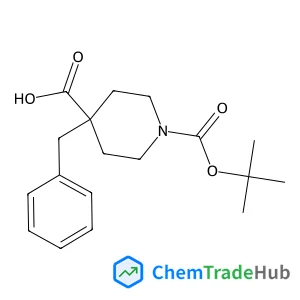
![6-Benzyl-4,5,6,7-tetrahydro-1H-pyrazolo[3,4-c]pyridin-3(2H)-one structure](https://cnstatic.chemtradehub.com/structs/909/909187-64-0-f54f.webp "6-Benzyl-4,5,6,7-tetrahydro-1H-pyrazolo[3,4-c]pyridin-3(2H)-one structure")
推荐供应商





免责声明
本页面提供的学术期刊信息仅供参考和研究使用。我们与任何期刊出版商均无关联,也不处理投稿事宜。如有投稿相关咨询,请直接联系相关期刊出版商。
如发现页面信息有误,请发送邮件至 support@chemtradehub.com 联系我们。我们将及时核实并处理您的问题。