


![6-Benzyl-4,5,6,7-tetrahydro-1H-pyrazolo[3,4-c]pyridin-3(2H)-one structure](https://cnstatic.chemtradehub.com/structs/909/909187-64-0-f54f.webp "6-Benzyl-4,5,6,7-tetrahydro-1H-pyrazolo[3,4-c]pyridin-3(2H)-one structure")
Efficient suppression of the chain transfer reaction in ethylene coordination polymerization with dibenzosuberyl substituents
文献信息
发布日期
2022-06-06
DOI
10.1039/D2PY00282E
影响因子
5.582
作者
Zhou Lu, Weigang Fan
查看原文
摘要
The chain transfer reaction plays an important role in governing the polymer molecular weight in coordination polymerization. In this work, we demonstrate that dibenzosuberyl substituents are efficient in suppressing chain transfer reactions and significantly enhancing the molecular weight of polymers and copolymers in ethylene (co)polymerization with α-diimine Ni(II) and Pd(II) species. Herein, a family of α-diimine Ni(II) and Pd(II) complexes with dibenzosuberyl substituents were designed, synthesized and characterized. In the nickel-catalyzed ethylene polymerization, dibenzosuberyl Ni(II) catalysts exhibited high activities (level of 106 g mol−1 h−1) and yielded highly branched (80–93/1000C) polyethylenes with high molecular weights (up to 586.4 kg mol−1). On the other hand, in the corresponding palladium-catalyzed ethylene polymerization, the Pd(II) catalysts displayed moderate activities (level of 105 g mol−1 h−1) and yielded highly branched (72–113/1000C) polyethylenes with high molecular weights (up to 297.3 kg mol−1). Moreover, dibenzosuberyl Pd(II) catalysts generated highly branched (72–107/1000C) E-MA copolymers with high molecular weights (up to 78.5 kg mol−1) and high incorporation ratios (up to 9.6 mol%). As compared with the classical dibenzhydryl Ni(II) and Pd(II) catalysts, dibenzosuberyl catalysts displayed an outstanding ability to suppress chain transfer reactions and generated polymers and copolymers with 1–2 orders of magnitude higher molecular weights during ethylene (co)polymerization. The sandwich-like structure formed by dibenzosuberyl substituents was proposed to be responsible for the observed phenomenon.
期刊推荐

Journal of Peptide Science
Crystallography Reports

Chemistry Education Research and Practice

New Journal of Chemistry

Current Opinion in Solid State & Materials Science

Chemical Communications
Organic Process Research & Development
Journal of Saudi Chemical Society
Russian Chemical Bulletin
Drug Discovery Today
相关文献
Neutral excited radicals formed by ethylene photodissociation in the 8–24 eV region
Koutayba Alnama, Séverine Boyé, Stéphane Douin, Fabrizio Innocenti, John O'Reilly, Anne-Lise Roche, Niloufar Shafizadeh, Lucia Zuin, Dolores Gauyacq
2004-03-02
Paper
DOI: 10.1039/B316056D
Paramagnetic relaxation of cyclohexane radical cation in solution as measured by the method of time-resolved magnetic field effect
2004-03-17
Paper
DOI: 10.1039/B400072B
Binary colloidal systems in two-dimensional circular cavities: Structure and dynamics
C. Bechinger
2004-01-23
Paper
DOI: 10.1039/B312966G
X-ray and neutron diffraction studies and molecular dynamics simulations of liquid DMSO
Tünde Megyes, Imre Bakó, Tamás Radnai, Tamás Grósz, Kersti Hermansson
2004-04-07
Paper
DOI: 10.1039/B311027C
Reaction of O(3P) with the alkyl iodides: CF3I, CH3I, CH2I2, C2H5I, 1-C3H7I and 2-C3H7I
M. A. Teruel, T. J. Dillon, A. Horowitz, J. N. Crowley
2004-03-31
Paper
DOI: 10.1039/B316402K
Construction of planar graphs for IPR fullerenes using 5- and 6-fold rotational symmetry: some eigenspectral analysis
Bholanath Mandal, Manas Banerjee, Asok K. Mukherjee
2004-03-29
Paper
DOI: 10.1039/B316775E
Dynamic solvent effects on the fading of a merocyanine formed from a spironaphthoxazine. A case of a strong coupling between chemical and medium coordinate
Hiroharu Kono, Hiroyuki Osako, Makoto Sasaki, Toru Takahashi, Yasushi Ohga, Tsutomu Asano, Michael Hildebrand, Noham N. Weinberg
2004-03-22
Paper
DOI: 10.1039/B316983A
Formation of cyanide-functionalized SBA-15 and its transformation to carboxylate-functionalized SBA-15
Chia-min Yang, Yanqin Wang, Bodo Zibrowius, Ferdi Schüth
2004-03-18
Paper
DOI: 10.1039/B314538G
Solvation properties and stability of ribonuclease A in normal and deuterated water studied by dielectric relaxation and differential scanning/pressure perturbation calorimetry
P. Sasisanker, A. Oleinikova, H. Weingärtner, R. Ravindra, R. Winter
2004-03-10
Paper
DOI: 10.1039/B314070A
您可能还喜欢
化合物问答
3 - (二氟甲基)-1 -氟苯(CAS号:26029-52-7)适用哪些法规指南?
3 - (二氟甲基)-1 -氟苯需遵循联合国全球化学品统一分类和标签制度(GHS),包括急性毒性、皮肤腐蚀/刺激、严重眼损伤/眼刺激等分类。同时,该化合物还需符...
26029-52-71-(Difluoromethyl)-3...
化合物问答
3,5-二甲基苯胺(CAS号:108-69-0)通常如何合成?
3,5-二甲基苯胺通常通过乙苯的氨解反应合成。反应中使用硫酸作为催化剂,反应温度为120-130°C。乙苯在硫酸存在下与氨反应,生成3,5-二甲基苯胺和苯胺副产...
108-69-03,5-Dimethylaniline
化合物问答
3-甲基异噻唑-5-胺(CAS号:24340-76-9)安全吗?
3-甲基异噻唑-5-胺在适当使用和储存条件下是相对安全的,但在操作时应注意防护措施。应避免吸入粉尘,避免与皮肤和眼睛直接接触。在操作过程中,应穿戴适当的防护装备...
24340-76-93-Methyl-1,2-thiazol...
化合物问答
3-(1,3-Thiazol-2-yl)-1H-indole(CAS号:135531-86-1)通常如何合成?
3-(1,3-噻唑-2-基)-1H-吲哚通常通过多步合成方法制备。首先,由噻唑-2-基溴化物和吲哚进行偶联反应,得到中间体。然后,通过还原反应将中间体转化为所需...
135531-86-13-(1,3-Thiazol-2-yl)...
化合物问答
4-溴-2-氟苯甲基氯(CAS号:85510-82-3)的主要用途是什么?
4-溴-2-氟苯甲基氯主要用于有机合成中间体,特别是在医药、农药和染料等领域。作为一种具有特定结构的化合物,它在合成复杂有机分子时扮演重要角色。
85510-82-34-Bromo-1-(chloromet...
化合物问答
处理Fmoc-β-(3-噻吩基)-D-Ala-OH(CAS号:220497-90-5)时应注意哪些实验室安全事项?
处理Fmoc-β-(3-噻吩基)-D-Ala-OH时,应佩戴防护手套、护目镜和实验服。操作应在通风橱内进行。如发生泄露,应立即用大量水冲洗,并通知实验室管理人员...
220497-90-5N-[(9H-Fluoren-9-ylm...
化合物问答
氮化硅(CAS号:12033-89-5)通常如何合成?
氮化硅通常通过氮化硅的直接反应合成,即在高温下将四氯化硅与氨气反应。具体步骤是将四氯化硅和氨气混合并加热至1300-1700℃,在该条件下,四氯化硅与氨气反应生...
12033-89-5Trisilicon tetranitr...
化合物问答
Cetirizine EP Impurity B DiHCl(CAS号:1000690-91-4)通常如何合成?
Cetirizine EP Impurity B DiHCl通常通过一锅法合成,首先将4-氯苯基-苯甲基氯甲酸酯与1-哌嗪乙酸反应,生成相应的酸,然后与盐酸反应...
1000690-91-4{4-[(4-Chlorophenyl)...
化合物问答
如何储存1-哌啶-4-基丁-1-酮(CAS号:3509-15-7)?
1-哌啶-4-基丁-1-酮应储存在阴凉、干燥的地方,避免阳光直射。存储容器应密封,并确保通风良好。建议储存温度不超过25℃,湿度保持在相对较低的水平。
3509-15-71-Piperidin-4-ylbuta...
化合物问答
如何处理含有VORUCICLIB(CAS号:1000023-04-0)的废料?
含有VORUCICLIB的废料应进行专业的收集和处理,包括使用适当的容器进行隔离,避免与其他化学品接触。处理方法通常包括化学中和、沉淀反应或吸附过程,随后进行焚...
1000023-04-02-[2-Chloro-4-(trifl...
来源期刊
Polymer Chemistry

CiteScore:
8.6
自引率:
7.3%
年发文量:
457
Polymer Chemistry welcomes submissions in all areas of polymer science that have a strong focus on macromolecular chemistry. Manuscripts may cover a broad range of fields, yet no direct application focus is required.
推荐化合物
![Methyl 4-({[(2-methyl-2-propanyl)oxy]carbonyl}amino)bicyclo[2.2.2]octane-1-carboxylate structure](https://cnstatic.chemtradehub.com/structs/943/943845-74-7-b7e5.webp "Methyl 4-({[(2-methyl-2-propanyl)oxy]carbonyl}amino)bicyclo[2.2.2]octane-1-carboxylate structure")
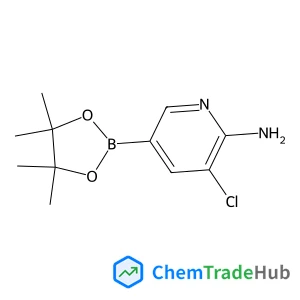
3-Chloro-5-(4,4,5,5-tetramethyl-1,3,2-dioxaborolan-2-yl)-2-pyridinamine
CAS号:
1032758-99-8
分子式:
C11H16BClN2O2
推荐供应商





免责声明
本页面提供的学术期刊信息仅供参考和研究使用。我们与任何期刊出版商均无关联,也不处理投稿事宜。如有投稿相关咨询,请直接联系相关期刊出版商。
如发现页面信息有误,请发送邮件至 support@chemtradehub.com 联系我们。我们将及时核实并处理您的问题。