



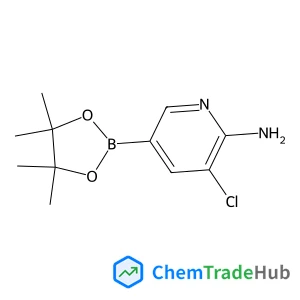
3-Chloro-5-(4,4,5,5-tetramethyl-1,3,2-dioxaborolan-2-yl)-2-pyridinamine
CAS号:
1032758-99-8
分子式:
C11H16BClN2O2
Richard Hoogenboom
The unique material properties of cyclic polymers have made them attractive biomaterials, prompting the need for more efficient cyclization protocols. Due to their chemical versatility, poly(2-alkyl-2-oxazoline)s (PAOx) and poly(2-oxazine)s (POzi) provide potent candidates in this field. However, little to no comprehensive data on the cyclization process of these materials is available, especially not for POzi. In this study, we investigate the impact of a number of reaction parameters (batch volume, catalyst equivalents, molecular weight, and polymer addition method) on the macrocyclization efficiency of PAOx and POzi using copper(I)-catalysed azide–alkyne cycloaddition (CuAAC). It was found that POzi show more efficient conversion to the desired monocyclic species compared to PAOx, possibly due to increased chain flexibility of POzi. Considering macrocyclization efficiency, up to 33× more cyclic POzi could be synthesized per unit volume of solvent, compared to previous protocols for related PAOx, indicating potential for the future scale-up of macrocyclic POzi.
Yong Zhao
DOI: 10.1039/C1CP21813A
Andrew Das Arulsamy, Zlatko Kregar, Kristina Eleršič, Martina Modic, Uma Shankar Subramani
DOI: 10.1039/C1CP20138G
Natalya Schmerl, Gunther Andersson
DOI: 10.1039/C1CP20734B
T. Gál, P. Geerlings, F. De Proft, M. Torrent-Sucarrat
DOI: 10.1039/C1CP21213C
N. Renaud, M. Hliwa, C. Joachim
DOI: 10.1039/C1CP21221D
Ah-Young Jee, Seohyun Park, Minyung Lee
DOI: 10.1039/C1CP20835G
Johan Scheers, Jagath Pitawala, Frederic Thebault, Jae-Kwang Kim, Jou-Hyeon Ahn, Aleksandar Matic, Per Jacobsson
DOI: 10.1039/C1CP21062A
Maria Rosa Antognazza, Francesco Scotognella, Karol Miszta, Dirk Dorfs, Marco Zanella, Margherita Zavelani-Rossi, Liberato Manna, Francesco Tassone
DOI: 10.1039/C1CP21402K
Abu Md Asaduzzaman, Georg Schreckenbach
DOI: 10.1039/C1CP21168D
3 - (二氟甲基)-1 -氟苯需遵循联合国全球化学品统一分类和标签制度(GHS),包括急性毒性、皮肤腐蚀/刺激、严重眼损伤/眼刺激等分类。同时,该化合物还需符...
3,5-二甲基苯胺通常通过乙苯的氨解反应合成。反应中使用硫酸作为催化剂,反应温度为120-130°C。乙苯在硫酸存在下与氨反应,生成3,5-二甲基苯胺和苯胺副产...
3-甲基异噻唑-5-胺在适当使用和储存条件下是相对安全的,但在操作时应注意防护措施。应避免吸入粉尘,避免与皮肤和眼睛直接接触。在操作过程中,应穿戴适当的防护装备...
3-(1,3-噻唑-2-基)-1H-吲哚通常通过多步合成方法制备。首先,由噻唑-2-基溴化物和吲哚进行偶联反应,得到中间体。然后,通过还原反应将中间体转化为所需...
4-溴-2-氟苯甲基氯主要用于有机合成中间体,特别是在医药、农药和染料等领域。作为一种具有特定结构的化合物,它在合成复杂有机分子时扮演重要角色。
处理Fmoc-β-(3-噻吩基)-D-Ala-OH时,应佩戴防护手套、护目镜和实验服。操作应在通风橱内进行。如发生泄露,应立即用大量水冲洗,并通知实验室管理人员...
氮化硅通常通过氮化硅的直接反应合成,即在高温下将四氯化硅与氨气反应。具体步骤是将四氯化硅和氨气混合并加热至1300-1700℃,在该条件下,四氯化硅与氨气反应生...
Cetirizine EP Impurity B DiHCl通常通过一锅法合成,首先将4-氯苯基-苯甲基氯甲酸酯与1-哌嗪乙酸反应,生成相应的酸,然后与盐酸反应...
1-哌啶-4-基丁-1-酮应储存在阴凉、干燥的地方,避免阳光直射。存储容器应密封,并确保通风良好。建议储存温度不超过25℃,湿度保持在相对较低的水平。
含有VORUCICLIB的废料应进行专业的收集和处理,包括使用适当的容器进行隔离,避免与其他化学品接触。处理方法通常包括化学中和、沉淀反应或吸附过程,随后进行焚...

Polymer Chemistry welcomes submissions in all areas of polymer science that have a strong focus on macromolecular chemistry. Manuscripts may cover a broad range of fields, yet no direct application focus is required.