


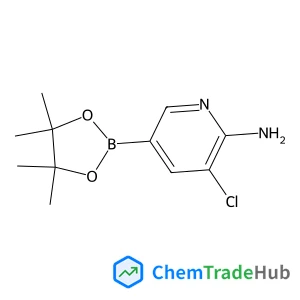
3-Chloro-5-(4,4,5,5-tetramethyl-1,3,2-dioxaborolan-2-yl)-2-pyridinamine
CAS号:
1032758-99-8
分子式:
C11H16BClN2O2
Naganatha Patil, Yves Gnanou, Xiaoshuang Feng
Mechanistically distinct polymerization systems can afford unique block copolymers that would not be accessible by mere sequential polymerization. Herein we report a convenient one-pot synthesis of miscellaneous di- and triblock copolymers comprising CO2-based and polyvinyl blocks, obtained orthogonally through triethylborane (TEB)-mediated ring opening copolymerization (ROCOP) of CO2 with epoxides on the one hand and reversible addition fragmentation chain transfer (RAFT) polymerization of vinyl monomers on the other. 4-Cyano-4-[(dodecylsulfanylthiocarbonyl) sulfanyl] pentanoic acid (TTC-COOH), which carries a trithiocarbonate function and a carboxylic acid group, played the dual role of a chain transfer agent for RAFT polymerization and an initiator for the ROCOP of CO2/epoxide. Different bases such as tetrabutylammonium hydroxide, N-heterocyclic carbene (NHC), and tributylamine (TBA) were used for the deprotonation of TTC-COOH; in each case the compatibility of the generated carboxylic salts with trithiocarbonate functions was checked when they were utilized to copolymerize CO2 and epoxides. It was found that the salts produced in situ by the deprotonation of TTC-COOH using NHC and TBA did not harm trithiocarbonate functions. The two distinct polymerizations occurred as expected, affording a series of well-defined CO2-based AB and ABC block copolymers comprising one or two poly(vinyl) blocks, depending upon the choice of different combinations of epoxides and vinyl monomers. The thermal characterization of these AB and ABC block copolymers revealed either two or three glass transition temperatures indicative of phase-separated materials.

Journal of Peptide Science

Russian Chemical Bulletin

Organic Process Research & Development

Chemistry Education Research and Practice
Nature Medicine

Russian Journal of Bioorganic Chemistry

Current Opinion in Solid State & Materials Science

Current Opinion in Colloid & Interface Science

Saudi Pharmaceutical Journal

New Journal of Chemistry
Viktor Hoffmann, Giridhar Pulletikurthi, Timo Carstens, Abhishek Lahiri, Andriy Borodin, Frank Endres
DOI: 10.1039/C7CP08243F
Natalia Rojas-Valencia, Marcela Manrique-Moreno, C. Z. Hadad, Albeiro Restrepo
DOI: 10.1039/C8CP04674C
Li-Fang Xu
DOI: 10.1039/C8CP04323J
Hao Chen, Qinghua Lu, Chunhai Yi, Bolun Yang, Suitao Qi
DOI: 10.1039/C7CP08562A
José M. Otero-Mato, Hadrián Montes-Campos, Oscar Cabeza, Diddo Diddens, Alina Ciach, Luis J. Gallego, Luis M. Varela
DOI: 10.1039/C8CP05632C
Simone Pezzotti, Daria Ruth Galimberti, Y. Ron Shen, Marie-Pierre Gaigeot
DOI: 10.1039/C7CP06110B
Cangtao Yin, Mica C. Smith, Maodu Chen, Chunlei Xiao, Dongxu Dai, Kaito Takahashi, Wenrui Dong
DOI: 10.1039/C8CP05920A
Chunkan Yu, Viatcheslav Bykov, Ulrich Maas
DOI: 10.1039/C7CP07213A
Jiahao Chen, Thomas J. Giroux, Yen Nguyen, Atte A. Kadoma, Boyce S. Chang, Brett VanVeller, Martin M. Thuo
DOI: 10.1039/C7CP07531F
3 - (二氟甲基)-1 -氟苯需遵循联合国全球化学品统一分类和标签制度(GHS),包括急性毒性、皮肤腐蚀/刺激、严重眼损伤/眼刺激等分类。同时,该化合物还需符...
3,5-二甲基苯胺通常通过乙苯的氨解反应合成。反应中使用硫酸作为催化剂,反应温度为120-130°C。乙苯在硫酸存在下与氨反应,生成3,5-二甲基苯胺和苯胺副产...
3-甲基异噻唑-5-胺在适当使用和储存条件下是相对安全的,但在操作时应注意防护措施。应避免吸入粉尘,避免与皮肤和眼睛直接接触。在操作过程中,应穿戴适当的防护装备...
3-(1,3-噻唑-2-基)-1H-吲哚通常通过多步合成方法制备。首先,由噻唑-2-基溴化物和吲哚进行偶联反应,得到中间体。然后,通过还原反应将中间体转化为所需...
4-溴-2-氟苯甲基氯主要用于有机合成中间体,特别是在医药、农药和染料等领域。作为一种具有特定结构的化合物,它在合成复杂有机分子时扮演重要角色。
处理Fmoc-β-(3-噻吩基)-D-Ala-OH时,应佩戴防护手套、护目镜和实验服。操作应在通风橱内进行。如发生泄露,应立即用大量水冲洗,并通知实验室管理人员...
氮化硅通常通过氮化硅的直接反应合成,即在高温下将四氯化硅与氨气反应。具体步骤是将四氯化硅和氨气混合并加热至1300-1700℃,在该条件下,四氯化硅与氨气反应生...
Cetirizine EP Impurity B DiHCl通常通过一锅法合成,首先将4-氯苯基-苯甲基氯甲酸酯与1-哌嗪乙酸反应,生成相应的酸,然后与盐酸反应...
1-哌啶-4-基丁-1-酮应储存在阴凉、干燥的地方,避免阳光直射。存储容器应密封,并确保通风良好。建议储存温度不超过25℃,湿度保持在相对较低的水平。
含有VORUCICLIB的废料应进行专业的收集和处理,包括使用适当的容器进行隔离,避免与其他化学品接触。处理方法通常包括化学中和、沉淀反应或吸附过程,随后进行焚...

Polymer Chemistry welcomes submissions in all areas of polymer science that have a strong focus on macromolecular chemistry. Manuscripts may cover a broad range of fields, yet no direct application focus is required.
![Pyrazolo[1,5-a]pyridine-3-carbothioamide structure](https://cnstatic.chemtradehub.com/structs/885/885275-44-5-aae0.webp "Pyrazolo[1,5-a]pyridine-3-carbothioamide structure")
![4-Chloro-3-(trifluoromethyl)-1H-pyrrolo[2,3-b]pyridine structure](https://cnstatic.chemtradehub.com/structs/869/869335-75-1-a9d0.webp "4-Chloro-3-(trifluoromethyl)-1H-pyrrolo[2,3-b]pyridine structure")






